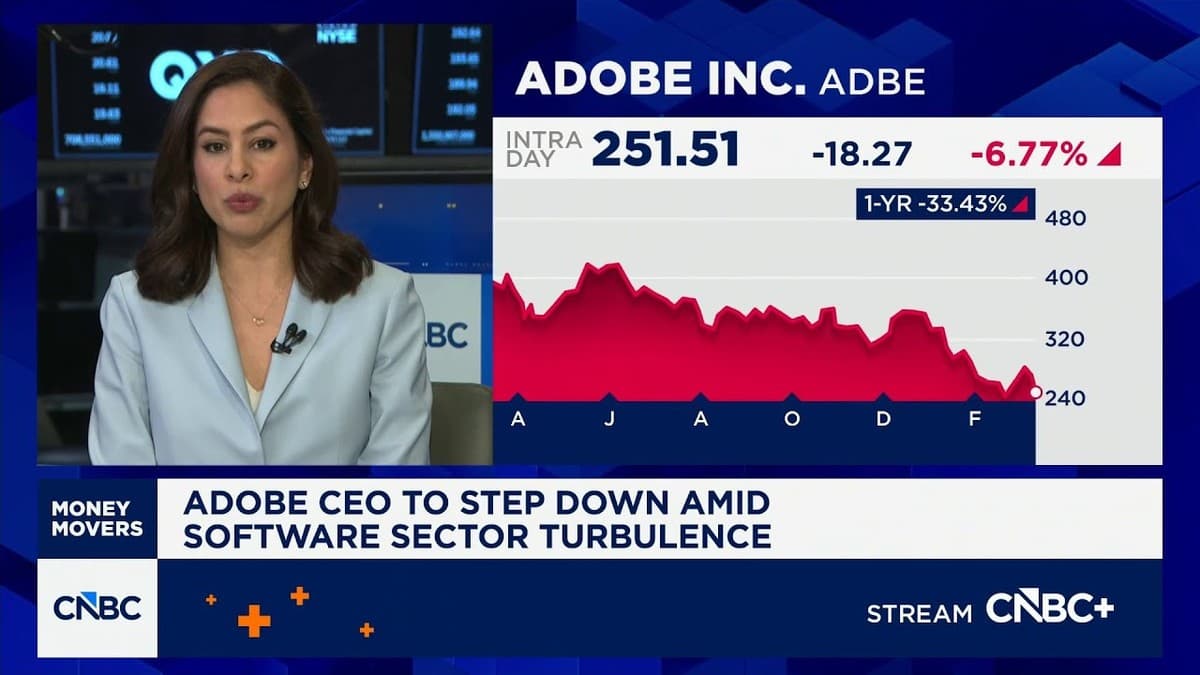
Adobe CEO Out as AI Fears Trigger Software Shakeup
Key insights
- Adobe's CEO departure follows a roughly 60% stock decline from its record high, despite the company launching new AI features
- Multiple enterprise software companies including Workday, Five9, MongoDB, and Asana have all replaced top executives in recent months
- Corporate boards are seeking leaders with both deep technology vision and M&A experience to navigate AI-driven consolidation
This is an AI-generated summary. The source video may include demos, visuals and additional context.
In Brief
Shantanu Narayen, CEO of Adobe for 18 years, announced he is stepping down once a successor is found. He is not alone. A wave of leadership changes is sweeping the enterprise software sector as boards scramble to find executives who can steer their companies through AI disruption. Workday, Five9, MongoDB, and Asana have all made recent changes to their top leadership, and Palantir CEO Alex Karp warns the workforce disruption could become a political issue.
Related reading:
What happened
CNBC reporter Seema Mody reported that Adobe CEO Shantanu Narayen is stepping down after leading the company for 18 years. Narayen successfully guided Adobe through its cloud transformation, the shift from selling boxed software to internet-based subscriptions. But investors have grown impatient. Adobe's stock is down about 60% from its record high despite the company rolling out new generative AI capabilities. In its latest quarter, annual recurring revenue (ARR), the predictable yearly income from subscriptions, showed signs of slowing.
Adobe is far from the only software company rethinking its leadership. Several major players have made changes in rapid succession:
- Workday is bringing back co-founder Aneel Bhusri as CEO
- Five9, a cloud contact center company, recently appointed Amit Mathradas as its new CEO
- MongoDB named CJ Desai, formerly of Cloudflare, as its new CEO and has been consolidating its executive team
- Asana hired a new CFO from Nvidia
What boards are looking for
According to M&A bankers Mody spoke with, corporate boards are conducting leadership reviews in real time. They are not simply looking for steady operators. Boards want visionaries with deep structural experience in M&A, mergers and acquisitions, the process of companies buying or merging with other companies. The reasoning: as AI drives more consolidation in the software sector, leaders need to understand both the technology and how to execute deals.
ServiceNow CEO Bill McDermott captured the mood, calling this a "time of business reinvention" where the stakes are high. The pattern echoes what happened with Intel, where the board sought a leader with deep chip engineering experience to turn the company around.
The political dimension
Palantir CEO Alex Karp added a broader warning. He described AI as a "dramatic transformation" that will disrupt "largely Democratic voters", arguing that knowledge workers, who tend to be college-educated and vote Democratic, face the greatest displacement. In Karp's view, this shift could increase the economic power of vocationally trained workers while weakening traditional white-collar jobs.
Karp believes state and federal representatives need to address this, whether through upskilling, training workers in new skills to keep up with technological change, or through other policy responses. The comment highlights how AI disruption is no longer just a business concern. It is becoming a question for lawmakers.
Glossary
| Term | Definition |
|---|---|
| C-suite | The top executives of a company: CEO, CFO, CTO, and similar roles. The "C" stands for "Chief." |
| Cloud transformation | Moving software from locally installed programs to internet-based subscription services. |
| Annual recurring revenue (ARR) | Predictable yearly income from subscriptions. A key metric for software companies. |
| M&A (mergers and acquisitions) | When companies buy or merge with other companies to grow or consolidate. |
| Upskilling | Training workers in new skills to keep up with technological change. |
Sources and resources
Want to go deeper? Watch the full video on YouTube →