AI Closes the Gap Between Degrees and No Degrees
Key insights
- The shrinking unemployment gap doesn't mean degrees lost value. It means alternatives like bootcamps and certifications got better, narrowing the advantage from both sides.
- AI is accelerating a structural shift that started after the 2008 financial crisis, when banks and law firms began automating entry-level tasks well before ChatGPT existed.
- Skills-based hiring helps people who can't afford college but creates new risks for those who already invested four years and $1.7 trillion in student debt.
This is an AI-generated summary. The source video may include demos, visuals and additional context.
In Brief
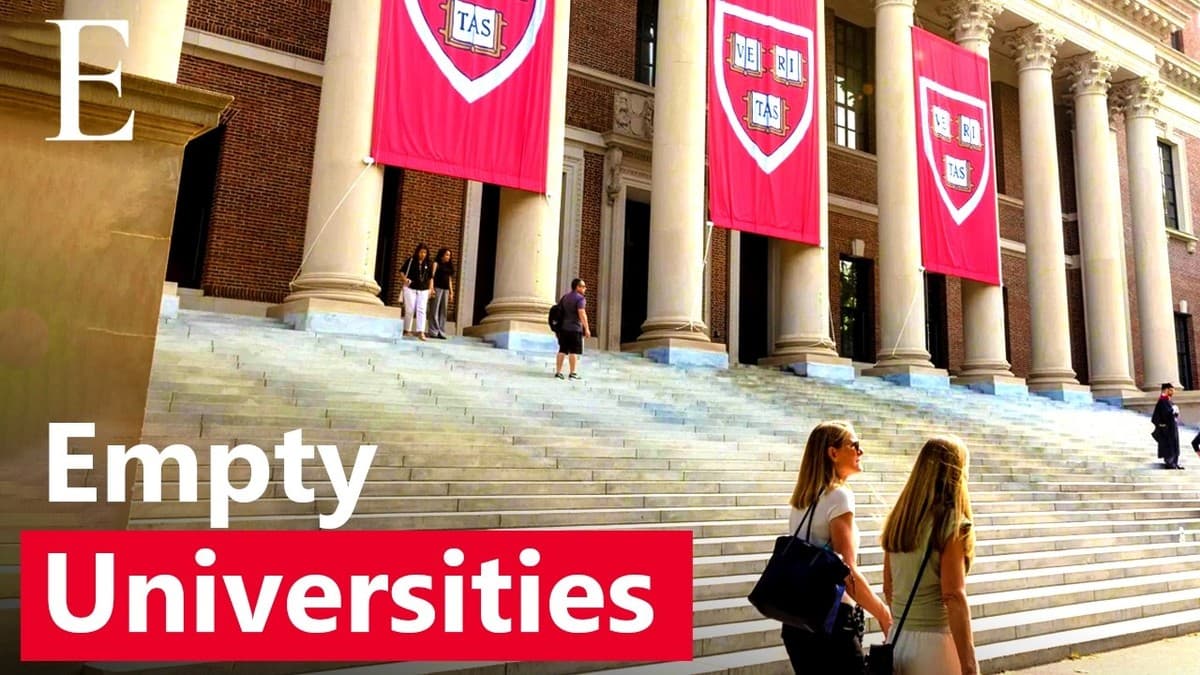
A video by Economy Media argues that AI is eroding the value of a bachelor's degree. The central evidence: the unemployment gap between young college graduates and non-graduates in the United States shrank from 6 percentage points to just 1 between 2010 and 2024. Sectors like finance and law have cut entry-level hiring as automation handles tasks that once went to fresh graduates. At the same time, college enrollment dropped 5% between 2013 and 2022, while student debt crossed $1.7 trillion. The video argues that the degree is not dead, but it is no longer enough on its own. Employers increasingly want proven skills and practical experience over diplomas.
Related reading:
The central claim
Economy Media presents a straightforward argument: AI and automation are stripping the bachelor's degree of its historical advantage in the job market. For decades, a college degree meant lower unemployment, higher starting salaries, and better career prospects. The video claims that advantage has largely disappeared.
The numbers are striking. Recent college graduates aged 22 to 27 now face a 5.8% unemployment rate, according to the video, nearly double the rate for workers of all ages with college degrees. Two-thirds of Americans reportedly believe you can find a stable, well-paying job with only a high school diploma.
The evidence presented
The video builds its case around several data points that paint a picture of structural change in the labor market.
| Metric | Figure | Context |
|---|---|---|
| Youth unemployment gap | 6% to 1% | Gap between graduates and non-graduates (2010 vs. 2024) |
| Finance/insurance youth hiring | Down 14% | Between 2010 and 2024 |
| College enrollment | Down 5% | United States, 2013-2022 |
| Student debt | $1.7 trillion | Total across the United States |
| Employers dropping degree requirements | 45% | According to ZipRecruiter |
| AI document processing speed | 40% faster | Compared to entry-level workers |
The finance and insurance sector is a key example. Youth employment in those industries fell 14% between 2010 and 2024, as banks and firms replaced routine tasks with automation. Entry-level legal work shows a similar pattern, with algorithms now able to process documents 40% faster than junior employees.
The skills-based hiring shift
Perhaps the most concrete claim in the video is about how employers are responding. According to ZipRecruiter, 45% of employers said they dropped degree requirements for certain roles in the past year. Companies are prioritizing what candidates can do over where they studied.
Technical certifications, bootcamps, and online learning platforms now compete directly with four-year degrees. The video frames this as a democratization of knowledge: skills that once required university training can now be acquired faster and cheaper through alternative paths. The result is that a bachelor's degree has lost its position as the primary talent filter.
The speed of skill obsolescence
The video also highlights how quickly skills become outdated. 91% of IT professionals in the US and UK reportedly fear that AI will make their skills obsolete, a figure that jumped from 74% to 91% in just one year. An estimated 44% of job skills will change in the next five years, which makes a four-year degree feel like a snapshot of knowledge that starts aging the moment it is earned.
Opposing perspectives
The degree is not the problem
The video itself acknowledges that a bachelor's degree is not dead. Graduates who completed internships were 23% more likely to secure full-time employment in their first six months. For 63% of employers, human skills like communication, critical thinking, and adaptability remain decisive factors when hiring. The degree still provides a foundation, but it needs to be combined with practical experience and soft skills.
Alternatives are not risk-free
While the video presents bootcamps and certifications as viable alternatives, it does not address the completion rates or long-term career outcomes of those paths. A coding bootcamp may teach someone React in twelve weeks, but it does not provide the broader analytical framework that a university education offers. For some careers, particularly in research, medicine, or engineering, there is no shortcut around a formal degree.
How to interpret these claims
The video makes a compelling case, but several aspects deserve closer scrutiny.
US-centric data in a global context
Nearly all statistics in the video come from the United States, where higher education costs are unusually high. The video briefly notes that countries with subsidized or free higher education have seen enrollment grow by more than 15%. This suggests the "death of the degree" narrative may be more about American tuition costs than about AI specifically. In countries like Germany, Norway, or Finland, where university is free or nearly free, the cost-benefit calculation looks very different.
Correlation versus causation
The unemployment gap between graduates and non-graduates shrank from 6% to 1%. But is AI the primary driver? The video traces the trend back to the late 2000s financial crisis, which means the erosion started well before generative AI became mainstream. Tight labor markets, changing demographics, and the growth of the gig economy all play a role. Attributing the shift primarily to AI oversimplifies a complex structural change.
Missing context on what "dropping degree requirements" means
The 45% figure from ZipRecruiter is striking but needs context. Dropping a degree requirement from a job posting does not necessarily mean employers stopped preferring candidates with degrees. It may simply reflect a pragmatic response to a tight labor market where demanding a degree means losing qualified applicants. When the labor market loosens, those requirements could easily return.
What stronger evidence would look like
To truly show that AI is reducing the value of degrees, one would need longitudinal data comparing lifetime earnings of degree holders versus non-holders, controlled for field and region. The video relies heavily on hiring trends and sentiment surveys. Those capture a moment in time, not a permanent structural shift.
Practical implications
For current students
A degree alone is not enough. Internships, side projects, and practical experience matter as much as coursework. Students should treat their education as a starting point, not a finish line, and build visible, portfolio-ready skills alongside their academic work.
For career changers
The shift toward skills-based hiring creates real opportunities for people without traditional degrees. Certifications and portfolio-based learning can open doors that used to be locked. But choosing the right alternative path matters: not all bootcamps or online programs deliver equal value.
For employers
Dropping degree requirements is a start, but it requires building better evaluation methods. If a company no longer asks for a degree, it needs a clear way to assess whether a candidate actually has the skills the role demands.
Glossary
| Term | Definition |
|---|---|
| Skills-based hiring | Hiring based on what a candidate can show they can do, rather than what degree they hold. |
| Skill obsolescence | When a worker's existing skills become outdated because technology or market demands have changed. |
| Entry-level jobs | Starting positions for recent graduates, typically involving routine or supervised tasks. |
| Return on investment (ROI) | Whether the money and time spent on education pays off through higher earnings over a career. |
| Continuous learning | Ongoing education and skill development throughout a career, rather than relying on a one-time degree. |
| Bootcamp | An intensive, short-term training program focused on a specific skill like coding or data analysis. |
| Gig economy | A labor market based on short-term contracts and freelance work rather than permanent jobs. |
| Human skills | Capabilities like communication, empathy, and critical thinking that are difficult for AI to replicate. |
Sources and resources
Want to go deeper? Watch the full video on YouTube →