Andrew Yang: AI Job Losses Hit Within 12 Months
Key insights
- Yang moved up his displacement timeline to 12 months after attending an AI conference, saying the next six months will outstrip ten years of prior AI progress.
- Anthropic CEO Dario Amodei has predicted that AI will automate up to 50% of entry-level white-collar jobs. He has reportedly also called on policymakers to tax AI companies to fund the transition.
- Corporate signals back up the warnings: Block laid off 40% of staff and its stock jumped 24%, and Yang says Fortune 500 executives are quietly planning 15-20% workforce cuts.
This is an AI-generated summary. The source video may include demos, visuals and additional context.
In Brief
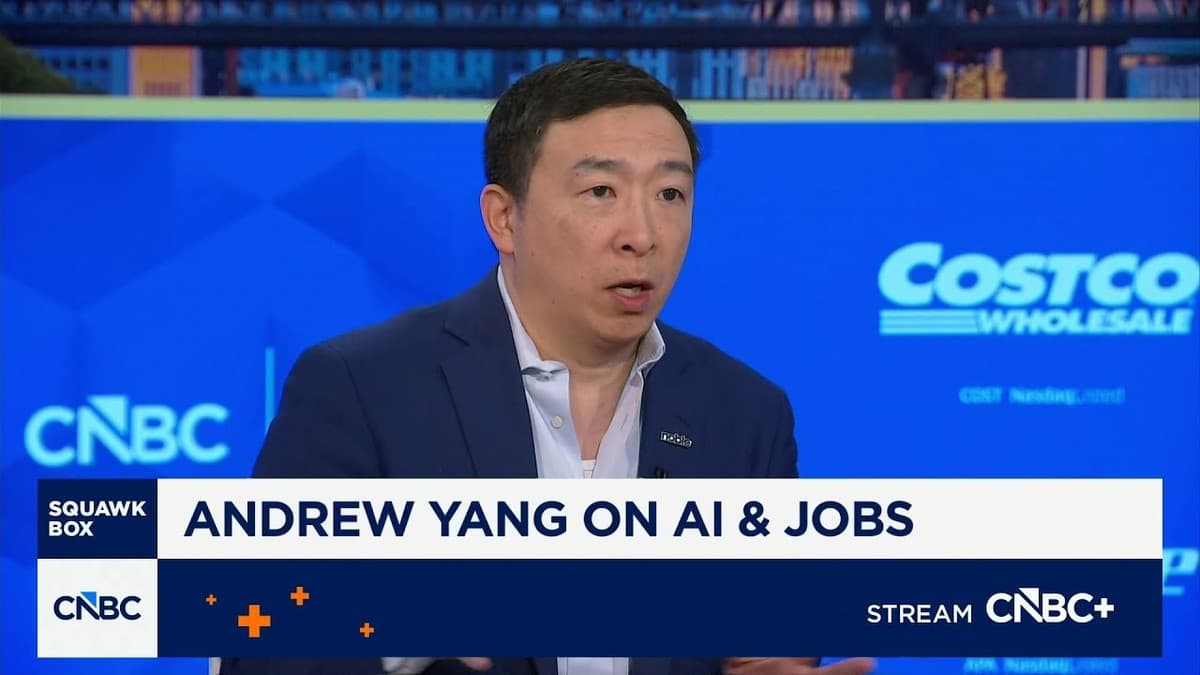
Andrew Yang founded the wireless carrier Noble Mobile and ran for US president in 2020. On March 11, 2026, he appeared on CNBC Squawk Box to argue that AI-driven job losses are not a distant threat: they are arriving within months. Fresh from an AI conference, Yang moved up his displacement timeline to 12 months. He pointed to three converging signals: collapsing hiring for computer science graduates, a 50% automation prediction from Anthropic Chief Executive Dario Amodei, and a wave of corporate layoffs being cheered by stock markets. His proposed policy response: stop taxing labor and tax AI agents instead. Yang also briefly discussed the Anthropic-Pentagon dispute.
Related reading:
The central claim
Yang's core argument is simple: AI job displacement is no longer a future scenario. It is happening now, and the coming 12 months will accelerate it sharply. He told Squawk Box hosts that the next six months will outstrip everything AI has done in the last ten years. The rate of change, he argued, is "on a hockey stick and heading up".
His central piece of evidence is Dario Amodei, the Chief Executive Officer (CEO) of Anthropic (an American AI safety company that builds the Claude family of AI models). Amodei has repeatedly stated, according to Yang, that AI will automate away up to 50% of entry-level white-collar jobs. These are office and professional jobs that require a degree but not years of experience. Yang says he believes that prediction.
Supporting evidence
Yang points to several concrete signals that this shift is already under way.
Autonomous coding revenue. At the AI conference Yang attended, one company selling autonomous coding software to large enterprises reported that its revenue had grown 100-fold in the past 12 months. Autonomous coding means AI that writes software code without human developers doing the typing. Yang argues that spending which previously went to human engineers is now flowing to AI tools instead.
The "learn to code" reversal. Just four years ago, "learn to code" was standard career advice for young people seeking job security. Yang argues that advice has now flipped. Hiring of recent computer science graduates has "fallen off a cliff," and the underemployment rate among college graduates (working in jobs that do not match their qualifications) has crossed 50%. He adds that, for the first time in recorded history, the unemployment rate among college graduates is the same or higher than among non-college graduates.
Corporate layoffs rewarded by markets. Block, the fintech company co-founded by Jack Dorsey and best known for Square and Cash App, announced a 40% workforce reduction. Its stock rose 24% in response. Yang argues that stock markets now reward companies that cut headcount. "Savvy CEOs are seeing the writing on the wall," he said. He claims an unnamed Fortune 500 executive told him privately that an entire organizational layer is being removed, roughly 15-20% of staff, with no public announcement yet. A CEO of a publicly traded tech company told him privately: "15% this year, 20% two years from now".
The human scale
Yang emphasizes that it is not just tech workers at risk. More than 2 million Americans work in call centers, and Yang argues that AI will decimate that sector. He flags truck driving as the more volatile flashpoint: it is the number one job in 28 US states, employs millions of middle-aged men, and 10-15% of those workers are military veterans. When autonomous vehicles reach that occupation at scale, Yang predicts the social reaction will be severe.
He describes a "K-shaped reaction" emerging in Silicon Valley. In economics, a K-shaped recovery describes a split where one group surges ahead while another falls behind, forming the shape of the letter K. Yang applies this to AI: some tech workers are becoming "superpowered" by AI tools, working faster and producing more than ever before. Others are quietly concluding that their skills are already obsolete and, in Yang's words, "moving to the woods".
The policy proposal
Yang argues that the tax system is pointing in the wrong direction. Societies tax things they want to discourage, he says, but right now labor is taxed heavily while AI agents face no comparable burden. An AI agent is a software system that performs tasks autonomously, without constant human input. His proposal: stop taxing labor and tax AI agents instead. He cites Amodei's own support for this idea. The Anthropic CEO has reportedly said "you should tax us". Yang describes this as a remarkable admission from the head of a major tech company who sees the backlash coming.
Opposing perspectives
Block is a complicated example
The Squawk Box hosts pushed back on the Block layoff as a clean AI-displacement story. One host noted that Block almost certainly overhired during the pandemic boom and was already being criticized for mismanagement well before AI entered the picture. Jack Dorsey also previously cut roughly 80% of Twitter's workforce, which complicates any simple attribution to AI. Yang acknowledged the nuance but argued that Block may be "the canary in the coal mine": the first highly visible case of what many other, better-managed companies are about to do.
The "more jobs after disruption" argument
The hosts also raised the standard economic counterargument: every major technological disruption in history, from the printing press to the internet, ultimately created more jobs than it destroyed. Yang does not dismiss this. His concession is that the transition itself will be "rough with a capital R," even if some new equilibrium eventually arrives. His claim is not that jobs disappear permanently, but that the transition period will be severe enough to cause serious social instability.
How to interpret these claims
Yang's arguments are attention-grabbing and draw on real trends, but several factors should shape how readers weigh them.
Conference selection bias
Yang's updated 12-month timeline came directly from conversations at an AI conference. AI conferences attract the most optimistic builders and investors in the industry, people whose livelihood depends on fast adoption and who have every incentive to present the most bullish projections. Forecasts from inside an AI conference should be treated as maximum-case scenarios, not consensus estimates.
Anecdotal corporate intelligence
The specific layoff figures Yang cites from unnamed Fortune 500 executives and tech CEOs are unverified private conversations. They may reflect real planning underway. They may also reflect what those executives said to impress a former presidential candidate. Without corroboration, these numbers carry real uncertainty.
The timeline problem
Yang has shifted his displacement timeline at least once, now citing 12 months after returning from an AI event. Predictions about when AI disruption will hit a specific threshold have consistently been wrong in both directions. The 50% automation figure from Amodei refers to "the next several years," not 12 months, and "several years" in tech often expands in practice.
Amodei's statement in context
Yang's characterization of Amodei calling for taxation of AI companies is an important claim that deserves verification from the primary source. Amodei has written and spoken at length about AI's risks, but the precise framing matters for whether the policy conclusion Yang draws actually follows.
Practical implications
For workers in at-risk sectors
Call center employees, junior software developers, and administrative workers in large organizations face the most immediate exposure, according to Yang's analysis. Whether his 12-month timeline proves accurate or not, building skills that AI tools currently struggle to replicate (complex judgment, physical dexterity, human relationship management) is a reasonable hedge regardless of timeline.
For students and recent graduates
The collapse in hiring for computer science graduates that Yang describes is worth watching independently of his overall framing. Job posting data and graduate employment surveys from universities are publicly available and would provide a more grounded picture than conference anecdotes.
For policymakers
Yang's proposal to tax AI agents rather than labor is an early-stage idea without a worked-out implementation mechanism. The counterargument that taxing AI would slow development and US competitiveness against China was raised directly in the interview. Any serious policy discussion would need to grapple with how to define a taxable "AI agent," how to set rates, and what to do with the revenue.
Glossary
| Term | Definition |
|---|---|
| Autonomous coding | AI software that writes computer code on behalf of developers, without requiring humans to type the code manually. |
| Entry-level white-collar job | An office or professional job (analyst, junior developer, customer support) that typically requires a degree but limited prior experience. |
| Job displacement | When technology replaces a human worker in a role, either eliminating the position or significantly reducing demand for it. |
| Underemployment | Working in a job that is below your qualifications or that provides fewer hours and income than you need. |
| AI agent | A software system that can perform multi-step tasks autonomously, such as browsing the web, writing code, or managing files, without constant human input. |
| K-shaped economy | An economic pattern where outcomes split sharply in two directions: some people's situations improve rapidly while others deteriorate, forming the shape of the letter K. |
| Escape velocity | In this context, the point at which AI progress becomes self-reinforcing: models improve fast enough to help build better models, making further investment in competitiveness less decisive. |
Sources and resources
Want to go deeper? Watch the full video on YouTube →