Why Anthropic Drew Red Lines on Pentagon AI
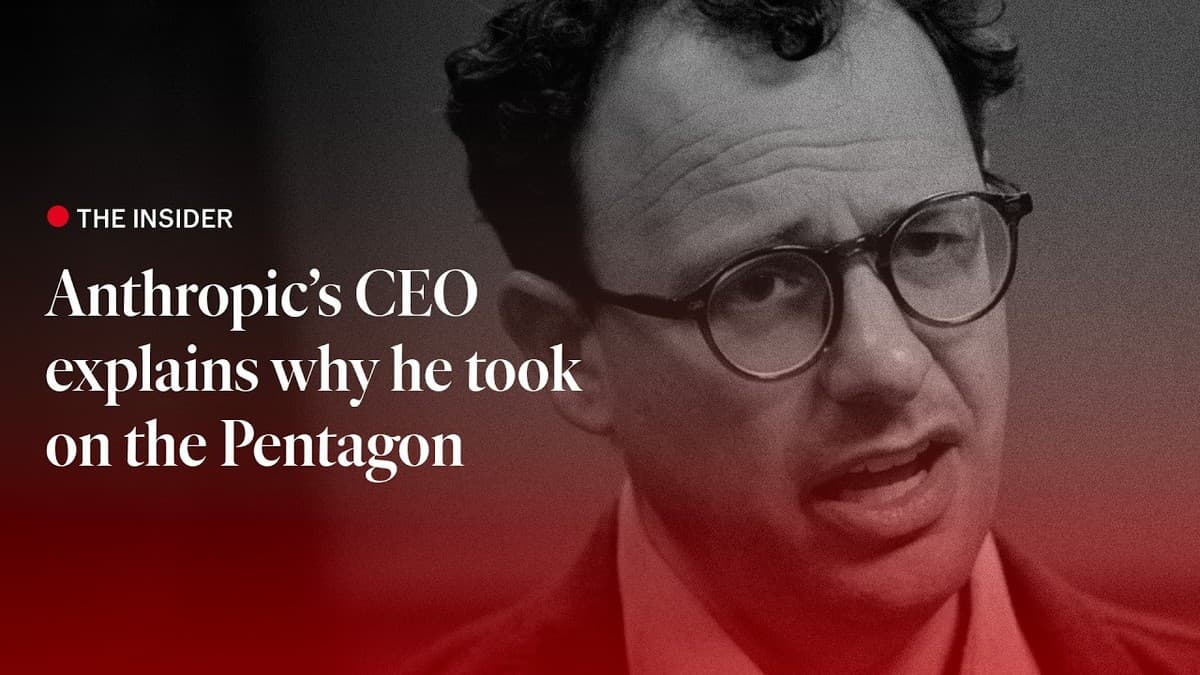
Key insights
- Amodei frames Anthropic's pushback as a product safety issue, comparing it to an aircraft supplier flagging unsafe operating conditions
- The Pentagon's supply chain risk designation is unprecedented for a US company, previously reserved for adversaries like Huawei
- Amodei warns of a 'dual dilemma' where AI risks making both private companies and governments more powerful than democratic systems can check
This is an AI-generated summary. The source video may include demos, visuals and additional context.
In Brief
Dario Amodei, CEO of Anthropic, explains why his company refused to lift all safeguards on the Pentagon's use of its AI model Claude. In a conversation with The Economist's editor-in-chief Zanny Minton Beddoes, Amodei argues the dispute is not political but structural: the technology is not reliable enough for fully autonomous weapons, and concentrating that kind of power without oversight poses risks that go beyond any single administration. The Pentagon responded by designating Anthropic a supply chain risk, a label previously reserved for adversary nations like China's Huawei.
The central claim: a product safety issue, not a political one
Amodei's core argument reframes the dispute as a technical and safety question rather than a political stance. He compares Anthropic to an aircraft supplier telling a buyer that a plane is not safe to fly above a certain altitude or turn at a certain speed (0:24). The systems were not built for certain use cases, and deploying them that way creates risks the manufacturer cannot stand behind.
Anthropic's two red lines are mass surveillance of Americans and fully autonomous weapons, systems that select and attack targets without a human in the loop (meaning no person approves the decision to fire). Amodei stresses that the existing, more limited contract worked well. Claude was used in operations related to Venezuela and Iran without problems (0:52). The conflict arose when the Pentagon sought a broader contract that would allow "any lawful use."
Amodei repeatedly insists the disagreement is narrow. He claims 99% agreement with the Pentagon on how the technology should be used (3:11). The dispute, he argues, is about where to draw the line on a small number of use cases that the technology is not yet ready for.
The dual dilemma: too powerful for anyone
The interview's most striking argument comes in its second half. Amodei describes what he calls a "dual dilemma" at the heart of AI governance (5:09).
On one side, AI threatens to make private companies more powerful than they have ever been. On the other, it threatens to give governments unprecedented power that cannot be checked. Amodei says he worries about both scenarios equally, whether the government in question is democratic or autocratic (5:35).
He illustrates the oversight concern with a thought experiment: what happens when an army of 10 million AI-driven drones replaces 10 million human soldiers? Human soldiers have norms. They follow orders, but if something extreme enough happened, they would refuse (6:10). Drones have no such norms. Without careful governance, a very small number of people, or one person, could control an autonomous military force with no way to refuse.
Beddoes frames the conclusion bluntly: "This technology is too powerful to be in the hands of a few private companies, and it's too powerful to be in the hands of a government." Amodei's reply: "That is, unfortunately, the situation" (7:03).
Opposing perspectives
The Pentagon's position
The Pentagon argues that military suppliers cannot dictate how their products are used in combat. Beddoes summarizes their likely response: they need suppliers they can trust, and they cannot have "some guy in Silicon Valley" deciding what the military can and cannot do (2:42). From this perspective, Anthropic's conditions weaken the military's ability to act quickly and set a dangerous precedent for civilian control of military tools.
The nationalisation risk
Beddoes raises the logical endpoint: if the government demands total control over AI used in defense, the result could be effective nationalisation of AI companies that work with the military (3:41). Amodei does not dismiss this. He acknowledges that the coming years will require difficult conversations about the relationship between AI companies and government.
How to interpret these claims
Amodei presents a coherent argument, but several factors shape how it should be read.
The framing favors Anthropic
The aircraft analogy positions Anthropic as a responsible manufacturer flagging safety risks. But the Pentagon's opposing argument, that a contractor should not get to veto military operations, is also reasonable. The interview gives Amodei's framing far more airtime than the opposing view.
99% agreement is a rhetorical device
Claiming 99% agreement makes the dispute sound trivial, but the remaining 1% includes autonomous weapons and mass surveillance. These are not minor use cases. The number is effective rhetoric, but it hides how important the disagreement really is.
The dual dilemma has no proposed solution
Amodei identifies the core tension clearly: AI is too powerful for any single actor. But he does not propose a framework, oversight body, or system to resolve it. The diagnosis is compelling. The prescription is missing.
Business incentives are not discussed
Anthropic is a commercial company competing with OpenAI, Google, and others. The supply chain risk designation could damage its commercial business. Whether principled stance and business strategy happen to align is a question the interview does not explore.
Practical implications
For policymakers
The dispute highlights an urgent gap: there is no established framework for how AI companies and governments should negotiate the boundaries of military AI use. Existing rules for buying military equipment were designed for hardware, not for software that can be used for very different purposes.
For the AI industry
OpenAI has reportedly moved to take over the Pentagon contract Anthropic may lose. How each major AI lab positions itself on military use will shape both government partnerships and public perception for years to come.
For the public
The 10 million drones thought experiment is not science fiction. Autonomous weapons development is accelerating globally. The question of who controls these systems, and what norms govern their use, affects everyone.
Glossary
| Term | Definition |
|---|---|
| Supply chain risk | A government designation that restricts federal agencies and contractors from doing business with a company. Previously applied only to foreign adversaries like Huawei. |
| Autonomous weapons | Weapons systems that can select and engage targets without direct human control. Sometimes called "lethal autonomous weapons systems" (LAWS). |
| Human in the loop | A requirement that a human must approve critical decisions, such as firing a weapon, before the system acts. |
| Red lines | Non-negotiable limits a company or government sets on what it will or will not do. Anthropic's red lines are mass surveillance and autonomous weapons. |
| Dual dilemma | Amodei's term for the situation where AI is simultaneously too powerful for private companies and too powerful for governments to control without checks. |
| Nationalisation | Government takeover of a private company or industry, either formally or through regulations that leave the company with no independent decision-making power. |
Sources and resources
Want to go deeper? Watch the full video on YouTube →