NVIDIA Open-Sources a Self-Driving AI That Explains Itself
Key insights
- Alpamayo narrates its reasoning before acting, reducing close encounters by 25% compared to silent systems.
- NVIDIA released model weights, inference code, and a training data subset, making it the first open reasoning system for self-driving.
- A consistency reward punishes the AI when its stated reasoning contradicts its actual driving, solving the hallucination problem at the wheel.
This is an AI-generated summary. The source video may include demos, visuals and additional context.
In Brief
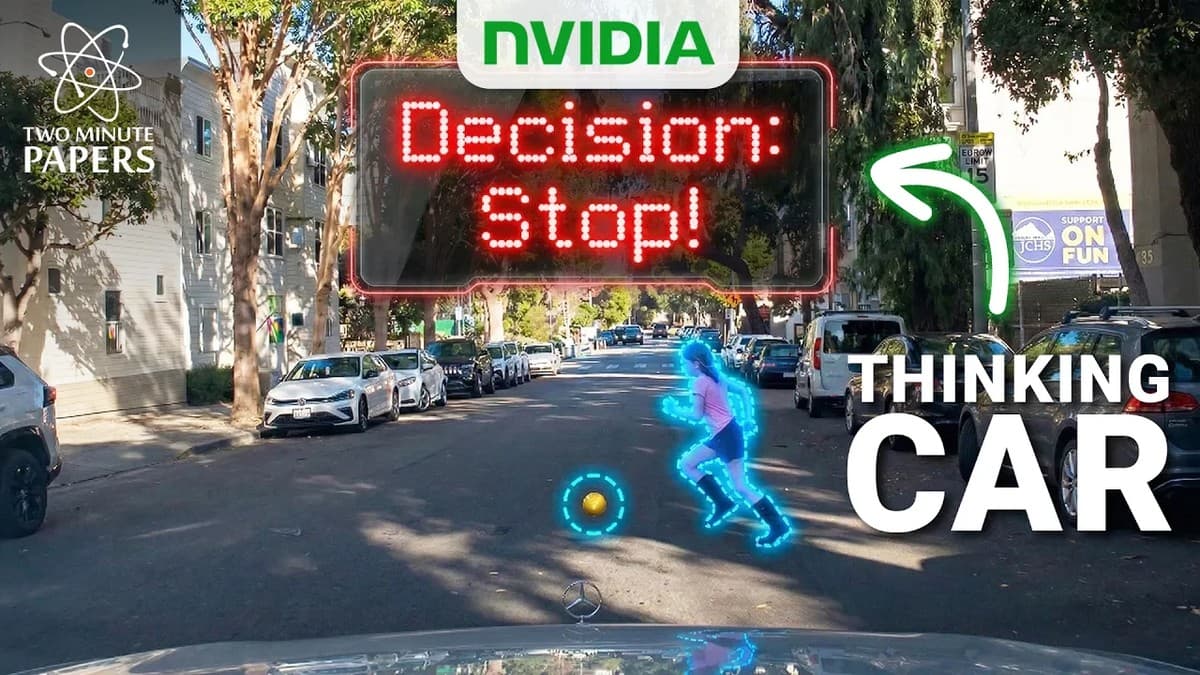
NVIDIA has released Alpamayo, described as the first completely open reasoning system for self-driving cars. Unlike existing proprietary systems that look at camera footage and output steering commands without explanation, Alpamayo narrates what it is about to do and why before it acts. Károly Zsolnai-Fehér of Two Minute Papers argues this is significant for two reasons: the AI actually drives better when it reasons out loud, and when it makes mistakes, engineers can see exactly why. The release includes model weights, inference code, and a training data subset, making it available to anyone. For context on how far self-driving has already come, Waymo is now handling roughly 400,000 paid trips per week across US cities.
Related reading:
The central claim
The core argument is that self-driving AI improves when it is forced to explain itself. Zsolnai-Fehér frames Alpamayo as a breakthrough not just because it is open, but because it shows that transparency and safety are linked. When the system narrates its reasoning, its close encounter rate (how often the car comes dangerously close to other objects) drops by 25%. The act of reasoning, according to the video, is not just a user interface feature. It is what makes the car drive better.
The problem Alpamayo addresses is a familiar one in AI: systems that say one thing and do another. A current self-driving car "looks through the cameras and outputs steering commands" without any explanation. When something goes wrong, there is no trail to follow. Alpamayo is a Vision-Language-Action model (VLA), meaning it combines camera vision, language-based reasoning, and physical action in a single system. It sees the road, generates a text explanation of its next move, and then executes that move.
How reasoning improves driving
Alpamayo uses a technique called chain-of-causation reasoning, where the AI explains what caused a situation before deciding how to respond. In a demonstration described in the video, the system outputs statements like "we are nudging to the left because there is a car stopped on the right. Now we keep left to follow the temporary corridor". This is not just narration for the passenger's benefit. The system is trained so that its stated reasoning must match its actual steering.
The mechanism enforcing that match is a consistency reward, described in the video as a "lie detector." It works through reinforcement learning (RL): the AI is rewarded for good decisions and penalized for bad ones. If the system claims it will slow down for a red light and then keeps driving, it receives zero points. Over millions of training repetitions, the AI learns that its words and its wheel movements must align.
A second technique, called conditional flow matching, addresses a related problem: even when the AI knows what to do, translating that decision into smooth steering is difficult. Conditional flow matching smooths the output into continuous, non-jerky motions rather than abrupt corrections.
Handling rare situations
One of the hardest problems in self-driving is the long tail: the rare, unusual scenarios that almost never appear in training data. A unicyclist on a highway, a construction worker using hand signals, an ambiguous road closure — these situations are dangerous precisely because no AI has seen enough of them to learn from. Alpamayo's reasoning architecture allows it to apply general judgment rather than pattern matching, meaning it can respond to a construction worker giving instructions even without a dedicated training example for that scenario.
Training used 700,000 video clips, and for each clip the model wrote what the video's description calls a "diary entry" explaining the cause of the car's movement. Before road deployment, the system trained inside AlpaSim: a photorealistic simulator built with 3D Gaussian splatting, a technique for reconstructing detailed 3D scenes from real-world photos.
The open-source release
NVIDIA has released model weights, inference code, and a subset of the training data. The model weights are the learned parameters of the trained AI, the part that would normally remain locked inside a company's servers. Releasing them means a researcher or engineer can download and run a state-of-the-art self-driving system without building one from scratch. Zsolnai-Fehér describes this as "the keys to the kingdom."
Opposing perspectives
The cost of reinforcement learning
The video acknowledges the most significant limitation directly: reinforcement learning is expensive. Every decision the AI makes during training must be evaluated by a reward model, which acts like a private driving instructor grading every micro-movement. That continuous evaluation requires substantial compute resources, making it difficult to scale or replicate without NVIDIA-level infrastructure.
A non-commercial license
Model weights are released under a non-commercial license, restricting their use to research. The inference code uses the more permissive Apache 2.0 license. This distinction matters: researchers can study the model, but building a product on top of it requires a separate commercial agreement with NVIDIA. The "open" framing is accurate for research purposes, but it is not the same as fully open-source.
DeepSeek's alternative approach
Researchers at DeepSeek have explored a different approach to the cost problem. Their method, called Group Relative Policy Optimization (GRPO), skips the dedicated reward model entirely. Instead, the AI generates 16 different plans and grades them against each other. This eliminates the need for a separate teacher model. Zsolnai-Fehér suggests this approach could potentially be applied to Alpamayo in the future, though no such work has been announced.
How to interpret these claims
The video presents Alpamayo enthusiastically, and the 25% reduction in close encounters is the central performance claim. Several questions are worth holding in mind before treating this as a settled result.
What baseline is the 25% measured against?
The figure comes from NVIDIA's own research paper, comparing Alpamayo with reasoning enabled against Alpamayo with reasoning disabled. This is a meaningful comparison, but it is not an independent benchmark against other self-driving systems. The claim is that reasoning improves this particular model, not that Alpamayo outperforms Waymo, Tesla, or any other deployed system. Independent replication on standardized benchmarks would provide stronger evidence.
How much of the improvement is the reasoning itself?
Alpamayo combines several innovations: chain-of-causation reasoning, consistency reward, conditional flow matching, a large training dataset, and a photorealistic simulator. The video attributes the performance gain primarily to reasoning, but separating the contribution of each component from a system this complex is difficult. The 25% figure may reflect the combination rather than any single factor.
The training data question
A "subset" of the training data has been released alongside the model weights. The full 700,000-clip dataset remains proprietary. Researchers who want to study how the model's behavior relates to its training distribution will have limited visibility into the complete picture.
What "open" means in practice
NVIDIA's release is genuinely significant for research. But the non-commercial license means that practical deployment requires commercial licensing terms that are not yet publicly defined. The release lowers the barrier to studying and critiquing the technology. That is valuable on its own terms, but it does not create a freely deployable alternative to existing proprietary systems.
Practical implications
For researchers and engineers
The model weights and inference code are available now at NVlabs/alpamayo on GitHub, with the 10-billion parameter model also hosted on HuggingFace. For the first time, the internal reasoning of a state-of-the-art self-driving system can be examined, tested, and challenged without proprietary access.
For everyone riding in cars
The broader significance of reasoning-based systems is accountability. If an autonomous vehicle causes an accident, an AI that narrates its decisions provides an evidence trail. The question of who is responsible when a self-driving car fails is unresolved legally in most countries. Systems that log their reasoning at least make the technical question answerable.
Glossary
| Term | Definition |
|---|---|
| Vision-Language-Action model (VLA) | An AI that combines camera vision, language reasoning, and physical action in one system. It sees, explains, and then acts. |
| Chain-of-causation reasoning | The AI states what caused a situation before deciding how to respond, like thinking out loud. |
| Reinforcement learning (RL) | A training method where the AI learns by receiving rewards for good decisions and penalties for bad ones, repeated over millions of examples. |
| Consistency reward | A "lie detector" that penalizes the AI when its stated reasoning contradicts its actual driving behavior. |
| Conditional flow matching | A mathematical technique that converts the AI's planned path into smooth, continuous steering rather than jerky corrections. |
| Long tail | Rare, unusual driving situations that rarely appear in training data, such as a unicyclist on a highway or ambiguous hand signals. |
| 3D Gaussian splatting | A technique for reconstructing detailed 3D scenes from real-world photos, used here to build AlpaSim's photorealistic driving simulator. |
| Model weights | The learned parameters of a trained AI model. Releasing them means others can run or study the model directly. |
| Close encounter rate | How often an autonomous vehicle comes dangerously close to another object, used as a safety benchmark. |
| GRPO (Group Relative Policy Optimization) | DeepSeek's alternative to reward-model training: the AI generates multiple plans and grades them against each other, eliminating the need for a separate teacher. |
Sources and resources
- Two Minute Papers — NVIDIA's New AI Just Cracked The Hardest Part Of Self Driving (YouTube) (9 min)
- Alpamayo GitHub repository (NVlabs)
- AlpaSim GitHub repository (NVlabs)
- Alpamayo-R1-10B model weights (HuggingFace)
- NVIDIA newsroom announcement
- NVIDIA technical blog — Building Autonomous Vehicles That Reason with NVIDIA Alpamayo
Want to go deeper? Watch the full video on YouTube →