Box CEO: AI Agents Will Use More Software Than People
Key insights
- AI agents will be the biggest users of enterprise software, but not all software will survive the shift
- Enterprises that tie their data to a single AI model risk losing access overnight, as the Anthropic-Pentagon conflict shows
- The winning strategy is a neutral data layer that connects to any AI system without moving your files
This is an AI-generated summary. The source video may include demos, visuals and additional context.
In Brief
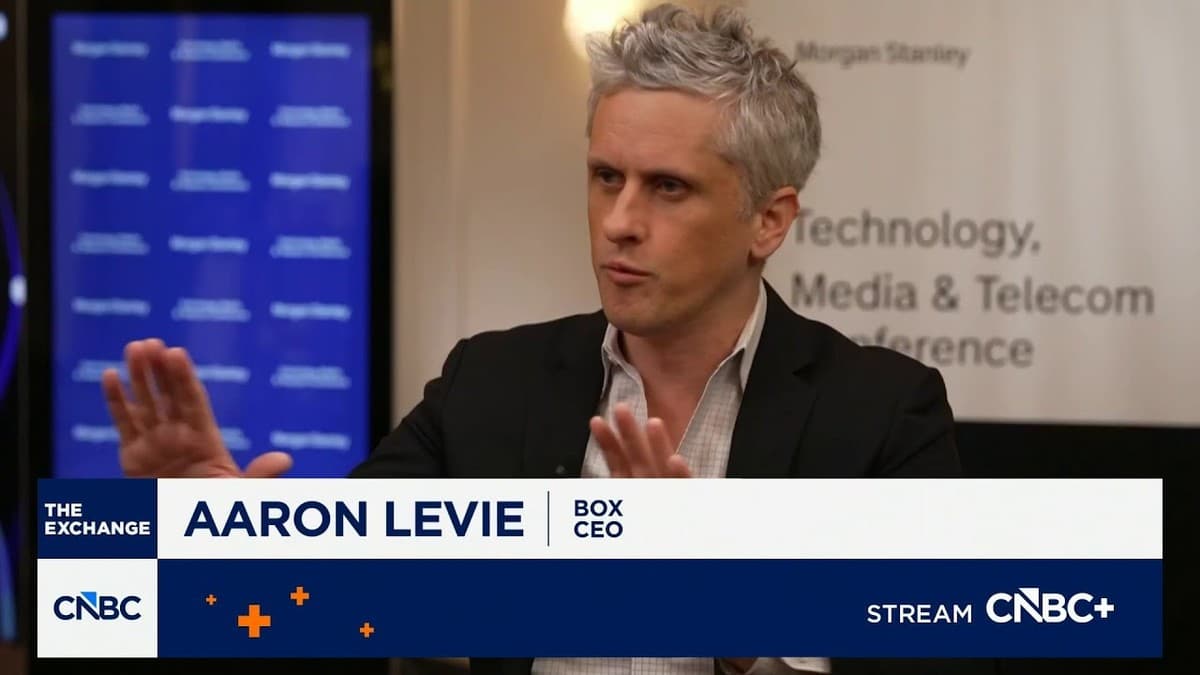
Aaron Levie, CEO of Box, argues that AI agents (software that performs tasks autonomously) will become the biggest users of enterprise software, surpassing humans. Speaking on CNBC's The Exchange after Box stock jumped 8% on earnings, Levie makes the case that enterprises need a neutral data layer that works with any AI model, not one locked to a single provider. The recent Anthropic-Pentagon conflict, he suggests, is an early example of why that separation matters.
The central claim
Levie's core argument is simple: AI agents will be the biggest users of software in the future (1:40). Not humans clicking through dashboards, but autonomous AI systems performing tasks on behalf of people.
But he adds a critical qualifier. Not all software will benefit from this shift. "That doesn't mean they're going to use all software," Levie notes (1:43). Companies need to figure out which tools are essential to agentic workflows (tasks performed by AI agents) and which ones will become irrelevant.
Why agents need a file system
At Box, Levie argues the answer is unstructured data, meaning documents, files, and other content that doesn't live in neat database rows. "Agents actually need a file system to be able to do their work" (2:02), he claims, positioning Box as the infrastructure layer that gives AI agents access to the critical context stored across an enterprise.
This is Box's strategic bet: rather than building AI models, they're building the platform that AI agents use to access information (1:54). Think of it as building the roads rather than the cars.
The case for model neutrality
The conversation takes a sharper turn when Deirdre Bosa asks about Anthropic's Pentagon blacklisting and whether it gives Levie pause about AI partnerships.
His answer is counterintuitive: the conflict actually reinforces Box's multi-model strategy (2:36). Box recently added Claude (Anthropic's AI model) to Box AI Studio, but Levie argues the real risk isn't choosing the wrong model. It's tying your data to any single one.
"Having all of your data get sucked into one model or another puts you in a risky position," Levie warns (2:48). If a government bans your AI provider or a vendor changes terms, enterprises locked into that model lose access to their own workflows overnight.
The Pentagon situation, Levie argues, is just one example. There are "a lot of reasons why you want to be able to have choice in which AI agents and AI systems you want to be able to use without having to move all of your data between those systems" (3:05).
Opposing perspectives
Is model neutrality just a sales pitch?
Levie has an obvious commercial interest in this framing. If enterprises lock their data into a single AI platform (like Microsoft's Copilot ecosystem or Google's Gemini suite), Box becomes less relevant. The "neutral layer" argument conveniently positions Box as essential infrastructure. Investors should weigh whether this reflects genuine market insight or strategic positioning.
Do agents really need a separate file system?
Major AI platforms are building their own data integration layers. OpenAI, Google, and Microsoft are all working on ways for agents to access enterprise data natively. If AI models can connect directly to data sources, the value of a middleman file system becomes less clear.
How to interpret these claims
Levie presents a compelling vision, but several factors deserve consideration before taking the argument at face value.
Consider the source
Box is a cloud storage company facing existential questions about its role in an AI-first world. The "agents need a file system" argument is also Box's core business case. That doesn't make it wrong, but the motivation is worth noting.
The SaaS sell-off context
Levie acknowledges that software stocks went through "indiscriminate selling" (1:00) as investors rotated into AI infrastructure plays. His interview comes on Box's best stock day in nearly a year. The optimism about agents using software should be read alongside the pressure SaaS companies face to prove AI relevance.
What would make this claim stronger
Independent data on how enterprises are actually deploying AI agents, rather than vendor projections, would strengthen the argument. Case studies showing agents actively using Box-style infrastructure over direct model integrations would be particularly convincing.
Practical implications
For enterprise IT leaders
The model neutrality argument has practical merit regardless of Box's commercial interest. Building workflows around a single AI vendor creates real dependency risk. The Anthropic-Pentagon situation shows how quickly access can be revoked. A data architecture that decouples storage from AI processing offers more flexibility.
For SaaS investors
Watch which software companies can credibly position themselves as infrastructure for AI agents versus those simply adding AI features to existing products. The distinction matters: infrastructure companies benefit from agent adoption, while feature-layer companies may be replaced by agents entirely.
Glossary
| Term | Definition |
|---|---|
| AI agent | Software that performs tasks autonomously using AI, like scheduling meetings or analyzing documents without human intervention. |
| Agentic AI | AI systems designed to act independently and complete multi-step tasks, rather than just answering questions. |
| Unstructured data | Files, documents, images, and other content that doesn't fit neatly into database tables. Most enterprise data is unstructured. |
| SaaS | Software as a Service. Software you access online through a subscription rather than installing locally. |
| Model neutrality | A strategy where a platform works with multiple AI models rather than being locked to one provider. |
| Box AI Studio | Box's platform that lets enterprises connect their stored content to multiple AI models for processing. |
| Supply chain risk | The risk that comes from depending on a single vendor. If that vendor is cut off, your operations are disrupted. |
Sources and resources
Want to go deeper? Watch the full video on YouTube →