Suno Hits 7M Songs a Day and Strikes a Warner Deal
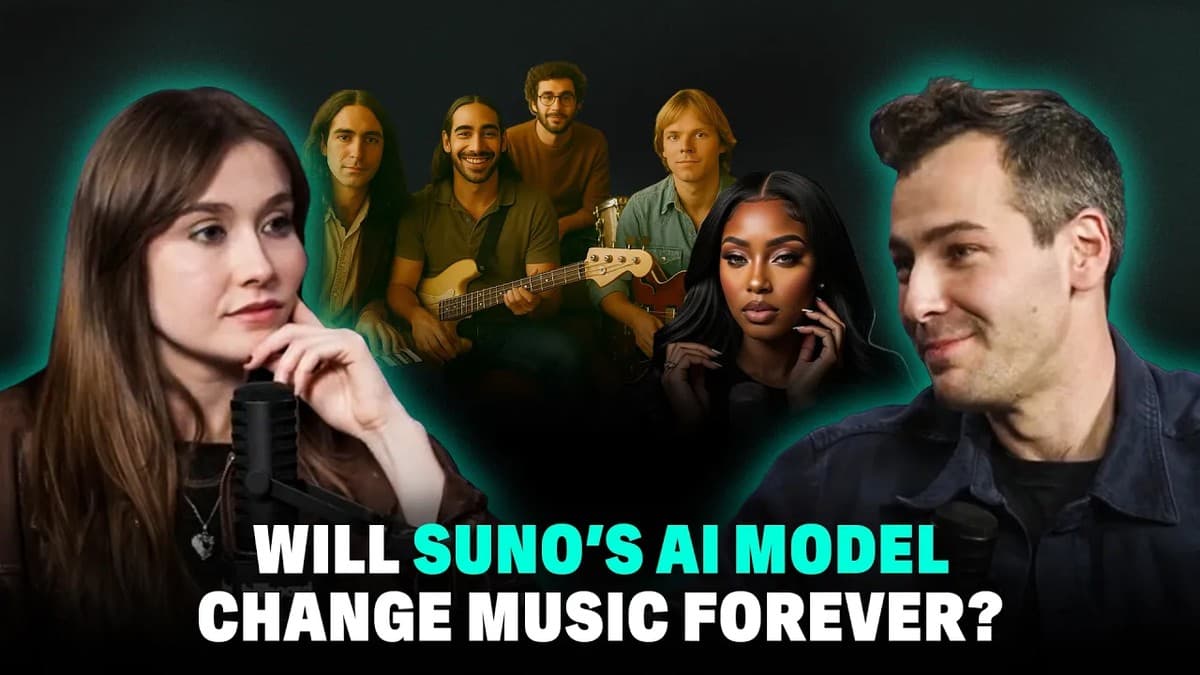
Key insights
- Suno will relaunch its AI model in 2026 using only licensed music, starting with a Warner Music Group partnership, while UMG and Sony lawsuits remain unresolved
- Professional songwriters and producers are Suno's most engaged users, with retention rates closer to social media apps than typical software
- Suno's ambition extends beyond music creation to a 'music super app' combining generation, consumption, and social features
- The line between AI-generated and AI-assisted music is already blurred, with Shulman claiming AI-assisted tracks are likely on the Hot 100 today
This is an AI-generated summary. The source video may include demos, visuals and additional context.
In Brief
Suno, the AI music generation platform that produces 7 million songs per day, has struck a landmark deal with Warner Music Group. The company plans to relaunch its model using only licensed music sometime in 2026. In a Billboard interview, CEO Mikey Shulman defends training on copyrighted music as legal and reveals that professional songwriters are the platform's heaviest users. Shulman also outlines a vision for Suno as a "music super app." Suno now has 2 million paid subscribers and $300 million in annual recurring revenue (ARR), the yearly income from subscriptions. Lawsuits from Universal Music Group and Sony Music Group remain active.
Related reading:
The Warner deal and a licensing pivot
At the end of 2025, Suno reached an agreement with Warner Music Group that settled Warner's portion of a lawsuit filed by the three major music companies in the summer of 2024. As part of the deal, Suno will relaunch its AI model later in 2026 trained exclusively on licensed music. The company also acquired Songkick, a concert discovery platform, from Warner as part of the agreement.
Shulman calls it a long-term partnership, not a legal settlement. "It's much more of a partnership about being able to build products that we can't build on our own," he says.
The big question is whether Universal Music Group and Sony Music Group will follow. When asked if Suno could be left in a difficult position if those deals don't materialize, Shulman is vague on how many songs the model needs to perform well. "More is always better," he says. "It's really hard to give definitive answers here."
"What we did is legal"
Despite pivoting to licensed training data, Shulman maintains that Suno's original approach of training on copyrighted music without permission was legal. This is the core of the fair use defense, a legal doctrine that allows limited use of copyrighted material without the owner's permission under certain circumstances.
When pressed on why Suno would settle if it believes it could win in court, Shulman pivots to the partnership narrative. The Warner deal is about building products together that neither side could create alone, he argues, not about admitting wrongdoing.
It is a tricky position. Suno says its past training was legal, but promises to only use licensed music from now on.
From 12-second clips to 7 million songs a day
Suno launched about three years ago with four co-founders working out of one of their houses. The first version could only generate 12-second clips of music. Following Midjourney's playbook, the team launched on Discord to get rapid user feedback without building a full interface. The community grew to hundreds of thousands of users quickly, and Suno raised its first funding round during the Silicon Valley Bank collapse in 2023.
Today, the platform has over 100 million total users who have tried the service. Suno raised $250 million in its Series C round at a $2.45 billion valuation.
The "Ozempic of music"
One of the interview's most striking claims is that professional songwriters and producers are Suno's most active users, not casual hobbyists. An anonymous songwriter reportedly told Shulman that Suno is "the Ozempic of music": everyone uses it but nobody talks about it.
Suno runs a VIP program with thousands of top professionals. According to Shulman, these users have retention rates far higher than typical tool users, with patterns that look more like social media apps. For subscribers overall, bounded day-30 retention (meaning the percentage who come back exactly 30 days after their first use) exceeds 25%, and weekly retention sits around 75%.
At the company's songwriting camps, professional musicians reportedly create finished-sounding master recordings in as little as 30 minutes. The workflow typically starts with an AI-generated prompt and lyrics, then session musicians re-record individual parts to create the final product.
Shulman also believes AI-assisted music is likely already on the Billboard Hot 100. "It'll be very subtle. It'll be the artifacted electric piano in the pre chorus," he says.
Platform ambitions: the "music super app"
Suno's vision goes well beyond a song generator. Shulman describes the company's goal as building a "music super app" that combines creation, consumption, and social features. Recent additions include Hooks, a TikTok-style vertical feed where users share short music videos and remix each other's work.
Shulman explains that the goal is not endless scrolling. "The intention is to keep you scrolling until you hit something that you really like and then to go do something with it."
Shulman rejects what he calls a "walled garden" approach, where AI-generated music stays locked inside a platform and cannot be downloaded or used elsewhere. This is the model that Universal Music Group's Michael Nash favors. Shulman calls this vision "way smaller than it needs to be." He says gaming does this better: different games for different players, different ways to pay.
The company is not trying to replace digital audio workstations (DAWs), the professional software producers use for recording and editing music. "This is another tool in the arsenal," Shulman says. Nor does Suno plan to become a record label. "They are way too culturally important," he says of the major labels.
Industry pushback
Not everyone is welcoming AI music. Bandcamp banned AI-generated and "substantially AI-generated" music in January 2026, though the platform did not define where it draws that line. iHeartRadio launched a "Guaranteed Human" program, promising that its radio stations across the United States will not program any AI-generated music.
Shulman doesn't push back hard. He calls the ambiguous policies "actually the right thing," adding: "We don't know where the line is and so we're going to have some ambiguous policy that lets us figure it out as we go."
Meanwhile, Udio, Suno's closest competitor, is reportedly pivoting to a walled garden model. This leaves Suno as the most prominent AI music platform pushing for an open approach, where users can download and distribute their creations freely.
Suno by the numbers
| Metric | Figure |
|---|---|
| Songs generated daily | 7 million |
| Paid subscribers | 2 million |
| Annual recurring revenue | $300 million |
| Series C funding | $250 million (at $2.45 billion valuation) |
| Subscriber growth | 300% year-over-year |
| Weekly subscriber retention | ~75% |
| Primary user demographic | 25-34-year-old men |
Why startups lead AI music
When asked if Suno would ever sell to a company like OpenAI or Google, Shulman says probably not. His take on why startups are winning is interesting: the big AI companies win by throwing more computing power at problems, but music is art, not a scaling challenge.
"We will be outscaled by Google seven days of the week on spending money on computers," Shulman says. "That's just fine. That's not what's going to make music better."
He also offers a broader cultural prediction: "We're past peak scrolling," he says. "People want to do something else." In Suno's view, making music could become a mainstream pastime, much like playing guitar, where most people do it for fun rather than fame.
Glossary
| Term | Definition |
|---|---|
| Generative AI | AI systems that create new content such as text, images, or music based on patterns learned from training data. |
| AI-generated music | Music created partly or wholly by artificial intelligence, from fully automated output to subtle AI-assisted touches in professional productions. |
| Fair use | A legal doctrine that allows limited use of copyrighted material without the owner's permission, typically for purposes like commentary, education, or transformation. Courts decide case by case. |
| Walled garden | A closed platform where content created inside it cannot be downloaded, exported, or used elsewhere. |
| DAW (digital audio workstation) | Professional software for recording, editing, and producing music. Examples include Ableton Live, Logic Pro, and Pro Tools. |
| ARR (annual recurring revenue) | A company's yearly income from subscriptions. A key metric for software businesses. |
| Retention | How often users come back to a product over time. Higher retention means more people keep using it regularly. |
| Bounded day-30 retention | The percentage of users who return to a product exactly 30 days after their first use. A standard metric for measuring long-term engagement. |
| Prompt | A text instruction that tells an AI system what to generate. In Suno's case, this could be a genre description, lyrics, or a style direction. |
| Training data | The dataset used to teach an AI model. For music AI, this typically includes recordings the model learns musical patterns from. |
| Production music | Pre-made music licensed for use in films, ads, podcasts, and other media content. |
Sources and resources
- Billboard — How Suno's AI Model Is Disrupting the Music Business w/ CEO Mikey Shulman (YouTube) (1h 1m)
- TechCrunch — Suno hits 2M subscribers and $300M ARR
- Warner Music Group / Suno partnership announcement
- Suno Series C announcement ($250M at $2.45B)
- Suno official website
- Bandcamp bans AI-generated music (Billboard)
- iHeartRadio "Guaranteed Human" program (Billboard)
- What Suno and Udio licensing deals mean for AI music (Billboard)
Want to go deeper? Watch the full video on YouTube →