Anthropic and Blackstone in Talks for AI Joint Venture
Key insights
- Private equity firms could mandate AI adoption top-down across hundreds of portfolio companies, giving Anthropic access to hundreds of enterprises at once.
- PE firms face a cannibalization paradox: cutting software costs at one portfolio company may destroy revenue at another they also own.
- Ramp data shows Anthropic's enterprise adoption jumped from 1 in 25 to roughly 1 in 4 companies in about a year.
This is an AI-generated summary. The source video may include demos, visuals and additional context.
In Brief
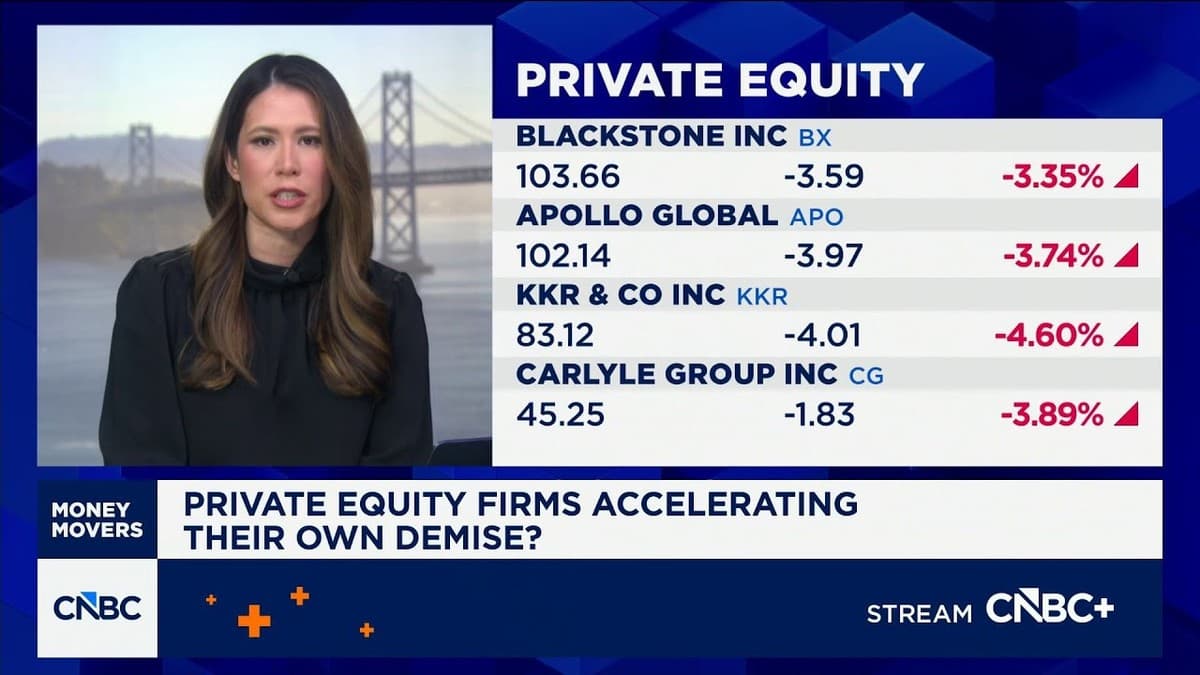
Anthropic is reportedly in talks with Blackstone and other private equity (PE) firms, including Hellman & Friedman, to form an AI joint venture, according to The Information. The deal would give PE firms a ready-made way to push AI adoption across their portfolio companies from the top down. But as CNBC's Deirdre Bosa reports, the arrangement comes with a catch: PE firms risk cannibalizing revenue at the very software companies they own.
Related reading:
What happened
According to a report from The Information, Anthropic is negotiating with Blackstone and other PE firms to create a joint venture focused on AI consulting and deployment. The idea: mandate AI adoption from ownership level, pushing tools like Claude into portfolio companies across the board.
For Anthropic, this is about getting Claude in front of more companies, fast. Private equity firms collectively own thousands of companies. A single partnership could put Claude in hundreds of enterprises overnight, without Anthropic having to sell to each one individually.
For private equity, the appeal is cost reduction. PE firms buy companies, make them more profitable, and sell them. AI tools that cut costs or automate work make every company in the portfolio worth more.
The cannibalization paradox
Here is where the deal gets uncomfortable. CNBC's Bosa frames it as "inviting the fox into the hen house".
Consider this example: a Blackstone portfolio company starts using Claude to manage projects and automate workflows, replacing standalone software tools known as point solutions. One of those tools might be Smartsheet, a work management platform that Blackstone also owns. Blackstone and Vista Equity Partners acquired Smartsheet for $8.4 billion in January 2025. So the same firm saves money on one side of its portfolio while destroying revenue on the other.
Bosa argues PE firms will make that trade anyway. Private equity does not optimize for any single company. It optimizes for the fund. If cost savings across 100 portfolio companies outweigh the revenue loss at one holding, that is a trade PE will make every time.
Why PE could accelerate the SaaS shakeout
The AI tools already exist. What has arguably been missing is someone with the authority and the incentive to rip out existing software contracts. As Bosa puts it: nobody cancels Salesforce because they saw a cool demo. But PE firms have board control, internal rate of return (IRR) targets, and a ticking clock.
If a joint venture with Anthropic gives PE firms a turnkey way to cut software spending across their portfolios, they will move quickly. PE might be the accelerant in what some investors are calling the "SaaSpocalypse".
There is also a longer-term risk for the software companies brought into these arrangements. By integrating AI tools, they may be handing over the data and domain expertise that eventually makes the AI better than them. As Bosa notes: "You could be training your replacement".
Anthropic's enterprise momentum
The joint venture talks come as Anthropic's enterprise business is growing rapidly. According to Ramp data cited on CNBC, about a year ago only 1 in 25 enterprises on the Ramp platform used Anthropic. By March 2026, that figure had grown to roughly 1 in 4.
This growth kept going even after the Pentagon blacklisted Anthropic as a supply chain risk. Bosa suggests the controversy may have actually boosted the company's brand in some circles.
Glossary
| Term | Definition |
|---|---|
| Private equity (PE) | Investment firms that buy companies using pooled investor capital, improve them, and sell them for profit. |
| Joint venture | A business arrangement where two or more companies pool resources for a specific project while remaining separate entities. |
| Portfolio company | A company that a PE firm has invested in or acquired. Large PE firms can own hundreds. |
| Point solution | A standalone software tool that solves one specific problem, like project management or expense tracking. |
| SaaS (Software as a Service) | Software delivered over the internet on a subscription basis, like Salesforce or Smartsheet. |
| IRR (Internal Rate of Return) | A metric PE firms use to measure the annual return on an investment. Higher IRR means faster, bigger profits. |
| Cannibalization | When a company's new product or strategy eats into the revenue of its own existing products or holdings. |
| SaaSpocalypse | An informal term for the predicted wave of traditional SaaS companies being disrupted or replaced by AI tools. |
| Turnkey solution | A ready-made product or service that can be implemented immediately, without significant customization. |
Sources and resources
Want to go deeper? Watch the full video on YouTube →