Pentagon vs Anthropic: what this conflict is really about
Key insights
- This is not only a contract fight; it is a governance fight over who sets practical boundaries for military AI use
- Anthropic argues for narrow red lines, while DOD wants full flexibility for all lawful use cases
- A supply-chain-risk label could affect much more than one contract by creating spillover risk across commercial channels
This is an AI-generated summary. The source video may include demos, visuals and additional context.
In Brief
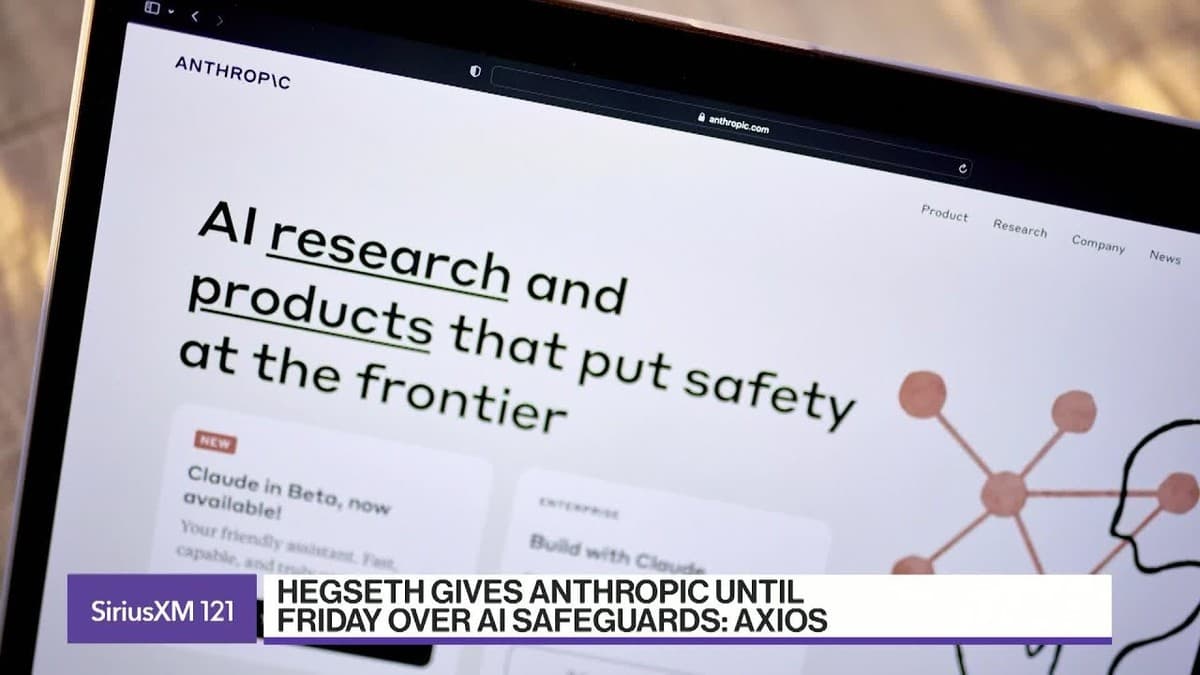
In this discussion with Bloomberg correspondents Joe Mathieu and Kailey Leinz, Gregory Allen describes an escalating conflict between the Pentagon (specifically the Department of Defense, or DOD) and Anthropic over AI contract terms for defense use. The most consequential element may not be the contract itself, but the threat of a supply-chain-risk designation (a formal label warning that a supplier poses risk to critical systems) that could spill into broader commercial channels. More broadly, the discussion signals a structural power question: will governments or model vendors define practical limits for high-capability AI in national security contexts?
What is the core dispute?
The commentator frames this as a tension between flexibility and guardrails (built-in safety limits on what an AI system can do): the Pentagon wants terms that preserve access for all lawful use cases, while Anthropic seeks to keep specific red lines (2:03).
At the same time, the segment claims Anthropic has already become central to advanced unmanned and cyber-adjacent defense workflows (military operations involving drones, cybersecurity, and related digital systems), especially after major defense contract wins in 2025 (0:49).
Why this is viewed as escalation
The strongest opinion in the segment is that threatening a "supply chain risk" designation appears disproportionate in what is fundamentally a contract-terms disagreement (1:48). The argument is that such signals are usually associated with deeper trust or security failures, not policy-boundary negotiation.
The segment also highlights the strategic contradiction: while U.S. leadership frames AI competition as existential, this dispute could weaken a domestic frontier vendor (a company building the most advanced AI models) over governance terms (3:02).
Related reporting around the dispute also points to a specific meeting between Anthropic CEO Dario Amodei and Defense Secretary Pete Hegseth. In those accounts, U.S. officials are described as raising potential contract termination, along with possible use of a supply-chain-risk designation or the Defense Production Act (a U.S. law giving the government emergency powers to force access to strategically important technology) to secure access. The same reporting describes Anthropic's two red lines as no autonomous targeting of enemy combatants and no mass surveillance of U.S. citizens (AI independently selecting who to attack without human approval).
The business risk may exceed the contract value
The discussion notes that the direct DOD exposure is meaningful, but the larger threat is second-order: downstream defense-adjacent partners may avoid a vendor carrying regulatory stigma (companies that work with or supply the military) (5:15). That is the mechanism that can spread beyond a single public contract.
Subtext: this is also a military AI governance debate
One difficult point in the interview is operational asymmetry: if geopolitical rivals are already deploying AI-enabled autonomy (systems that can act on their own using AI, with little or no human input), defense leadership will push for maximum latitude (4:28). From that lens, private vendor constraints can look like strategic friction.
The counterpoint is that model providers also carry legal and ethical exposure in high-consequence domains. Anthropic's safety-first culture shapes the company's position in this dispute. So the conflict is not mainly technical. It is governance: who owns the final call on acceptable use?
This tension is likely to become the norm, not the exception. As model capabilities increase, fully aligned risk tolerance between public buyers and private suppliers becomes less likely.
Why the labor-market segment still matters
Toward the end, the conversation shifts to productivity, automation, and labor disruption (8:22). The tractor analogy is familiar: technology can raise total output while displacing specific job categories.
The "horses vs humans" framing is rhetorical, but it points to a real distinction: people can retrain, yet not all roles adjust at the same speed (9:06). In an opinion context, this matters because defense and security incentives often accelerate deployment faster than the broader market would otherwise accept.
Conclusion
The conclusion is that this story should be read as an early signal of a new contract reality between states and frontier AI vendors. The core issue is not simply "can we use the model for X," but how power, accountability, and risk are allocated across public institutions and private model providers.
Three indicators worth tracking next:
- Whether governments standardize baseline AI terms across vendors.
- Whether vendors converge on shared minimum constraints in defense settings.
- Whether markets begin pricing "regulatory compatibility" as highly as raw model quality.
Glossary
| Term | Definition |
|---|---|
| Supply Chain Risk | A formal assessment that a supplier may introduce risk into critical systems. In practice, this can make the supplier harder to use in sensitive procurement contexts. |
| Lawful Uses | Contract language indicating technology should be available for all legally permitted use cases, without vendor-specific carve-outs. |
| DOD (U.S. Department of Defense) | The U.S. federal department responsible for military operations and defense policy. In this dispute, DOD is the government counterparty negotiating model usage terms. |
| Autonomous Lethal Weapons | Systems capable of selecting and engaging targets with limited human intervention. This remains one of the most contested AI policy topics in security and defense. |
| Frontier AI | The most capable models currently available, typically controlled by a small number of leading companies and increasingly deployed in high-risk domains. |
| Defense Production Act (DPA) | A U.S. law that gives the federal government emergency powers to prioritize and direct access to strategically important goods and services during national-security needs. |
| CSIS | Center for Strategic and International Studies, a Washington-based policy institute focused on security and geopolitics. Gregory Allen is affiliated with its Wadhwani AI Center. |
| JAIC (Joint Artificial Intelligence Center) | A former U.S. Department of Defense AI organization established to coordinate military AI strategy and deployment across defense agencies. |
Sources and resources
Want to go deeper? Watch the full video on YouTube →