Should Spotify Tell You When the Music Is AI-Made?
Key insights
- AI-generated songs reportedly make up nearly 40% of daily uploads to streaming platforms, yet most listeners cannot tell the difference
- Sienna Rose has 4 million monthly Spotify listeners but only ~7,000 Instagram followers, a disparity that suggests inflated or artificial engagement
- Beato argues streaming platforms should label AI music the same way food labels list artificial ingredients
This is an AI-generated summary. The source video may include demos, visuals and additional context.
In Brief
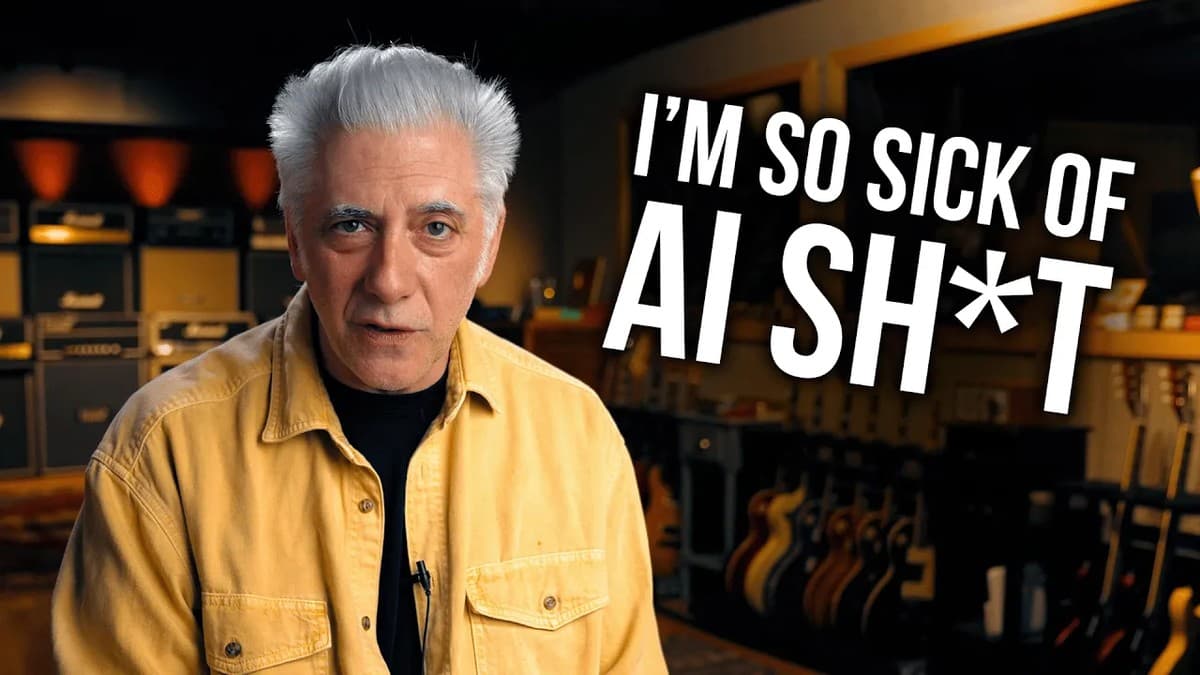
Rick Beato, a musician, producer, and YouTuber with over 5 million subscribers, argues that Spotify is allowing AI-generated music to flood the platform without labeling it. His central exhibit is Sienna Rose, an artist with 4 million monthly Spotify listeners but only about 7,000 Instagram followers. By comparing her metrics to real artists with similar listener counts, Beato builds a case that something about the numbers does not add up, and that listeners deserve to know when the music they hear was made by an algorithm rather than a person.
The central claim: AI music needs a label
Beato's argument is straightforward: streaming platforms should tell listeners when music is AI-generated, the same way food packaging lists artificial ingredients (4:22). He is not arguing that AI music is inherently bad. His point is about transparency. Listeners should be able to make an informed choice.
The urgency comes from scale. According to the LA Times article Beato reads on camera, AI-generated songs now make up nearly 40% of music uploaded to streaming services daily (0:55). In one study, only 3% of respondents could reliably tell AI-generated music from human-made music (1:04). And as of late January 2026, 6 of Spotify's top 50 trending songs in the US were fully AI-generated (1:15).
The Twizzlers analogy
Beato reaches for a surprisingly effective comparison. Even Twizzlers, a candy made of artificial flavoring and dyes, says "artificially flavored" on the packaging (4:33). If junk food tells you what is in it, why shouldn't streaming music?
The evidence: Sienna Rose vs real artists
The core of Beato's case is a statistical comparison. He examines Sienna Rose's engagement metrics side by side with two real artists who have similar monthly listener counts.
| Metric | Sienna Rose | Victoria Monet | Sleep Token |
|---|---|---|---|
| Monthly listeners | ~4M | 3.7M | 5.7M |
| Instagram followers | ~7,000 | 2.1M | N/A |
| Biggest song plays | 11M | 192M | 150–288M |
The pattern is clear. Victoria Monet has 3.7 million monthly listeners and 2.1 million Instagram followers (2:01). Her songs have hundreds of millions of plays (2:25). Sleep Token, a rock band with 5.7 million monthly listeners, has individual songs with 150 to 288 million plays (5:34).
Sienna Rose? Four million monthly listeners, but her biggest song has only 11 million plays (3:24). Her Instagram shows roughly 7,000 followers and 35 posts (1:47). The account is listed as "based in Norway" despite the artist's American-sounding music and accent.
Beato also notes that Deezer, a competing streaming platform, has already labeled Sienna Rose as AI-generated (3:47).
Opposing perspectives
Maybe the numbers are real
Beato himself acknowledges the possibility, albeit sarcastically: it is technically possible that Sienna Rose is a real artist whose fans simply do not use Instagram, whose songs get unusually low play counts relative to her listener base, and who happens to live in Norway despite sounding American (3:22). Each individual data point has an innocent explanation. The argument is about the combination.
Not everyone cares if music is AI-made
Some listeners may genuinely not mind. As Beato puts it, some people might say "hey, but it's a good song" (4:19). If AI can produce music that 97% of people cannot distinguish from human work, the quality argument for labeling weakens. The counterargument to labeling is that it could stigmatize AI music and limit artistic experimentation with new tools.
How to interpret these claims
Beato presents a compelling pattern, but several factors deserve consideration before drawing firm conclusions.
The engagement gap could have other explanations
The gap between monthly listeners and Instagram followers is suspicious, but it does not prove AI generation on its own. Playlist placement on Spotify can inflate monthly listener counts for any artist, human or AI. An unknown artist placed on popular playlists could accumulate millions of listeners without building a social media following. The question is whether Spotify's recommendation algorithm treats AI and human music differently.
The 40% figure needs context
The claim that 40% of daily uploads are AI-generated comes from the LA Times article Beato reads, not from Spotify's own disclosures. The source of this statistic, its methodology, and the definition of "AI-generated" matter. A song that uses AI for mixing is different from one generated entirely by an algorithm. Without knowing how the line is drawn, the number is hard to evaluate.
Deezer's label is significant
The fact that Deezer, an independent platform with its own detection systems, labeled Sienna Rose as AI is the strongest piece of external evidence. Unlike Beato's social media analysis, this is a platform-level determination by a company with technical tools and a business incentive to get it right.
What stronger evidence would look like
Independent verification of streaming data by a third party, a transparent methodology for the 40% claim, and a public statement from Spotify about its AI detection and labeling policies would all strengthen the case. Right now, the argument relies heavily on pattern recognition and one platform's classification.
Practical implications
For listeners
Check artist social media profiles before assuming someone is a real person. Look for the kind of engagement pattern Beato describes: do the listener numbers match the social following and play counts? Deezer already labels AI music, so switching to or cross-referencing with that platform is one option.
For the music industry
The labeling debate is not going away. As AI tools get better and the 3% distinguishability gap narrows further, the pressure on platforms to disclose AI-generated content will only increase. Artists, labels, and advocacy groups may need to push for regulation rather than relying on platform self-governance.
Glossary
| Term | Definition |
|---|---|
| AI-generated music | Music created by artificial intelligence algorithms that have been trained on existing human-made music. The AI produces original compositions that mimic the style, structure, and sound of real artists. |
| Monthly listeners | A Spotify metric that counts the number of unique listeners who played an artist's music in the past 28 days. High monthly listeners with low song play counts can indicate playlist-driven rather than fan-driven listening. |
| Streaming platform | An online service for listening to music on demand, such as Spotify, Deezer, or Apple Music. Users typically pay a monthly subscription for unlimited access. |
| Bot listeners | Automated accounts or programs that play songs repeatedly to inflate streaming numbers artificially. This can generate fraudulent royalty payments. |
| Neo soul | A music genre that blends traditional soul with contemporary R&B, jazz, funk, and hip-hop influences. Artists like Victoria Monet and Olivia Dean work in this space. |
| Playlist placement | When a streaming platform adds a song to a curated or algorithmic playlist, exposing it to that playlist's audience. A single popular playlist can add millions of listeners. |
Sources and resources
Want to go deeper? Watch the full video on YouTube →