Wyclef Jean Calls AI Music's New Instrument
Key insights
- A Google-produced video naturally showcases only the positive side of AI-assisted music production, leaving questions about copyright and job displacement unaddressed.
- Treating AI-generated sounds as raw samples to be cut and shaped preserves human creative control, but this workflow may not represent how most producers will use the tool.
- The 'soul versus information' framing positions AI as complementary, yet the commercial reality of who profits from AI-generated music remains unresolved.
This is an AI-generated summary. The source video may include demos, visuals and additional context.
In Brief
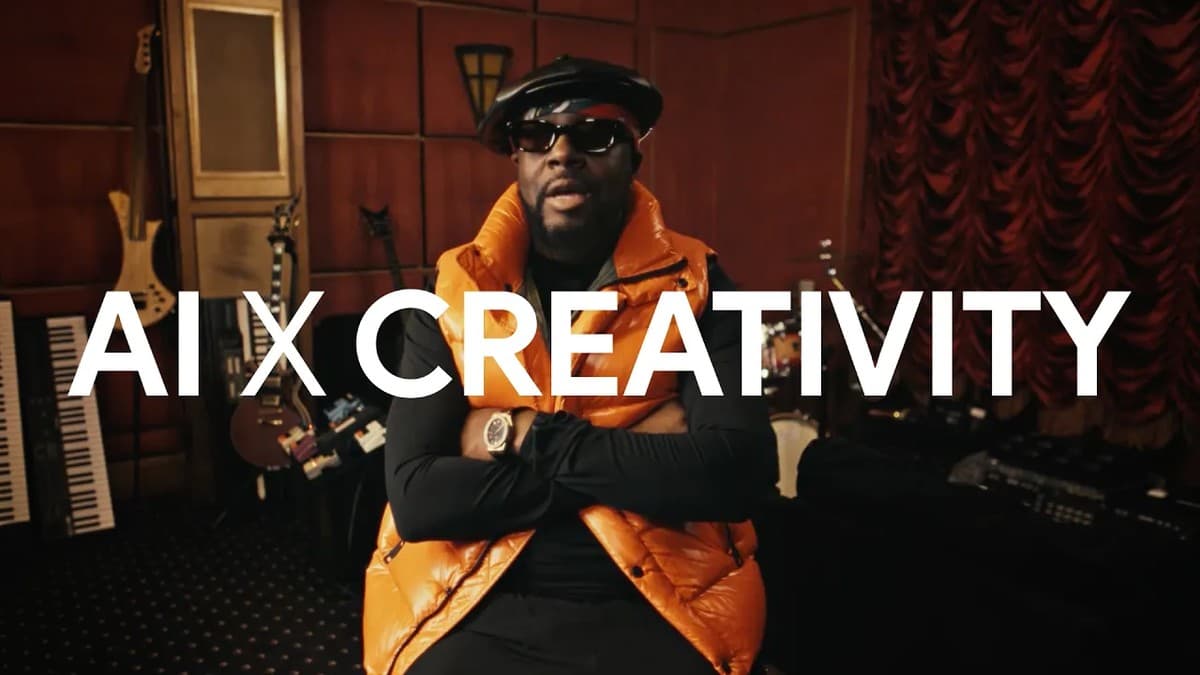
Google DeepMind recently published a promotional video featuring Grammy-winning producer Wyclef Jean and the company's Music AI Sandbox. In the video, Jean uses the tool to create a new track called "Back From Abu Dhabi," framing AI as just another instrument in the studio. He argues that human creativity and soul remain irreplaceable while AI provides infinite sonic possibilities. As a Google-funded piece, the video tells only one side of a much larger debate about AI's role in music.
Related reading:
The central claim
Wyclef Jean's argument is straightforward: AI is an enhancement tool, not a threat. "You're in the era where the human has to be the most creative," he says at the top of the video. In his framing, AI raises the bar for human artistry rather than replacing it.
Humans bring the soul, AI brings the information. As Jean puts it: "There's one thing that you have over the AI, a soul." And the AI? Infinite information. "The combination of both is invincible."
How it works in practice
The video shows Jean and his team using Music AI Sandbox during the production of "Back From Abu Dhabi." A DeepMind team member explains that the tool lets musicians generate different samples (short audio clips reused in new music). They can also upload their own clips and extend or edit them in new ways.
Jean describes hearing a flute in his head and using the tool to bring that vision to life. "The orchestra lives in your head," he explains. The first outputs were abstract, not ready to drop into a track. But that was the point. "We treat it like samples. We like to cut our own and make it our own," he says. In this workflow, AI-generated sounds are raw material to be shaped by human hands.
The DeepMind team member reinforces this idea, noting that the process involves careful curation (selecting the best elements from a large set of options). The process doesn't mean clicking a button 100 times and calling it done. It means going through the outputs, picking what works, and getting back to creating.
Jean summarizes it simply: "It becomes like an instrument on its own."
Opposing perspectives
Session musicians and lost work
The video does not address one of the most pressing concerns in the AI music debate: what happens to session musicians? If a producer can generate a flute part with AI instead of hiring a flutist, that is work that disappears. The American Federation of Musicians and similar organizations have raised alarms about AI tools displacing professional instrumentalists. Jean's framing of AI as "just an instrument" sidesteps this entirely.
Copyright and training data
Music AI Sandbox is powered by Lyria, Google's AI model for music generation. Like all generative AI (AI that creates new content based on patterns learned from training data), Lyria was trained on existing music. Whether AI-generated sounds count as derivative works, and who owns the output, remains unresolved across the industry. Google applies SynthID watermarking (invisible digital markers) to content generated by its tools, but watermarking does not solve the underlying ownership question.
How to interpret these claims
This video was produced and published by Google DeepMind on their official YouTube channel. That context matters. Several factors deserve consideration before taking the message at face value.
Commercial framing
Wyclef Jean is presented as a collaborator with DeepMind, not an independent reviewer. The video does not disclose the financial terms of this partnership, but it functions as a product endorsement. Celebrity testimonials are a standard marketing strategy, and this follows that pattern closely. A Grammy-winning producer calling the product great carries significant weight, especially when the format does not include tough questions.
Cherry-picked workflow
The video shows a single successful use case: Jean asking for a flute sound, getting useful outputs, and shaping them into a finished track. What it does not show is how many outputs were unusable, how long the process actually took, or whether a skilled session musician could have delivered something better in less time. Promotional content naturally highlights the wins and skips the friction.
Missing voices
No one in this video represents the concerns of working musicians, copyright holders, or independent artists who compete with AI-generated content. A balanced picture would include those perspectives. Their absence does not invalidate Jean's experience, but it limits what conclusions can be drawn from it.
Practical implications
For music producers
Tools like Music AI Sandbox offer a new way to explore sounds quickly. Treating AI outputs as raw samples, as Jean describes, is a practical approach that keeps the producer in creative control. Producers interested in experimenting can explore the Music AI Sandbox through Google DeepMind's website.
For the broader music industry
The larger question is not whether individual artists benefit from AI tools. Some clearly do. The question is what happens at scale when thousands of producers can generate instrumental parts without hiring musicians. That structural shift is what industry organizations, labels, and policymakers will need to address, regardless of how positively any single artist frames the technology.
Glossary
| Term | Definition |
|---|---|
| Music AI Sandbox | Google's tool suite that lets musicians generate, edit, and extend audio clips using AI. |
| Sample | A short audio clip taken from one source and reused in new music. A core technique in hip-hop and electronic music production. |
| Curation | The process of selecting the best elements from a large set of options. In this context, picking the most useful AI-generated sounds. |
| Generative AI | AI that creates new content (text, images, audio) based on patterns learned from training data. |
| Lyria | Google's AI model designed specifically for music generation. Powers the Music AI Sandbox. |
| SynthID | Google's technology for embedding invisible watermarks in AI-generated content, making it possible to identify machine-made media. |
| Sound design | The craft of creating and shaping sounds for music, film, or other media. |
Sources and resources
Want to go deeper? Watch the full video on YouTube →