Tesla's Cybercab Has No Steering Wheel, or Safety Approval
Key insights
- Tesla appears to be betting that political influence will replace the normal regulatory process, setting a precedent that affects every autonomous vehicle company
- The gap between NHTSA's 2,500-vehicle exemption limit and Musk's target of 2 million per year reveals how far the industry has pushed ahead of the legal framework
- Without manual controls, a Cybercab breakdown means calling a tow truck, not pulling over. That is a fundamentally different safety model than anything currently on US roads
This is an AI-generated summary. The source video may include demos, visuals and additional context.
In Brief
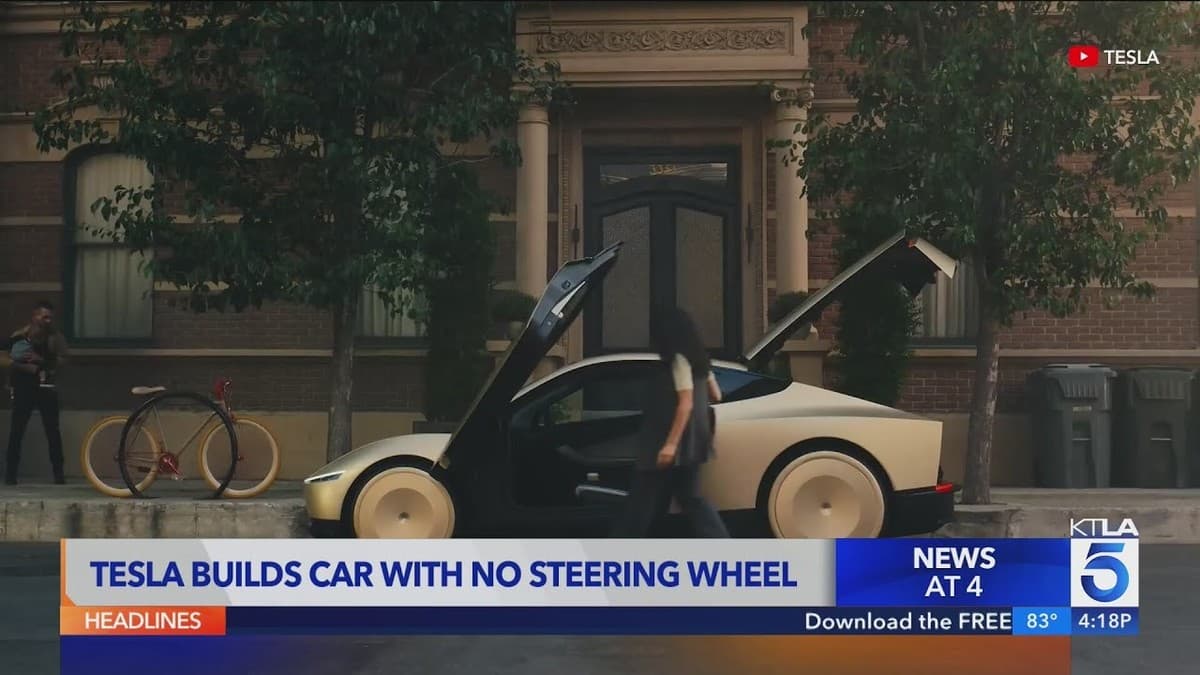
Tesla is already producing the Cybercab, a two-seat autonomous vehicle with no pedals, no steering wheel, and no side mirrors. The company plans to begin mass production in April 2026 and eventually sell 2 million units per year. But federal safety rules don't allow cars without basic manual controls, and according to the Wall Street Journal, Tesla has not applied for the regulatory exemption it would need. KTLA 5 consumer reporter David Lazarus argues this raises serious questions about whether Tesla is counting on political connections rather than the normal approval process.
Related reading:
The central claim
Lazarus frames the Cybercab as a vehicle that already exists in production but cannot legally be sold. Tesla rolled its first Cybercab unit off the line at Gigafactory Texas on February 17, 2026, and plans to begin mass production next month. The core tension: the car is being built before the rules exist to allow it on the road.
The Cybercab is designed to be the heart of a new Tesla ride-hailing service, a competitor to Uber and Lyft. Tesla also plans to sell it directly to taxi fleet operators and individual buyers. Tesla's chief executive Elon Musk has said the price will be under $30,000.
The regulatory gap
Federal Motor Vehicle Safety Standards (FMVSS), the rules that every car sold in the US must meet, require basic manual controls like pedals, a steering wheel, and side mirrors. The Cybercab has none of these.
The National Highway Traffic Safety Administration (NHTSA) can grant exemptions to these rules, but even a full exemption caps sales at 2,500 vehicles per year. That is a fraction of what Tesla needs. Musk has publicly stated his goal of selling 2 million Cybercabs annually.
| Target | Number | Context |
|---|---|---|
| NHTSA exemption limit | 2,500/year | Maximum vehicles allowed under a safety exemption |
| Musk's sales target | 2,000,000/year | 800 times the exemption limit |
| Planned price | Under $30,000 | Comparable to a mid-range sedan |
No application, no exemption
According to the Wall Street Journal, Tesla has not applied for an exemption. Production is already underway and sales are described as being "around the corner." Lazarus suggests this indicates Tesla may be planning to push through the safety rules rather than work within them. Musk's significant ties to the federal government make that a real possibility.
Opposing perspectives
Innovation requires new rules
Supporters of autonomous vehicles argue that FMVSS was written for human-driven cars and is overdue for an update. A steering wheel requirement makes little sense for a vehicle designed never to have a human driver. Waymo already operates fully driverless vehicles in several US cities, and NHTSA held its first National AV Safety Forum on March 10, 2026, with Tesla, Waymo, Zoox, and Aurora in attendance. The regulatory framework may simply be catching up to what the technology already allows.
Tesla chair Robyn Denholm has also indicated that the Cybercab could be fitted with a steering wheel and pedals if regulations ultimately require them. A Cybercab was recently spotted with federal compliance stickers, suggesting Tesla believes it can meet FMVSS requirements without needing an exemption.
Safety is not optional
Critics counter that the absence of manual controls creates risks that no amount of software can fully eliminate. If a Cybercab's autonomous system fails or encounters a scenario it cannot handle, only a tow truck can get it moving again. There is no option for a passenger to take over. For comparison, commercial aircraft have autopilot systems, but they still carry trained pilots who can intervene.
The question is not whether autonomous vehicles should eventually be allowed without steering wheels. It is whether one company should be permitted to skip the approval process that exists specifically to answer that question.
How to interpret these claims
Lazarus raises important points, but several pieces of context help fill in the picture.
A short segment, not an investigation
This is a three-minute TV news segment, not a deep regulatory analysis. It correctly identifies the core tension between FMVSS rules and the Cybercab's design but does not explore the details of how NHTSA might update those rules or what alternative compliance paths Tesla could pursue.
The political angle is real but uncertain
The segment implies that Musk's political influence could lead to special treatment. This is a reasonable concern given Musk's public role as a government contractor. However, whether that translates into an actual rule change, a broader FMVSS reform, or nothing at all remains speculation. Regulatory processes tend to move slowly, regardless of political pressure.
Waymo sets a partial precedent
Waymo already operates vehicles without steering wheels in limited deployments, though it has worked within NHTSA's existing exemption framework to do so. Tesla's apparent strategy of building first and seeking approval later is genuinely different from how other companies have approached the same problem.
What would make this clearer
Stronger evidence would include Tesla's actual regulatory filings (or confirmed lack thereof), NHTSA's stated position on Cybercab compliance, and independent safety data from the vehicle's testing program. Until those are public, much of the discussion remains informed speculation.
Practical implications
For potential buyers
The Cybercab is being produced, but nobody should plan to buy one until it has federal approval for sale. The under-$30,000 price point is a claim from Musk, not a confirmed retail price. Watch for NHTSA announcements rather than Tesla marketing timelines.
For the autonomous vehicle industry
How Tesla's regulatory approach plays out will set precedent for every company building autonomous vehicles. If Tesla succeeds in bypassing the exemption process, other manufacturers will face pressure to do the same. If regulators hold firm, it signals that FMVSS reform will happen through the standard rulemaking process, not through political shortcuts.
Glossary
| Term | Definition |
|---|---|
| Autonomous vehicle (AV) | A vehicle that can drive itself without human input, using sensors, cameras, and software to navigate. |
| Cybercab | Tesla's autonomous robotaxi. A two-seat vehicle with no steering wheel, pedals, or side mirrors, designed for ride-hailing. |
| NHTSA | National Highway Traffic Safety Administration. The US federal agency that sets and enforces vehicle safety standards. |
| FMVSS | Federal Motor Vehicle Safety Standards. The rules every car sold in the US must comply with, covering everything from brakes to mirrors. |
| Exemption | A special permission from NHTSA that allows a manufacturer to sell vehicles that don't meet one or more FMVSS requirements. Capped at 2,500 vehicles per year. |
| Ride-hailing | A service where passengers request a car through an app, like Uber or Lyft. Tesla plans to run its own ride-hailing network using Cybercabs. |
| Gigafactory | Tesla's term for its large-scale manufacturing facilities. The Cybercab is being produced at Gigafactory Texas in Austin. |
Sources and resources
- KTLA 5 — Tesla now has a car with no steering wheel (YouTube)
- KTLA 5 — Tesla's new Cybercab has no steering wheel, and that's a problem
- Tesla Robotaxi (official page)
- Electrek — Tesla rolls first Cybercab off the line (Feb 2026)
- Robb Report — Tesla Cybercab not street legal
- Wikipedia — Tesla Cybercab
Want to go deeper? Watch the full video on YouTube →