LEGO Smart Play: The Brick That Plays Back
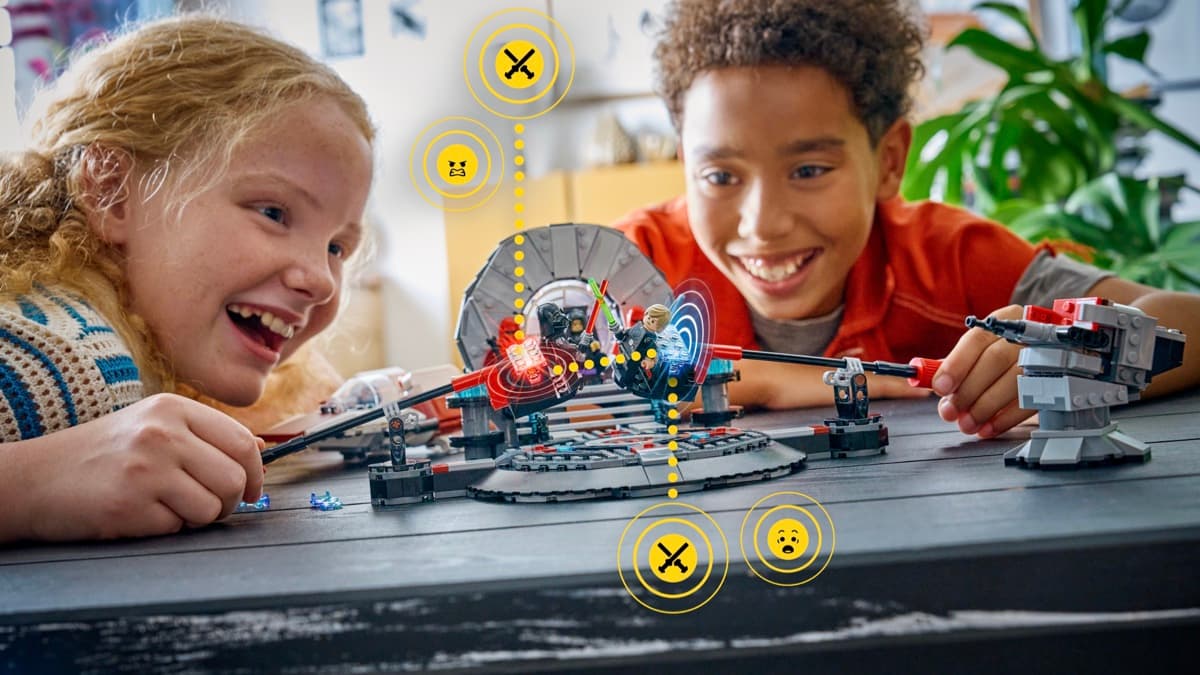
This article was last updated on March 15, 2026. Details such as availability, set selection, pricing, and app languages may have changed since publication.
In Brief
LEGO calls Smart Play its biggest innovation since the minifigure was introduced in 1978. The system is built around a SMART Brick, a piece that looks like a regular 2x4 LEGO brick but is packed with sensors, a speaker, and a custom-designed computer chip. When kids build with it, the brick responds to their movements with lights and sounds. No app, no tablet, no screen required. The first wave launched on March 1, 2026 with eight Star Wars sets across six countries, priced from $39.99 to $159.99.
Related reading:
What is LEGO Smart Play?
LEGO Smart Play is a new platform that adds sound, light, and interactivity to regular LEGO building. The idea is simple: you build something, and it plays back. Fly a spaceship through the air and it makes engine sounds. Tilt it sideways and you hear an alarm. Place a minifigure near it and the character reacts with its own personality.
The system has three parts that work together:
The SMART Brick is the brain. It looks like a normal 2x4 LEGO brick, but inside it has a tiny computer chip, a speaker, an accelerometer (a sensor that detects movement), and LED lights. It knows when you tilt it, shake it, or tap it, and responds with matching sounds and light effects.
SMART Brick. Source: LEGO Smart Play.
SMART Tags are small flat tiles, each carrying a unique digital identity. When you place a SMART Tag near a SMART Brick, the tag tells the brick what to become. A helicopter tag makes it sound like a helicopter. A speeder tag makes it sound like a speeder. Think of the tag as an instruction card that the brick reads automatically.
SMART Tag. Source: LEGO Smart Play.
SMART Minifigures look identical to regular LEGO minifigures on the outside. But each one has a tiny chip inside that gives it a unique personality. Place a brave character next to the SMART Brick and you hear confident sounds. Place a nervous character and the reactions are more hesitant. The minifigures do not make sounds themselves. They trigger the SMART Brick's speaker.
SMART Minifigure. Source: LEGO Smart Play.
How the technology works
A custom chip smaller than a LEGO stud
LEGO could have used off-the-shelf computer chips. That would have been faster and cheaper. Instead, they spent roughly a decade designing a custom ASIC chip. ASIC stands for Application-Specific Integrated Circuit, which means a chip built to do one specific job very well. The chip measures just 4.1 mm, smaller than a single LEGO stud. It runs what LEGO calls a "Play Engine," the software that decides how the brick should respond to each situation.
Building a custom chip was risky. LEGO describes it as "the boldest decision possible." But it gives them complete control over what the brick can do. Because the chip runs software, LEGO can update it with new features over time, similar to how your phone gets updates.
The three SMART components side by side: a SMART Minifigure, a transparent SMART Brick revealing the custom ASIC chip and electronics inside, and two SMART Tags. Source: Jay's Brick Blog.
Sensors that detect everything
The SMART Brick is loaded with sensors. The accelerometer picks up movement: tilting, shaking, spinning, tapping. Light sensors and a color-recognition scanner detect changes in the environment around the brick. A microphone works as a virtual button, responding to blowing or tapping sounds. It does not record audio.
A positioning system that nearly did not happen
One of the most ambitious pieces of technology in the SMART Brick is its positioning system, which LEGO calls Neighbour Position Measurement (NPM). Using precision copper coils, the brick knows exactly where every nearby SMART Tag and SMART Minifigure is located. These are the same coils used for wireless charging, serving double duty.
LEGO engineers worked on this system for years without success. They eventually set a deadline: if it did not work by that date, they would scrap it entirely. On the morning of the deadline, the team agreed to give up. That afternoon, someone tried one final adjustment. It worked. LEGO filed more than 25 patents across the platform, many related to this positioning system.
Sounds built from scratch, not from a library
Most electronic toys play pre-recorded sound clips. The SMART Brick does something different. It has a built-in synthesizer, a component that generates sounds in real time by combining basic sound principles. LEGO breaks down a few core sounds into their fundamental parts, then adjusts frequency and volume to create wildly different results. The same underlying sound can produce a plane engine roar or a toilet flush, depending on how the parameters are tuned.
This approach means there is no practical limit to the sounds a SMART Brick can produce. Future SMART Tags could unlock entirely new sound categories without any hardware changes.
Bricks that talk to each other
When multiple SMART Bricks are in the same play area, they communicate using a wireless mesh protocol called BrickNet. This is based on Bluetooth and lets bricks detect each other's position and orientation without needing an app or central hub. If a child builds two vehicles and flies them toward each other, the bricks know it and can react.
How it was built
The SMART Brick did not appear overnight. LEGO spent roughly a decade getting from idea to product, starting around 2016. Research in 2017 told them that kids wanted three things from toys: something that could interact like a friend, play that responded to their actions, and experiences that evolved over time.
To figure out what the brick should do, the team built hundreds of prototypes. They tried adding interactivity to practically every type of LEGO set in the portfolio, testing which play patterns worked and which did not. This testing phase took months of back-and-forth between play designers and engineers.
The first working brick
When the first custom ASIC chip arrived from manufacturing, it was around 1 p.m. The team planned to do a quick test. Instead, they kept going. By 2:30 a.m. the next morning, they had a fully assembled brick with working audio. The first SMART Brick was born. "Much pizza was had by all," LEGO writes.
Less scripting, more play
LEGO chose Star Wars for the launch because kids already know the characters, which makes it easier to jump into a new system. But there was another discovery during testing. Early versions of the battle play feature were heavily scripted, with lots of specific things kids could do. Kids enjoyed it briefly. When LEGO made the battles simpler and less scripted, kids played longer and with more creativity. The lesson: the less LEGO defined, the more kids explored on their own.
The production line for the SMART Brick alone stretches as long as seven school buses, with around 160 workstations. LEGO describes it as a level of tech production they have never attempted before.
No screens by design
No screen needed. A child plays with 75422 Yoda's Hut and Jedi Training, one of the eight Smart Play launch sets. Source: LEGO Smart Play Star Wars, Nuremberg Toy Fair.
In a world where most interactive toys come with a companion app, LEGO made a deliberate decision to keep screens out of children's hands. The Smart Play system does not require a phone, tablet, or any screen to work. Kids pick up the bricks and start playing.
LEGO did experiment with cameras during development. The cameras could have triggered reactions based on what the brick "saw." But that approach would have required a smart device nearby, pulling attention away from physical building. They rejected it.
There is an app called LEGO SMART Assist, but it is only for parents. It handles setup, firmware updates, battery monitoring, and volume control. The app only connects to the SMART Brick while it is charging, so it never interrupts play. As LEGO puts it: "It's an app for grown-ups, so that kids can keep on playing."
The app is free for iOS and Android, but currently only supports four languages: English, Japanese, Korean, and Traditional Chinese. Notably missing are French, German, and Polish, despite these being launch countries.
What sets are available
All eight launch sets are Star Wars themed. There are two types of sets:
All-In-One sets include everything needed to start: a SMART Brick, SMART Charger, SMART Tags, and SMART Minifigures. These are the entry point.
Compatible sets include SMART Tags and SMART Minifigures but no SMART Brick. They work as regular LEGO sets on their own and unlock interactive features when combined with a SMART Brick from an All-In-One set.
All-In-One sets
Images: LEGO Smart Play.
75421 Darth Vader's TIE Fighter: $69.99, 473 pieces, ages 8+ SMART Minifigure: Darth Vader. SMART Tag: TIE Fighter. The twin ion engines roar to life, and you can attack a Rebel outpost with laser shooters, dodge return fire, and repair at the Imperial fuel station.
75423 Luke's Red Five X-Wing: $89.99, 581 pieces, ages 6+ SMART Minifigures: Luke Skywalker, Princess Leia. SMART Tags: X-wing, Imperial turret, transporter, command center, R2-D2 accessories. Engine sounds, laser fire, radar scanning, and ship repairs across multiple play stations.
75427 Throne Room Duel & A-Wing: $159.99, 962 pieces, ages 9+ SMART Minifigures: Luke Skywalker, Darth Vader, Emperor Palpatine. SMART Tags: A-wing, throne, Death Star turret, Lightsaber duels (2 tags). Lightsaber hums during duels, and The Imperial March plays when Palpatine sits on his throne. Includes 2 SMART Bricks.
Compatible sets
75420 Luke's Landspeeder: $39.99, 215 pieces, ages 6+ SMART Minifigure: Luke Skywalker. SMART Tag: Luke's Landspeeder. Refueling, repairs, and engine startup sounds at a Tatooine service station with a Jawa and Gonk Droid.
75422 Yoda's Hut and Jedi Training: $69.99, 440 pieces, ages 8+ SMART Minifigures: Yoda, Luke Skywalker. SMART Tags: Force training, cooking. Motion-activated cooking sounds and slurps, Jedi balance training, and resting in a brick-built bed on Dagobah. Includes R2-D2.
75424 AT-ST Attack on Endor: $49.99, 347 pieces, ages 8+ SMART Minifigure: Wicket. SMART Tags: AT-ST, Speeder Bike. AT-ST walking sounds, engine noises, laser battles, and a speeder chase through the forests of Endor.
75425 Mos Eisley Cantina: $79.99, 666 pieces, ages 8+ SMART Minifigures: Obi-Wan Kenobi, Greedo. SMART Tags: Dewback, karaoke, drink mixing. Sing karaoke with Greedo and the band, mix drinks at the bar, eject unwelcome guests, and ride the Dewback.
75426 Millennium Falcon: $99.99, 885 pieces, ages 9+ SMART Minifigures: Han Solo, Chewbacca, C-3PO, Luke Skywalker. SMART Tags: Millennium Falcon, Hyperspace, Lightsaber, fuel container. Jump to lightspeed, play holochess, practice Lightsaber skills, and shoot lasers from the stud shooters.
All SMART components work with any LEGO bricks ever made. You can snap a SMART Brick onto a 20-year-old LEGO set and it will still respond to movement with sounds and lights.
Where to buy
Smart Play launched March 1, 2026 in six countries: the United States, the United Kingdom, France, Germany, Poland, and Australia. Notably, Denmark, LEGO's home country, is not included in the initial launch. Sets are available on LEGO.com in these markets. LEGO has not announced a timeline for expansion to other countries.
Common misconceptions
"Kids need an app to play"
No. The SMART Assist app is for parents only, and it handles behind-the-scenes tasks like firmware updates and battery checks. Children never need to touch a phone or tablet. The app only connects to the brick during charging, not during play.
"It only works with Smart Play sets"
SMART Bricks, SMART Tags, and SMART Minifigures click onto any LEGO bricks ever manufactured. The stud-and-tube system has not changed. You need a Smart Play set to get the SMART components, but once you have them, they work with your entire LEGO collection.
"It is just a brick that makes noise"
The SMART Brick does far more than play sounds. It detects motion, orientation, nearby tags and minifigures, changes in nearby light, and can communicate with other SMART Bricks wirelessly. The sounds themselves are generated in real time by a synthesizer, not played from a fixed library. This means the brick can produce different reactions to the same action depending on context, which tag is active, which minifigure is nearby, and how the brick is being moved.
What this means for you
For parents
The screen-free approach is the headline feature for families. Smart Play adds interactivity without requiring device management, app permissions, or screen-time negotiations. The battery lasts about 45 minutes per charge with a roughly 2-hour recharge time via wireless charging pad. The app is optional for basic play, but needed for firmware updates that unlock new features over time.
For LEGO collectors and fans
Every SMART component uses the standard LEGO stud system. Nothing breaks compatibility with existing sets. For collectors, the SMART Minifigures are interesting because they look identical to regular minifigures but contain embedded chips. The Compatible sets work as standard LEGO builds even without a SMART Brick, so they hold their value as display pieces regardless of the technology.
The six-country launch means fans in most of the world cannot buy these sets yet. LEGO knows people want it but hasn't said when more countries will follow.
Building instructions
LEGO provides free building instructions for all Smart Play sets as downloadable PDFs. Each set is split into multiple booklets, one per building stage. You can find them on the LEGO building instructions page by searching for the set number, or use the direct links below.
All-In-One sets
| Set | Instructions |
|---|---|
| 75421 Darth Vader's TIE Fighter | Bags 1-4, Bag 5 |
| 75423 Luke's Red Five X-Wing | Part 1, Part 2, Part 3, Part 4, Part 5 |
| 75427 Throne Room Duel & A-Wing | Bags 1-2, Bags 3-5, Bag 6, Bags 7-9 |
Compatible sets
| Set | Instructions |
|---|---|
| 75420 Luke's Landspeeder | Bag 1, Bag 2 |
| 75422 Yoda's Hut and Jedi Training | Bags 1-2, Bags 3-4 |
| 75424 AT-ST Attack on Endor | Bag 1, Bags 2-4 |
| 75425 Mos Eisley Cantina | Bag 1, Bag 2, Bag 3, Bag 4, Bag 5 |
| 75426 Millennium Falcon | All instructions |
Glossary
| Term | Definition |
|---|---|
| SMART Brick | A 2x4 LEGO brick with built-in sensors, speaker, lights, and a custom computer chip. The central piece of the Smart Play system. |
| SMART Tag | A flat tile with a digital identity that tells a nearby SMART Brick what to "become" (helicopter, speeder, etc.). |
| SMART Minifigure | A LEGO minifigure with an embedded chip that gives it a unique personality when placed near a SMART Brick. |
| ASIC (Application-Specific Integrated Circuit) | A computer chip designed to do one specific job very well, as opposed to a general-purpose processor. |
| Accelerometer | A sensor that detects movement, tilt, and orientation. The same type of sensor that rotates your phone screen when you turn it sideways. |
| Synthesizer | An electronic component that creates sounds in real time by combining basic sound properties, rather than playing pre-recorded clips. |
| BrickNet | LEGO's Bluetooth-based mesh protocol that lets multiple SMART Bricks communicate with each other without an app or hub. |
| NPM (Neighbour Position Measurement) | LEGO's proprietary positioning system using copper coils to detect the exact location of nearby SMART Tags and Minifigures. |
| Firmware | Software built into a device that controls how it works. Can be updated, similar to app updates on a phone. |
| Mesh network | A network where devices communicate directly with each other without needing a central control point. |
Sources and resources
- LEGO Smart Play (official landing page, FAQ, and product listings)
- LEGO Smart Play Innovation Story (development history and technology decisions)
- LEGO Smart Play Announcement, CES 2026 (official press release)
- LEGO Smart Play Star Wars, Nuremberg Toy Fair (Compatible sets press release)
- Jay's Brick Blog: LEGO Unveils the SMART Brick (battery specs, technical details)
- Jay's Brick Blog: Only Available in 6 Countries (availability analysis)
- Dezeen: LEGO Smart Play Brick at CES 2026 (CES 2026 coverage)
- Hackster.io: The LEGO Smart Brick Is Here (technical overview)