AI Can Help Kids Learn, But Only If It Makes Them Think
Key insights
- One in five children reportedly use AI to do all their homework, turning a learning tool into an avoidance tool.
- The neuroscience behind productive struggle is well-established, but Lakhani's leap from brain science to her specific product lacks independent validation.
- The real question is not whether AI belongs in classrooms, but whether anyone can build AI that students willingly struggle with instead of bypassing.
This is an AI-generated summary. The source video may include demos, visuals and additional context.
In Brief
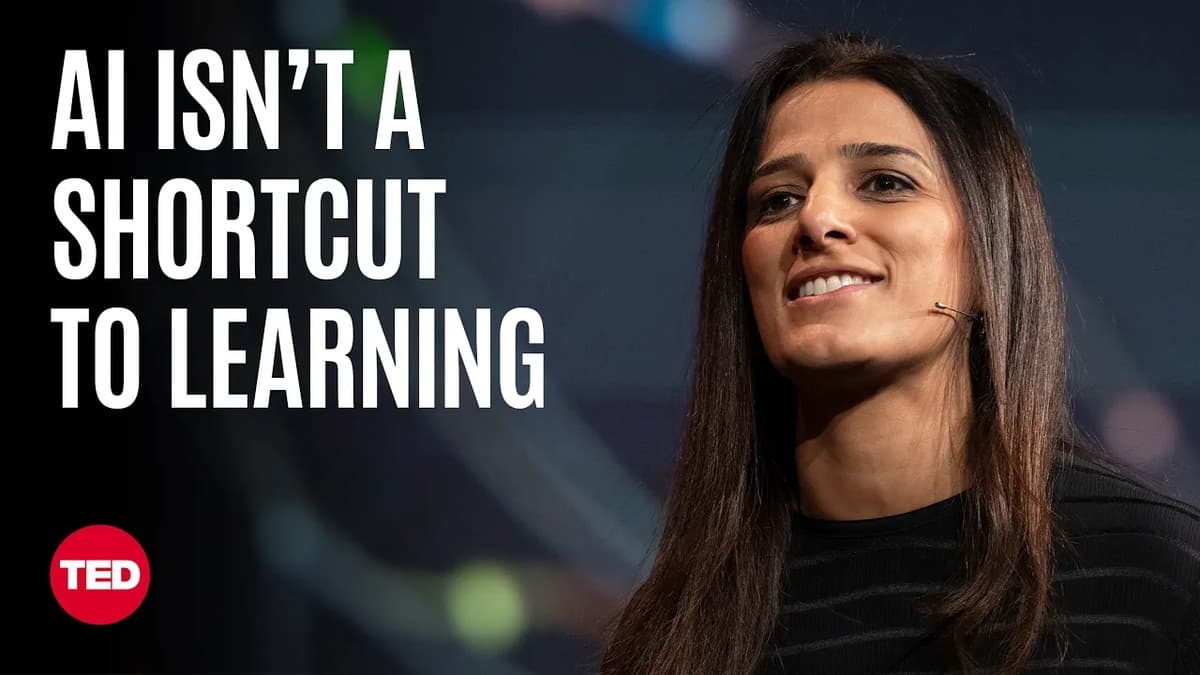
Priya Lakhani, founder of Century Tech and UK AI Council member, argues in a TEDNext 2025 talk that AI in education is failing students. It lets them skip the mental effort that makes learning stick. She points to surveys showing one in five children use AI to do all their homework, and presents neuroscience research suggesting that "productive struggle" is what actually builds understanding. Her proposed solution: AI designed to force retrieval, spacing, and self-generated answers rather than handing over polished responses. The argument is compelling, but Lakhani also runs the company selling exactly that kind of AI.
Related reading:
The case against easy answers
Lakhani opens with a blunt picture of education in crisis. She claims that 20 percent of students leave secondary schools in the UK unable to read and write well enough, and that 74 percent of teachers want to quit within three years because of workload. Teachers, she argues, have become "data analysts by night," buried in micro-marking and assessment tasks that leave no room for actual teaching.
Into this already strained system, she says, comes a new problem. A recent survey found that a fifth of children admitted they use AI to do all of their work, not to help them learn, but to avoid learning entirely. Lakhani frames this as the predictable result of giving students tools optimized for fluency rather than understanding.
The core of her argument rests on what researchers call the "illusion of competence," the tendency to mistake a polished AI-generated answer for actual knowledge. When a chatbot produces a well-structured response, it feels like learning. But Lakhani argues that real learning requires "productive struggle", the kind of mental effort that feels harder in the moment but creates deeper understanding.
Four techniques that force the brain to work
Lakhani presents four evidence-based learning techniques, all of which share one feature: they are harder than passive reading.
| Technique | How it works | Why it matters |
|---|---|---|
| Retrieval practice | Recalling information from memory instead of re-reading it | Students who read a passage once and then tried to recall it remembered more than those who re-read it multiple times |
| Spaced repetition | Spreading learning sessions over time instead of cramming | Forces repeated productive struggle, strengthening memory with each cycle |
| Generation effect | Producing answers yourself, even if wrong at first | Creating an answer builds a stronger memory trace than receiving one |
| Reflection | Structured self-assessment: Where am I? What's my goal? What are the gaps? | Turns passive consumption into active evaluation of one's own understanding |
To illustrate why effort matters, she points to London taxi drivers. They must memorize 26,000 streets to pass a test called "The Knowledge." Neuroscientists scanned their brains and found that parts of the hippocampus, the brain region for spatial memory, were physically larger in experienced drivers. The brain literally grew from sustained mental effort.
The analogy is vivid, but it is also carefully chosen. Taxi drivers cannot use GPS on the job. The struggle is mandatory. The open question for education is whether students, who can always switch tabs to ChatGPT, will accept struggle when an easier option exists.
What well-designed AI could do
Lakhani argues that AI built on these learning principles could transform education rather than undermine it. Her vision: AI that spots patterns in how each student learns and predicts when they are about to forget something. It would resurface material at the right time, force students to generate answers instead of revealing them, and provide structured feedback against teacher-designed rubrics.
She points to Century Tech, her own platform used in over 140 countries, as proof this approach works. The platform has collected over 40 billion data points on how children learn, she says, and the results show improved outcomes.
Her broader argument goes beyond classrooms. She notes that AI breakthroughs in drug discovery and protein folding did not happen with AI working alone. Humans framed the questions, chose the datasets, and decided which discoveries mattered. Knowledge is not trivia, she argues, but "the raw material of thinking and discovery." She closes with a simple point. "You do not get the growth unless you go through the struggle."
Opposing perspectives
The access argument
Not everyone agrees that making learning harder is the right priority. Critics of the productive struggle framework point out that millions of students worldwide lack access to basic educational resources. For these students, AI that provides clear, immediate answers could be more valuable than AI that deliberately withholds them. The debate is not just about pedagogy; it is about who gets to struggle productively and who simply struggles.
The motivation problem
Lakhani's student feedback illustrates a tension her framework does not fully resolve. One student wrote: "I don't like this website, it makes me able to do my homework." Another offered a bribe of 100,000 pounds for a button that does the work. If students actively resist productive struggle when given the choice, the best-designed AI in the world may not matter. The question of motivation, why a student would choose the harder path, receives less attention in the talk than the neuroscience of why the harder path works.
How to interpret these claims
Lakhani presents a persuasive case, but several factors deserve consideration before accepting the conclusions at face value.
Conflict of interest
The most important context is one Lakhani mentions openly but does not dwell on: she is the founder and chief executive of Century Tech, the company that sells the AI education platform she describes. The talk is, in effect, a pitch for a product category she dominates. Her claims may well be right. But the audience should know they are hearing from someone with a financial stake in the answer.
Evidence quality
The neuroscience Lakhani cites, retrieval practice, spaced repetition, the generation effect, and the London taxi driver hippocampus study, is well-established in learning science research. These are not controversial claims among cognitive scientists. However, the leap from "these learning techniques work" to "our AI platform successfully implements them at scale" is a much larger claim. Lakhani offers her platform's 40 billion data points and presence in 140 countries as evidence, but does not cite independent studies or controlled trials comparing Century Tech to alternative approaches.
What stronger evidence would look like
To move beyond a compelling TED talk, independent researchers would need to conduct randomized controlled trials comparing Century Tech students to control groups. Long-term retention studies, not just immediate test scores, would show whether productive struggle via AI translates to durable knowledge. Transparent methodology around the 40 billion data points, what they measure and how outcomes are defined, would help outside experts evaluate the claims.
Practical implications
For parents and students
The core insight is useful regardless of what platform you use. When AI does your thinking for you, you feel productive but learn nothing. Try a simple test: after using AI for a task, close the chat and explain the answer in your own words. If you cannot, you have not learned it. The four techniques Lakhani describes, recall, spacing, self-generation, and reflection, work with or without specialized software.
For educators and policymakers
The talk highlights a real gap in how schools approach AI. Banning it does not work (students find workarounds), but unrestricted access creates the homework-avoidance problem Lakhani describes. The challenge is building systems and classroom norms that channel AI toward productive struggle rather than shortcuts. Whether Century Tech specifically is the answer is a separate question from whether the underlying principle is sound.
Glossary
| Term | Definition |
|---|---|
| Productive struggle | The mental effort required for deep learning. It feels harder in the moment but creates stronger, longer-lasting understanding. |
| Retrieval practice | Recalling information from memory rather than re-reading it. Strengthens long-term retention more effectively than passive review. |
| Spaced repetition | Spreading learning sessions over time instead of cramming everything into one sitting. Each return to the material forces another round of productive struggle. |
| Generation effect | The finding that producing an answer yourself, even an incorrect one, creates a stronger memory trace than passively receiving the correct answer. |
| Illusion of competence | Mistaking the fluency of an AI-generated or well-written answer for genuine understanding of the topic. |
| Hippocampus | A brain region responsible for spatial memory, navigation, and learning. Studies show it can physically grow in response to sustained mental effort. |
| EdTech | Educational technology. Software and platforms designed for teaching and learning. |
| LLM (Large Language Model) | AI systems like ChatGPT that generate human-like text by predicting the most likely next word in a sequence. |
Sources and resources
Want to go deeper? Watch the full video on YouTube →