OpenAI Shuts Down Sora as Disney Deal Dissolves
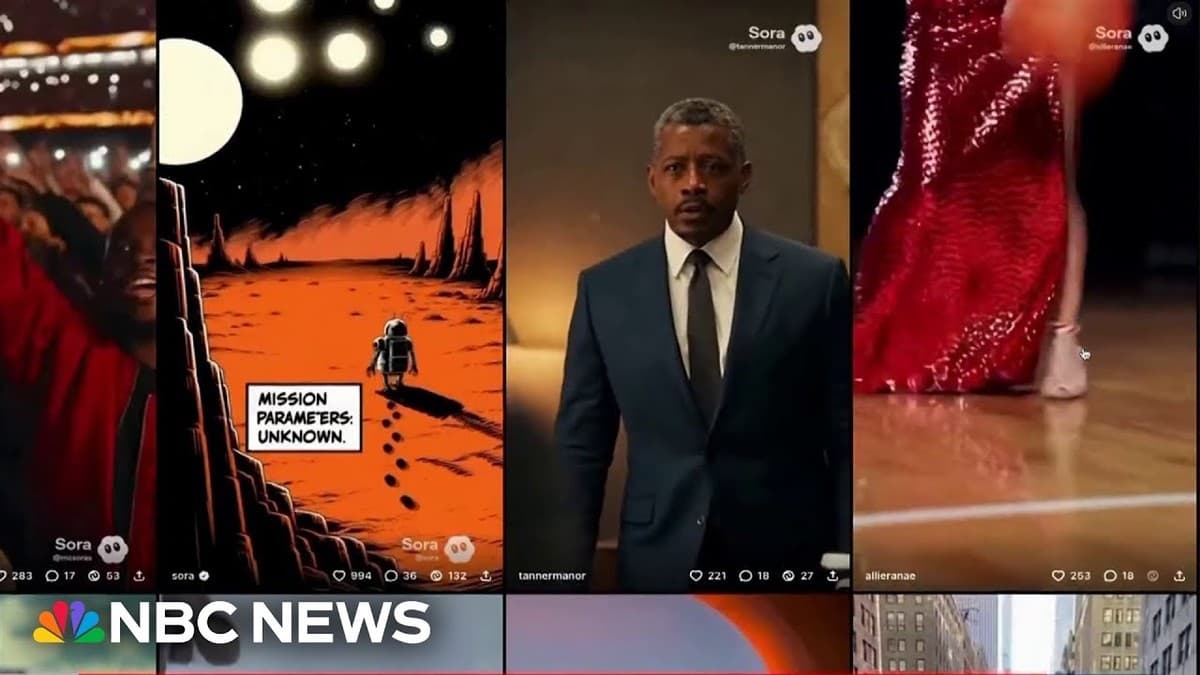
Key insights
- Sora lasted barely 15 months. Even a $1 billion Disney partnership wasn't enough to keep it alive, showing how fast AI products can rise and fall.
- OpenAI says it's refocusing compute on 'real world physical tasks,' a pivot toward robotics and embodied AI, and away from creative media tools.
- Anthropic chose from day one not to build image or video generators. OpenAI is now partly arriving at the same conclusion: different companies have fundamentally different views on what's worth building.
This is an AI-generated summary. The source video may include demos, visuals and additional context.
In Brief
OpenAI is shutting down Sora, its text-to-video platform, just over a year after it launched to the public in December 2024. The platform let users type a description and get a video clip back, generated entirely by AI. The shutdown also ends a partnership with The Walt Disney Company that had tied a $1 billion equity investment (a purchase of ownership shares) to Sora. Disney said it "appreciates the constructive collaboration" and respects OpenAI's decision, but what happens to that $1 billion investment remains unclear.
Sora's farewell message to users on X. Source: @soraofficialapp.
OpenAI says it decided to discontinue Sora as focus and compute demand grows, and that it wants to shift resources toward things that are real world physical tasks. Sam Altman is under significant pressure to make OpenAI profitable ahead of a planned public offering (selling shares on the stock market), and questions are being raised about whether Sora was simply not generating enough revenue.
Related reading:
A billion-dollar bet that didn't last
The Disney deal had seemed like a major vote of confidence in Sora. Disney had a $1 billion equity investment in OpenAI as a result of a partnership that would allow Disney characters (arguably the most recognizable library of fictional characters in the world) to be used inside the Sora platform.
That partnership was announced in December 2024, the same month Sora launched to the general public. Less than 15 months later, both the platform and the partnership are gone.
Disney's response to the Sora shutdown. Source: NBC News.
Disney said it respects the company's decision to close down that particular platform, but a Disney spokesperson gave no details on what happens to the investment. A $1 billion equity stake in OpenAI doesn't just disappear. The financial side will need to be resolved, though neither company has addressed it publicly.
Why did OpenAI pull the plug?
OpenAI's statement on shutting down Sora. Source: NBC News.
OpenAI's stated reason is that running Sora costs a lot of computing power, and the company wants to focus that computing power on other priorities. The anchor raised whether this was about profitability pressure, given that Sam Altman is trying to take OpenAI public and needs to show strong finances.
Computing power (often called "compute") is the underlying resource that all AI tools run on. It costs real money to generate AI videos: every clip requires significant processing. If those costs outpace the revenue from Sora subscriptions, the math doesn't work. OpenAI hasn't confirmed this directly, but the timing is suggestive.
OpenAI also said it is keeping its image-generation tools. The shutdown is specific to video. That's a meaningful distinction: images are cheaper to generate than videos, and the demand may be stronger.
Who's left in AI video?
With Sora gone, Google (with its video tool called Veo) and xAI's Grok are the main remaining players in AI video generation among the biggest AI companies.
Anthropic, the company behind Claude, is the notable exception on the other side. Anthropic has chosen from the get go to not do image or video generators. That was a deliberate strategic choice, not a technical limitation. OpenAI is now, at least partly, arriving at the same conclusion: video generation may not be where the real value is.
There's also a legal dimension. Deepfake pornography (AI-generated fake videos that make it look like a real person is doing or saying something they never did) has been a serious problem with AI video tools. The legal liability risk for platforms hosting such content is real and growing. That pressure may have factored into OpenAI's decision, even if it wasn't the primary stated reason.
Glossary
| Term | Definition |
|---|---|
| Text-to-video | An AI tool that creates a video clip from a written description. You type what you want to see, and the AI generates it. |
| Equity investment | Buying ownership shares in a company. Disney's $1 billion gave it partial ownership of OpenAI, tied to the Sora partnership. |
| Compute | Short for computing power: the processing resources AI models need to run. More complex AI tasks (like generating video) require significantly more compute than simpler ones. |
| Deepfake | An AI-generated fake video that makes it appear as though a real person is saying or doing something they never actually did. |
Sources and resources
Want to go deeper? Watch the full video on YouTube →