Andrew Ng Explains What AI Really Is
Key insights
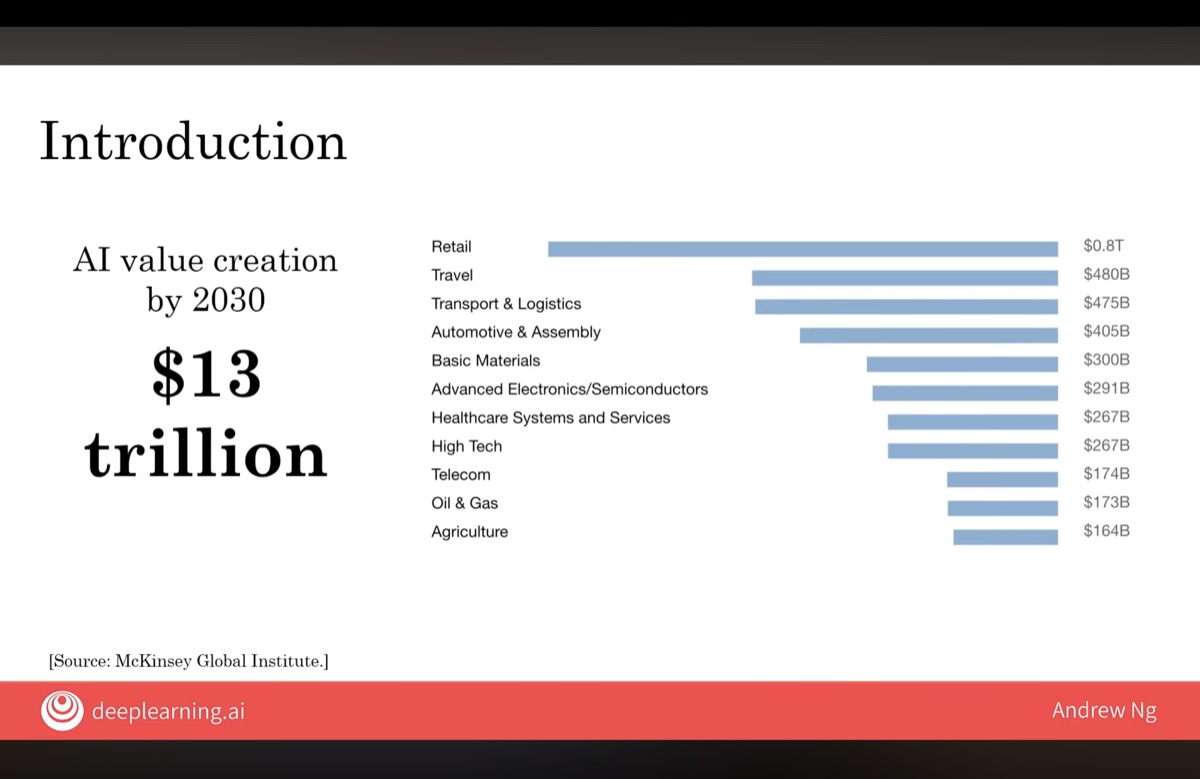
- McKinsey estimates AI will create $13 trillion in annual value by 2030, but most of that value lies outside the tech industry, in sectors like retail, manufacturing, and transportation.
- Almost all real AI progress is in narrow AI: systems that do one thing well. Progress toward AGI is nearly zero, and Ng says it may be decades, centuries, or even thousands of years away.
- Ng designed this course specifically for non-technical people: executives, managers, and anyone who works alongside AI teams. The goal is AI literacy, not coding skills.
This is an AI-generated summary. The source video may include demos, visuals and additional context.
In Brief
Andrew Ng, co-founder of DeepLearning.AI and part-time professor at Stanford University, has launched a free course called "AI for Everyone." It is designed not for engineers, but for the rest of us. In this opening lecture, Ng cuts through the hype by drawing a clear line between what AI can do today and what it cannot. His message: you don't need a technical degree to understand AI, and understanding it may be the most important professional skill of this decade.
Related reading:
The $13 trillion number
According to the McKinsey Global Institute, the research arm of consulting giant McKinsey, AI is expected to create an additional $13 trillion in annual value by 2030. That's a staggering number. But here's what makes it interesting: most of that value won't come from the tech industry. It will come from traditional sectors like retail, travel, transportation, automotive, and manufacturing.
Ng puts it directly: "I actually have a hard time thinking of an industry that I don't think AI will have a huge impact on in the next several years." His best counterexample was hairdressing. A robotics professor in his audience stood up and said most people's hairstyles would be hard for a robot to replicate. Then she looked at him and said, "Your hairstyle, Andrew, that a robot can do."
ANI vs AGI: the distinction that matters
A lot of public fear about AI comes from confusing two completely different things. Ng explains that "AI" is actually used to describe two separate ideas.
The first is artificial narrow intelligence (ANI). This is what almost all AI progress today actually is. ANI systems do one specific thing well: a smart speaker answers questions, a self-driving car navigates roads, an AI system filters spam. Ng calls these "one-trick ponies," but when you find the right trick, they can be extraordinarily useful.
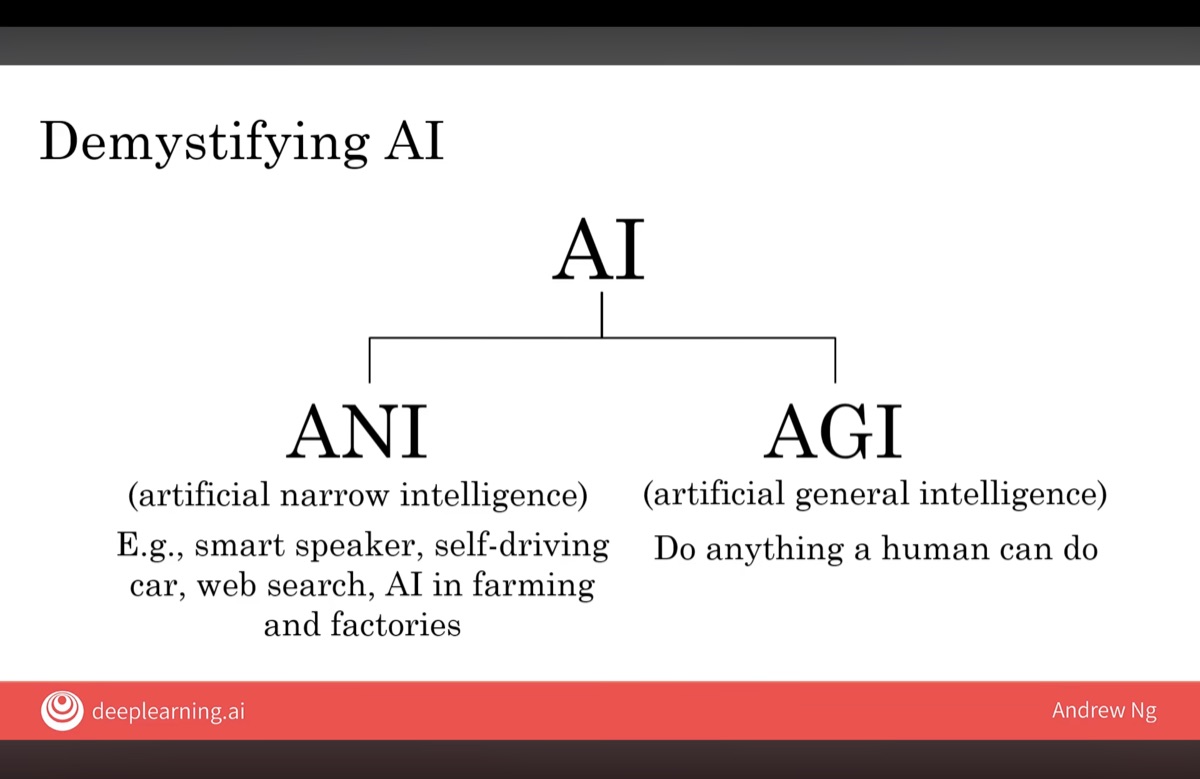
The second is artificial general intelligence (AGI): the idea of an AI that can do anything a human can do, or more. AGI is what fuels visions of killer robots and superintelligent machines. The problem is that it doesn't exist, and progress toward it is "almost none."
Ng says AGI may be "decades or hundreds of years or even thousands of years away" and that reaching it will require multiple technological breakthroughs. It is an exciting research goal, but not something to fear today.
The rapid progress in ANI is real and valuable. But it has caused many people to incorrectly assume that AGI is also advancing quickly, and that's where the irrational fears come from.
What the course actually teaches
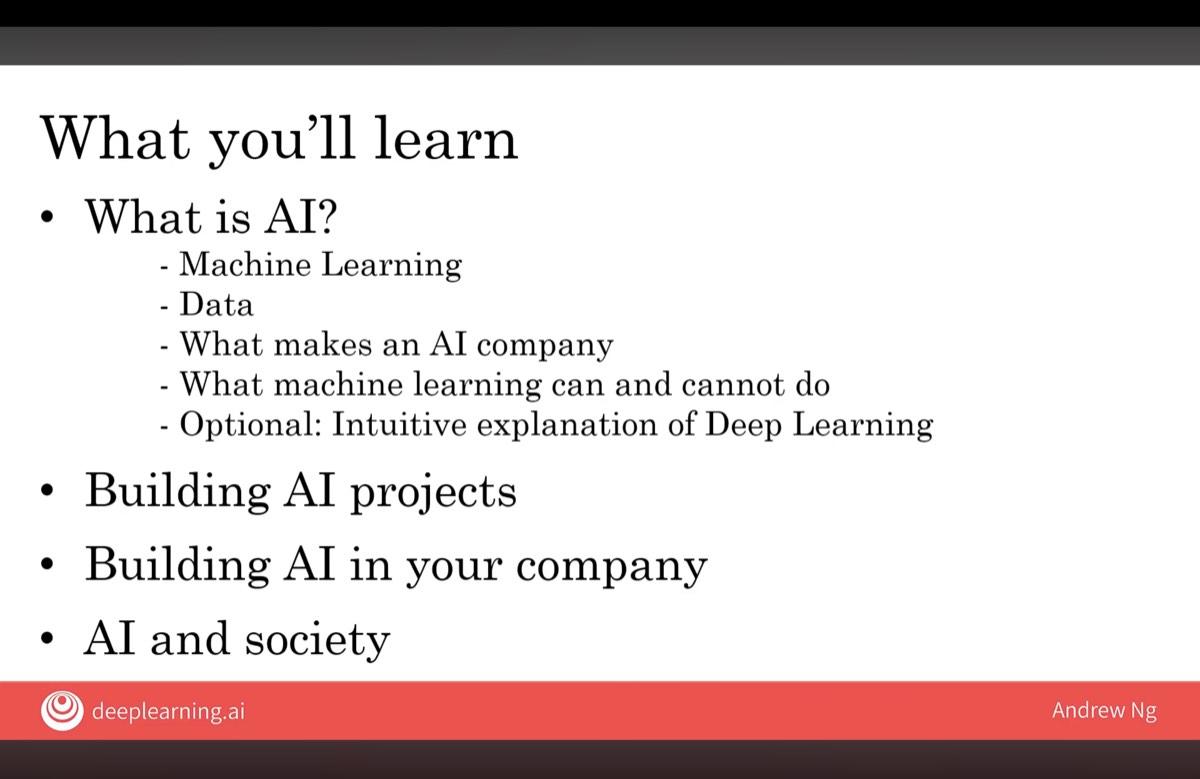
"AI for Everyone" spans four weeks and is built for non-technical people: managers, executives, and anyone who works alongside AI teams.
Week 1 covers what AI actually is. You learn what machine learning is (a way for computers to learn from examples instead of being given exact rules), what kinds of data are valuable, and importantly, what AI cannot do. Ng emphasizes this last point because success stories dominate the news while failure stories don't make headlines, giving most people a distorted picture.
Week 2 is about building AI projects. Not how to code them, but what it feels like to work on one, and how to judge whether a project is technically feasible and worth doing.
Week 3 focuses on bringing AI into a company. Ng introduces what he calls the "AI transformation playbook": how to build AI teams and develop AI-powered products.
Week 4 looks at AI and society: bias in AI systems (when AI treats people unfairly based on race, gender, or other factors), AI's impact on developing economies, and how AI is changing jobs. By the end, Ng says, you'll be more knowledgeable about AI than the CEOs of most large companies.
Why non-technical people need this
Ng built this course because AI decisions are being made at every level of every organization, by people who often don't understand what AI actually is. Executives approve AI investments they can't evaluate. Managers hire for AI roles without knowing what skills to look for. Teams build AI products without knowing what will and won't work.
The goal of "AI for Everyone" isn't to teach coding. It's to teach enough to lead: to ask the right questions, to spot real opportunities, and to recognize when the hype doesn't match reality.
Glossary
| Term | Definition |
|---|---|
| Artificial Narrow Intelligence (ANI) | AI that does one specific task well, like recognizing speech or recommending movies. Almost all AI today is ANI. |
| Artificial General Intelligence (AGI) | A theoretical AI that could do anything a human can do, or more. Does not exist yet, and may be very far away. |
| Machine learning | A way for computers to learn from examples rather than being given explicit rules. Powers most modern AI applications. |
| Deep learning | A type of machine learning inspired by how the brain works, using layers of artificial neurons. Behind most recent AI breakthroughs. |
Sources and resources
Want to go deeper? Watch the full video on YouTube →