Anthropic Asks Court to Block Pentagon Blacklist
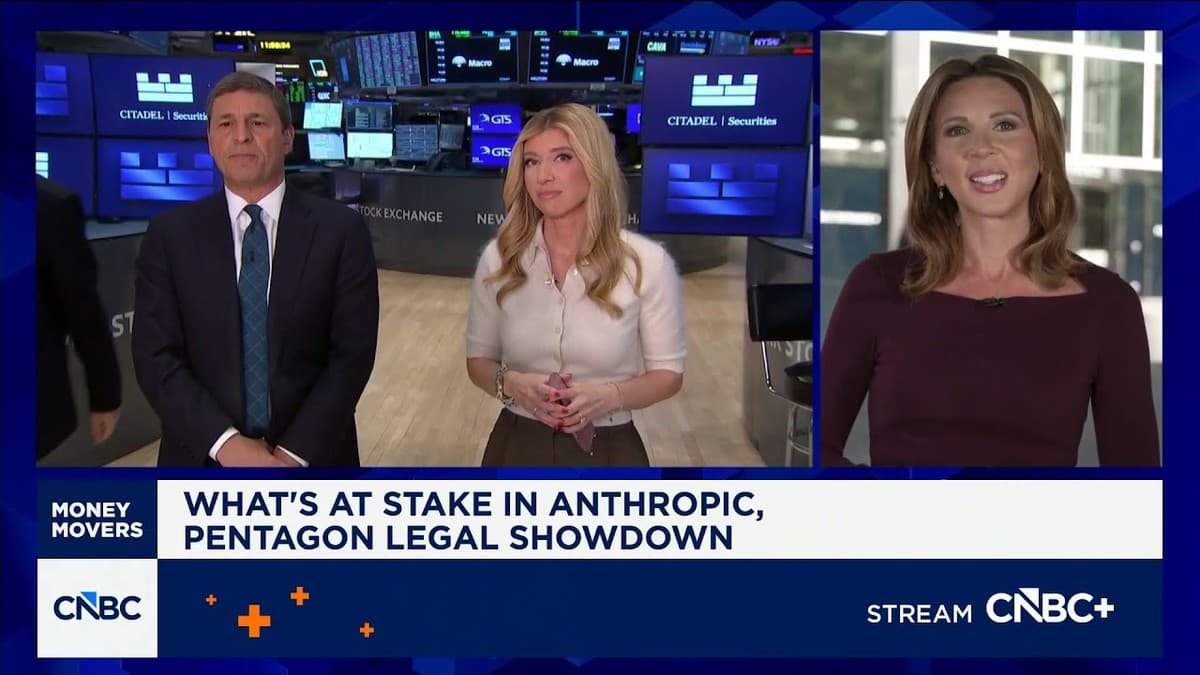
Key insights
- The Pentagon's 'supply chain risk' label was built for foreign adversaries like Huawei. Applying it to a US company sets a precedent any administration could exploit to shut a domestic tech firm out of government contracts over a business dispute.
- Even without a final ruling, Anthropic is already losing: customers are quietly dropping Claude to avoid the national security label, and competitors are locking in contracts that may never come back.
- The Department of Justice (DOJ) frames this as an operational security question, not a political fight. The key issue is how much access Anthropic retains to Claude once the model is deployed inside military systems.
This is an AI-generated summary. The source video may include demos, visuals and additional context.
In Brief
Anthropic went to federal court in San Francisco on March 24, asking a judge to temporarily block two things: the Pentagon's supply chain risk designation (a label that effectively kicked the company out of government business) and a White House directive ordering every federal agency to stop using Claude.
The stakes are significant. If the judge grants the injunction (a court order that pauses an action while a lawsuit plays out), defense agencies and contractors can keep using Claude while the case works its way through the legal system. CFO Krishna Rao has warned the cost of the blacklist could reach into the billions in lost contracts: both direct Defense Department deals and business from companies that are quietly dropping Claude to avoid any association with a national security label.
If the judge denies the injunction, Anthropic stays locked out of the government market for potentially years. Customers have already started moving away from Claude even though partners like Alphabet, Microsoft, and Amazon have said Claude can still be used for non-defense work. Every week of uncertainty hands competitors like OpenAI and xAI more time to lock in contracts Anthropic may never win back.
Related reading:
Why the "supply chain risk" label is a big deal
The Pentagon's supply chain risk designation is usually reserved for foreign adversaries, companies like Huawei that are seen as threats to US military infrastructure. Applying that same label to an American company is unusual, and if it holds up in court, it creates a template that any future administration could copy.
The concern is straightforward: a government could use national security powers to push a domestic tech company out of federal contracts, not because of a genuine security threat, but because of a contract dispute or political disagreement. That is why this case has every major cloud and AI company watching closely, well beyond the specific conflict between Anthropic and the Pentagon.
The DOJ's argument: it's about backdoor access
The Department of Justice (DOJ) is not arguing that Anthropic did anything wrong with its speech or political positions. Their case rests on a narrower technical question: does Anthropic retain access to Claude after the model has been deployed inside government systems?
The judge signaled where her focus lies when she sent lawyers a question the day before the hearing: how much access does Anthropic have to Claude once it is being used in battlefield contexts? The DOJ argues this is an operational security issue, not a free speech case. If the government prevails, the remedy lies with the executive branch rather than the courts.
Pentagon has already moved on
Even as the legal battle plays out, Emil Michael, the Pentagon's chief technology officer, has made clear that the department is not waiting around. The Pentagon has already signed contracts giving xAI and OpenAI classified access to fill the role Anthropic previously held.
That context matters for the injunction hearing. Anthropic's financials remain strong: chief executive Dario Amodei said last month at a technology conference that the company's annual run rate (projected yearly revenue based on current pace) is $19 billion, with $6 billion coming in February alone. The private market valuation stands at $350 billion. But losing a major government market while competitors fill the gap is a real hit. Even a delay in the ruling carries its own damage, because uncertainty alone is enough to push risk-averse customers toward alternatives.
Glossary
| Term | Definition |
|---|---|
| Supply chain risk designation | An official Pentagon label saying a company poses a security risk to the military's supply chain. Normally used against foreign adversaries. |
| Preliminary injunction | A court order that temporarily stops an action while a lawsuit is ongoing, like a pause button a judge can press. |
| DOJ | The Department of Justice — the US government's main law enforcement agency, which argues cases on behalf of the federal government in court. |
Sources and resources
Want to go deeper? Watch the full video on YouTube →