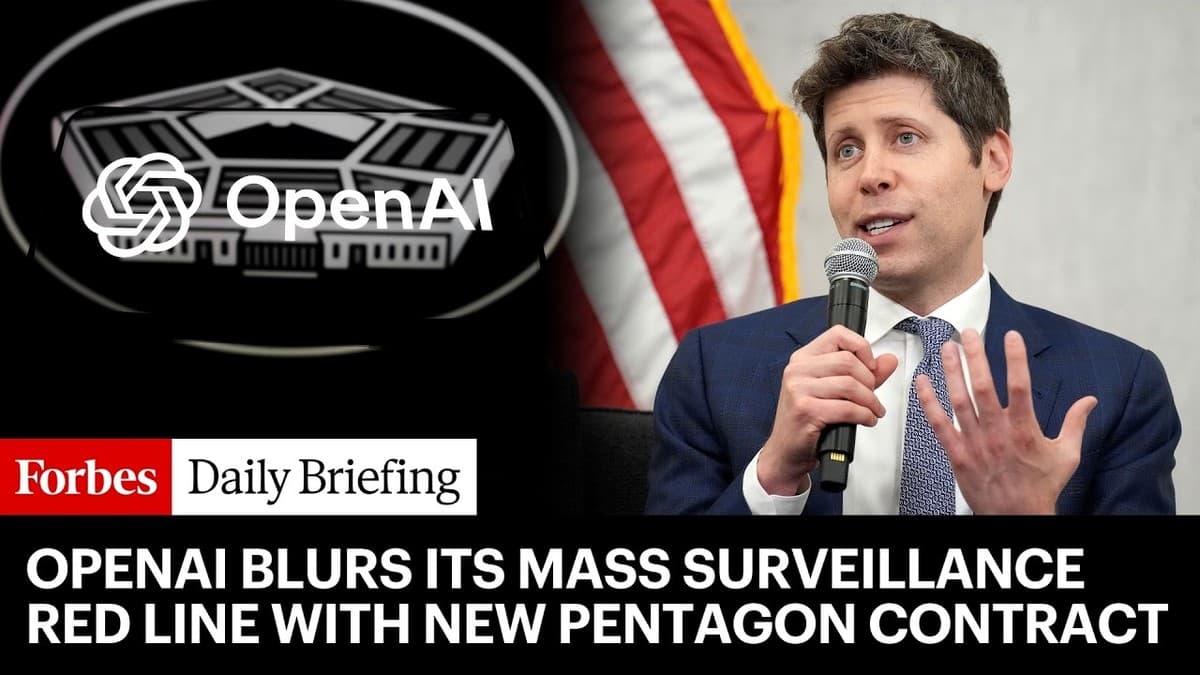
OpenAI's Pentagon Deal Blurs Its Surveillance Red Lines
Key insights
- OpenAI's contract defines 'no mass surveillance' by referencing FISA and Executive Order 12333, laws critics say already permit broad surveillance of Americans
- ChatGPT mobile app uninstalls jumped 295% day-over-day after the deal, while Anthropic's Claude topped app store charts
- The Pentagon designated Anthropic a 'supply chain threat' after negotiations broke down over surveillance and autonomous weapons limits
This is an AI-generated summary. The source video may include demos, visuals and additional context.
In Brief
Anthropic walked away from a Pentagon AI contract after the Department of War refused to guarantee limits on mass surveillance and autonomous weapons. Hours later, OpenAI signed its own deal, claiming it upheld the same red lines. Critics and policy experts argue that the contract's language actually permits the broad surveillance it claims to prohibit, because it defines protections through laws like FISA and Executive Order 12333 that already allow extensive data collection on Americans.
What happened
On Friday, February 27, Sam Altman announced that OpenAI had struck a deal with the Department of War to provide AI technology for classified networks. The deal came just hours after talks between Anthropic and the Pentagon collapsed.
Anthropic's CEO Dario Amodei had insisted on contractual limits preventing the use of Claude for fully autonomous weapons and mass domestic surveillance. Specifically, Amodei objected to the Pentagon using AI to create "a detailed and accurate picture of citizens' private lives by making connections between large data sets, all without the need for a warrant".
Within hours of the breakdown, the US government designated Anthropic a "supply chain threat," effectively cutting it off from federal contracts. Anthropic has said it plans to sue.
The contract language problem
OpenAI initially claimed its agreement upheld red lines against mass domestic surveillance. The company followed up with a blog post stating its AI could be used for "lawful purposes" and that private information handling would comply with surveillance-related laws.
Those laws include the Foreign Intelligence Surveillance Act (FISA), which gives the National Security Agency (NSA) broad authority to collect Americans' communications with foreign individuals. They also include Executive Order 12333, which permits bulk data gathering from foreign targets regardless of whether they're communicating with Americans.
The contract itself states: "The AI system shall not be used for unconstrained monitoring of US persons' private information as consistent with these authorities".
The word "unconstrained" is doing a lot of work in that sentence. As Mike Masnick at TechDirt wrote: "OpenAI has effectively adopted the intelligence community's dictionary, a dictionary in which common English words have been carefully redefined over decades to permit the very things they appear to prohibit".
Public backlash and Altman's response
The backlash was swift. Sensor Tower data showed ChatGPT mobile app uninstalls jumping 295% day-over-day on Saturday, February 28. Meanwhile, Anthropic's Claude shot to the top of AI app charts.
By Monday night, Altman responded with an internal message saying OpenAI would amend the contract. The new language would state that its AI "shall not be intentionally used for domestic surveillance of US persons and nationals". The amendment would also prevent the Department of War's intelligence agencies, including the NSA, from using OpenAI tools without a separate contract modification.
The data the Pentagon already buys
The contract dispute matters even more when you look at the data the Department of War already purchases. The Pentagon has contracts with Babel Street, a company that uses AI agents to connect data sets including social media information and mobile phone location history.
Contracting records also show that LexisNexis, owned by $56 billion market cap analytics company RELX, provides the Department of War with tools for "online identity verification" and access to "over 34 billion current public records". The NSA separately purchases "net flow" data, essentially footprints of people's online activities that reveal what websites they visit and what apps they use.
None of these existing data sources seem to be covered by OpenAI's contract language.
Glossary
| Term | Definition |
|---|---|
| FISA (Foreign Intelligence Surveillance Act) | A US law that governs how intelligence agencies can surveil communications, particularly between Americans and foreign individuals. Often criticized for enabling broad data collection. |
| Executive Order 12333 | A presidential directive from 1981 that gives intelligence agencies like the NSA authority to collect data from foreign targets, including communications that involve Americans. |
| Supply chain threat | A government designation that effectively bars a company from federal contracts by labeling it a risk to government operations. |
| Net flow data | Records of internet traffic patterns that show which websites people visit, which apps they use, and when. Essentially digital footprints of online behavior. |
| Data broker | A company that collects and sells personal information about individuals, often gathered from apps, websites, and public records. |
| Bulk data gathering | The practice of collecting large volumes of data on many people at once, rather than targeting specific individuals with a warrant. |
This surveillance angle sits next to the more strategic critique of OpenAI's Pentagon deal and Anthropic's separate case for drawing red lines on Pentagon AI work.
Sources and resources
- Forbes — OpenAI Blurs Its Mass Surveillance Red Line (YouTube) (5 min)
- Forbes — Thomas Brewster's full investigation
- OpenAI — Our Agreement with the Department of War
- Anthropic — Statement from Dario Amodei
- TechDirt — OpenAI's Red Lines Are Written in the NSA's Dictionary
- TechCrunch — ChatGPT Uninstalls Surged 295%
- Sensor Tower — ChatGPT Uninstalls Surge
- NPR — Pentagon Labels Anthropic a Supply Chain Risk
Want to go deeper? Watch the full video on YouTube →