AI Users Vote with Their Apps in Pentagon Standoff
Key insights
- Claude downloads surged 500% week-over-week after Anthropic refused Pentagon demands to remove AI safety restrictions
- ChatGPT uninstalls jumped 300% overnight, but with 900 million monthly users it remains dominant by a wide margin
- Zero switching costs between AI chatbots mean consumer sentiment can shift market share faster than in traditional software
This is an AI-generated summary. The source video may include demos, visuals and additional context.
In Brief
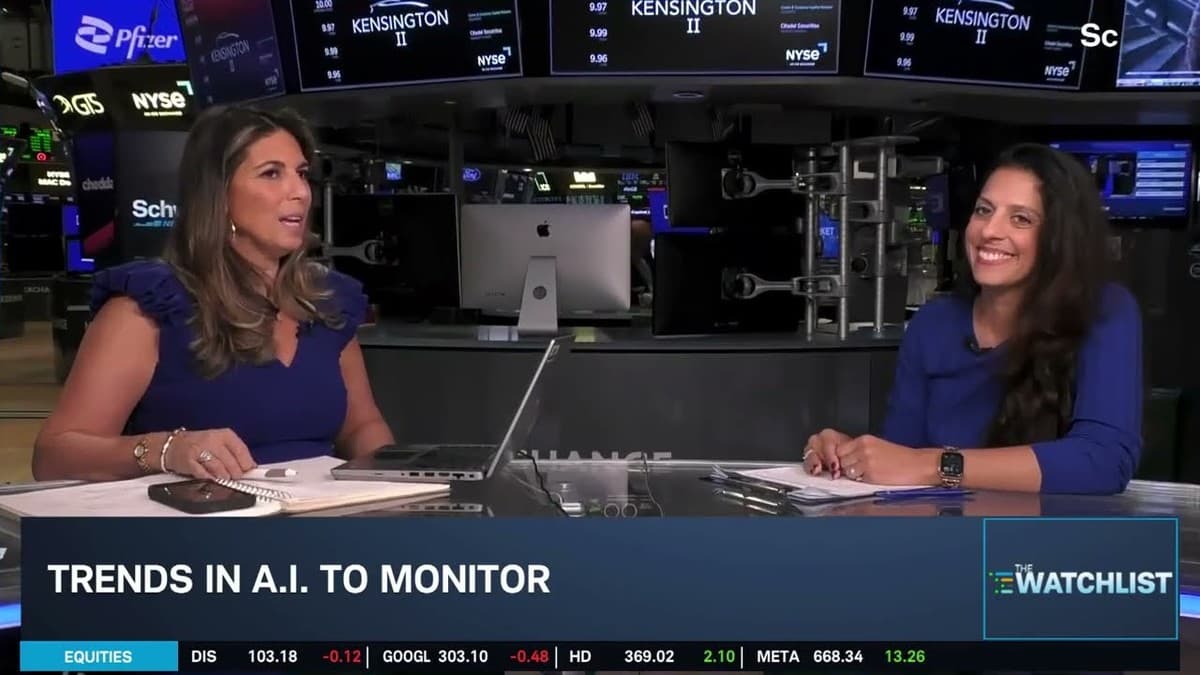
After Anthropic refused Pentagon demands to remove safety restrictions from Claude, U.S. consumers responded quickly. Sensor Tower data presented on Schwab Network shows Claude downloads surging 500% week-over-week, while ChatGPT uninstalls spiked by 300% overnight. Seema Shah, VP of Research and Insights at Sensor Tower, argues that AI chatbots have become large enough that public perception now directly shapes how people use them.
The central claim
Shah argues that AI chatbots have reached a tipping point where consumer loyalty is driven by company values, not just product quality (0:46). The average user does not know the technical differences between Claude, ChatGPT, and Gemini. They switch freely because there are essentially zero switching costs between AI chatbots (3:08).
This mirrors patterns seen in retail, where a company's stance on social or political issues can trigger rapid shifts in consumer behavior. When Anthropic walked away from having its technology used for military operations in the Middle East (0:49), the Pentagon pivoted to OpenAI's ChatGPT. The reaction from U.S. consumers was, in Shah's words, "visceral" (1:06).
The numbers behind the shift
Sensor Tower's numbers show how fast feelings turn into action:
| Metric | Change | Context |
|---|---|---|
| Claude downloads | Up 500% week-over-week | From a base of ~18 million monthly active users (MAUs) |
| ChatGPT uninstalls | Up 300% first night | Against a base of ~900 million MAUs |
| ChatGPT 1-star reviews | Up 400–700% | Immediate spike after the news broke |
| ChatGPT 5-star reviews | Down 40% | Simultaneous decline in positive sentiment |
These are dramatic percentage changes, but Shah is careful to note the absolute scale. ChatGPT still has roughly 50 times more monthly users than Claude (2:06). Hundreds of thousands of people continue downloading ChatGPT daily, even as a smaller but vocal group uninstalls it (4:09).
Opposing perspectives
ChatGPT is not going anywhere
Shah emphasizes that ChatGPT remains the clear market leader with 900 million MAUs, compared to 400 million for Gemini and 18 million for Claude (7:06). The brand has become a generic term for AI assistance. "ChatGPT is the code word for: are you using AI to help you do something?" (7:02), Shah notes. College students, in particular, have made it their default tool.
Gemini's structural advantage
Google's Gemini benefits from being embedded in Google Search (5:00). When users search for something, Gemini provides an AI-generated answer without requiring them to open a separate app. This built-in reach could last longer than download surges driven by news cycles.
A consolidation ahead
Shah compares the AI chatbot market to streaming services (4:38). Just as consumers eventually settled on one or two streaming subscriptions, they may not want to pay for multiple AI chatbots. When companies like OpenAI go public, actual revenue and profitability data will likely thin the field, with some smaller players fading or being acquired (6:04).
How to interpret these claims
Shah's analysis offers useful market data, but the picture isn't that simple.
Relative vs. absolute scale
A 500% increase in Claude downloads sounds explosive, but 500% of a small number is still a small number. Claude's 18 million MAUs represent roughly 2% of ChatGPT's user base. Even if Claude doubled its users overnight, ChatGPT would barely notice in absolute terms. The percentage changes capture momentum, not market dominance.
Temporary protest or lasting shift?
Consumer boycotts in retail often spike hard and then fade. The same pattern could apply here. The question is whether users who switched to Claude will stay, or whether the next news cycle will bring them back to whatever tool they find most convenient.
Missing context on the dispute
The segment touches lightly on why Anthropic refused the Pentagon contract, but the full picture is more complex. Reporting from CNN and NPR shows that the Pentagon demanded Anthropic drop restrictions on domestic mass surveillance and fully autonomous weapons. Defense Secretary Pete Hegseth then designated Anthropic a supply chain risk, and the Trump administration directed all federal agencies to stop using the company's technology. This context matters because it shapes whether consumers view Anthropic as principled or simply as a company that lost a major contract.
Advertising as a differentiator
Shah mentions that ChatGPT has started showing ads in categories like media, entertainment, and food (8:42). If ad-free alternatives like Claude position themselves as premium options, the competition could shift beyond ethics alone.
Practical implications
- For AI users: Switching between chatbots is free and easy. If a company's values matter to you, your choice of AI tool is now a form of consumer expression, much like choosing where to shop.
- For investors: Watch engagement metrics, not just download numbers. Shah's Netflix analogy suggests that the long-term winners will be determined by sustained usage and monetization, not headline-grabbing download surges.
- For AI companies: Brand perception is becoming a competitive factor alongside model quality. Anthropic's stance cost it a government contract but earned a measurable surge in consumer interest.
Glossary
| Term | Definition |
|---|---|
| MAU (Monthly Active Users) | The number of unique users who open an app at least once per month. A standard measure of an app's reach. |
| Switching costs | The effort or expense required to change from one product to another. AI chatbots currently have near-zero switching costs. |
| Supply chain risk | A government designation meaning a company's products could threaten national security if depended upon. |
| Uninstalls | When a user removes an app from their device. Tracked by analytics firms like Sensor Tower as a signal of user dissatisfaction. |
| IPO (Initial Public Offering) | When a private company first sells shares to the public on a stock exchange. OpenAI is expected to pursue an IPO. |
The download data matters most when read next to why Anthropic drew red lines on Pentagon AI, because that article explains the product and policy choices behind the backlash.
Sources and resources
Want to go deeper? Watch the full video on YouTube →