Netflix's $600M AI Bet: Filmmaker Tool or Cost-Cutter?
Key insights
- InterPositive trains AI models on a filmmaker's own footage, not on generic data, so the filmmaker retains control of the output
- Netflix framed the deal as 'about better, not cheaper,' but the acquisition comes during DOJ antitrust scrutiny of its $82.7B Warner Bros. Discovery bid
- Affleck's core argument is that film industry insiders must shape AI before outsiders do, but Netflix now controls how that shapes up
- The creative community's central worry, that AI will remove humans from the loop, was directly addressed but not fully resolved by either Affleck or Netflix
This is an AI-generated summary. The source video may include demos, visuals and additional context.
In Brief
Netflix has acquired InterPositive, the AI filmmaking startup founded by Ben Affleck, for reportedly up to $600 million. The deal brings a 16-person team into Netflix at a moment when the company is already under review by the U.S. Department of Justice over its $82.7 billion bid to acquire Warner Bros. Discovery. Affleck argues InterPositive is fundamentally different from the generative AI tools that have alarmed the creative community: it trains models on a filmmaker's own footage, not on someone else's content. Netflix frames the acquisition as a commitment to empowering filmmakers, but given the company's current consolidation ambitions, that framing deserves scrutiny.
Related reading:
The central claim
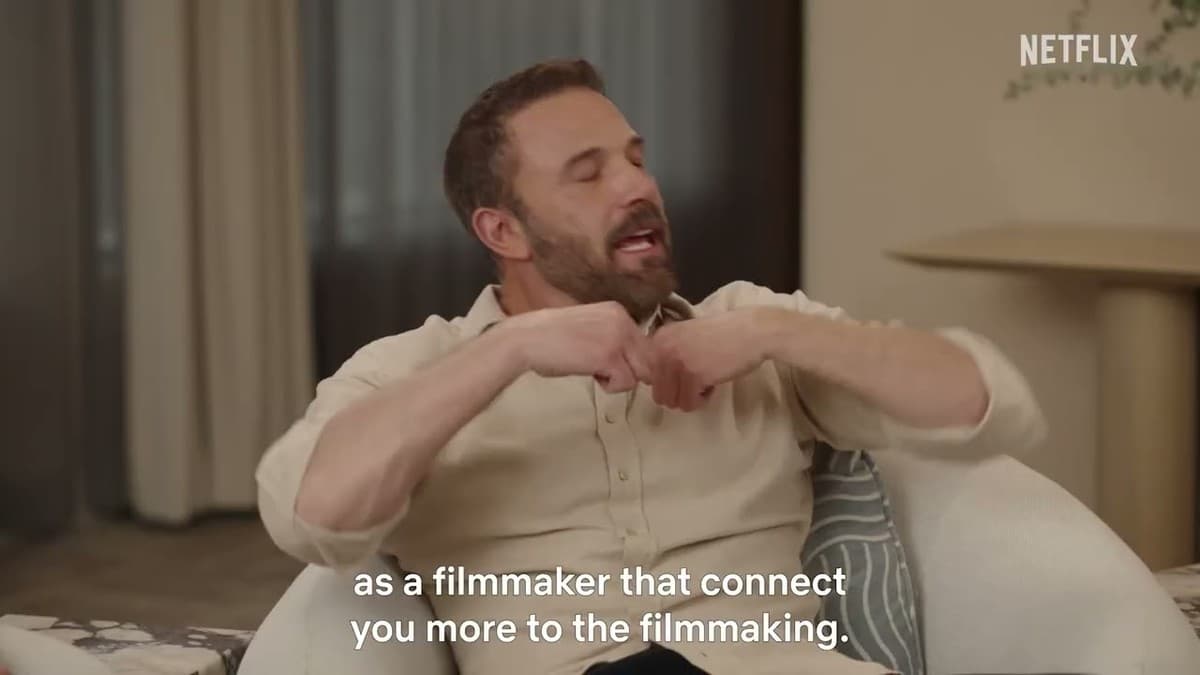
Affleck's central argument is that the film industry must shape AI itself, or risk having it shaped by technologists who have no interest in filmmakers or artists. The tool he built is not about generating content from nothing. As he explains in the video, it starts with your own material: you shoot your film, and then you use that footage to train a model that is specific to your production.
That distinction matters. Most public anxiety about AI in film is directed at text-to-video tools, where a user types a description and the system generates footage. InterPositive works the opposite way. It learns from what a filmmaker has already shot (the dailies: raw footage recorded each day on set, which directors review before the next shoot day), then assists with post-production tasks. Post-production is everything that happens after filming: editing, color grading, visual effects, and sound mixing.
What InterPositive actually does
According to Affleck, the tool handles practical, time-consuming tasks that slow productions down without adding creative value. Specific capabilities include wire removal, shot reframing, missed-shot recovery, lighting adjustment, and background enhancement.
These are real pain points. Removing safety wires from stunt sequences is tedious frame-by-frame work. Reframing a shot that was composed slightly wrong can save a costly reshoot. Because the model is trained on the film's own footage, the AI is expected to stay consistent with the visual language and characters the director has already established, rather than producing something generic.
Affleck's road to building it
Affleck describes being initially alarmed by early generative AI video tools: "it would often fall apart," he says. What troubled him more than the technology itself was the absence of filmmaking knowledge behind it: strong engineering, but no artistic or cinematic expertise shaping it. He saw that as both a danger and an opening, and founded InterPositive in 2022 in stealth mode.
Opposing perspectives
"Not cheaper, but better": how convincing is that?
A Netflix executive in the video states directly: "for me it's not really about cheaper, it's really about better." This is a careful choice of words. Post-production is expensive, and tools that automate wire removal or shot reframing will inevitably reduce the number of hours (and therefore wages) paid to the people who do that work manually today. Saying it's "about better" doesn't mean it won't also be cheaper. It may simply be both.
The creative community's worry remains unresolved
Affleck acknowledges directly that he heard many in the tech industry ask "how do we get the human out of the loop" and found that attitude troubling. He argues Netflix does not share that philosophy. But the concern from unions and creative workers is not only about intentions. It's about outcomes. Automation has a history of being introduced with reassurances that jobs will change, not disappear, only for the reality to be more complicated.
How to interpret these claims
Who is speaking, and why now?
This video is a promotional piece released jointly by Netflix and InterPositive. Affleck has a direct financial interest in presenting the acquisition favorably, and Netflix has a reputational interest in the creative community's goodwill while the DOJ reviews its attempted takeover of Warner Bros. Discovery, a deal that would have given Netflix over 55% of the Subscription Video on Demand (SVOD) market. The timing of this acquisition and its messaging can't be separated from that context.
The filmmaker-control argument has a ceiling
Affleck's core design principle is that the filmmaker controls the model because it is trained on their own footage. This is genuinely different from tools that scrape and remix existing content without consent. But once InterPositive is inside Netflix, a company with significant market power, the question becomes who actually controls deployment, licensing, and where the technology goes next. A 16-person startup has a very different relationship to its tools than a division of a global streaming platform.
What would stronger evidence look like?
The video describes what InterPositive can do in general terms, with no independent evaluation of output quality, no comparison with existing post-production workflows, and no data on time or cost savings. Affleck's word that the tool works is not the same as a proven production record. Until InterPositive's outputs are visible in credited productions, the claims remain difficult to assess.
Practical implications
For filmmakers and creative workers
The distinction Affleck draws between model-from-your-own-footage versus generic generative AI is worth understanding. If the approach holds up in practice, it represents a meaningfully different category of tool. But workers in post-production should watch how the technology is deployed at scale inside Netflix, not just how it is described in promotional content.
For anyone following the streaming industry
The InterPositive deal is a data point in a larger pattern: Netflix building or acquiring capabilities across the production pipeline during a period of aggressive expansion. The DOJ review of the Warner Bros. Discovery bid shows that regulators are watching. This acquisition is small by comparison, but it signals strategic intent.
Glossary
| Term | Definition |
|---|---|
| Dailies | Raw footage shot each day on set, reviewed by the director and crew before the next day of filming |
| Post-production | Everything that happens after filming: editing, color grading, visual effects (VFX), and sound mixing |
| Generative AI | AI that creates new content (text, images, or video) based on patterns learned from large amounts of existing data |
| Fine-tuning | Training an AI model further on a specific, smaller dataset to specialize it for a particular task or style |
| SVOD | Subscription Video on Demand: streaming services like Netflix, Disney+, and Max, where users pay a monthly fee |
| VFX | Visual effects: digitally created or enhanced imagery added to film footage during post-production |
| Antitrust | Laws that prevent companies from gaining so much market power that they eliminate fair competition |
| Dailies model | In InterPositive's approach, an AI model trained specifically on a film's own daily footage rather than generic data |
Sources and resources
Want to go deeper? Watch the full video on YouTube →