Japan's Manga Creators Draw the Line on AI
Key insights
- No manga artists in Japan publicly support generative AI, according to a researcher at the MANGA Research Institute
- Some creators are nonetheless already using AI for backgrounds quietly, and plan to expand its use as long as the story remains human work
- Japan's CODA is using AI itself to detect pirated manga online, turning the technology into a tool for protecting creators
This is an AI-generated summary. The source video may include demos, visuals and additional context.
In Brief
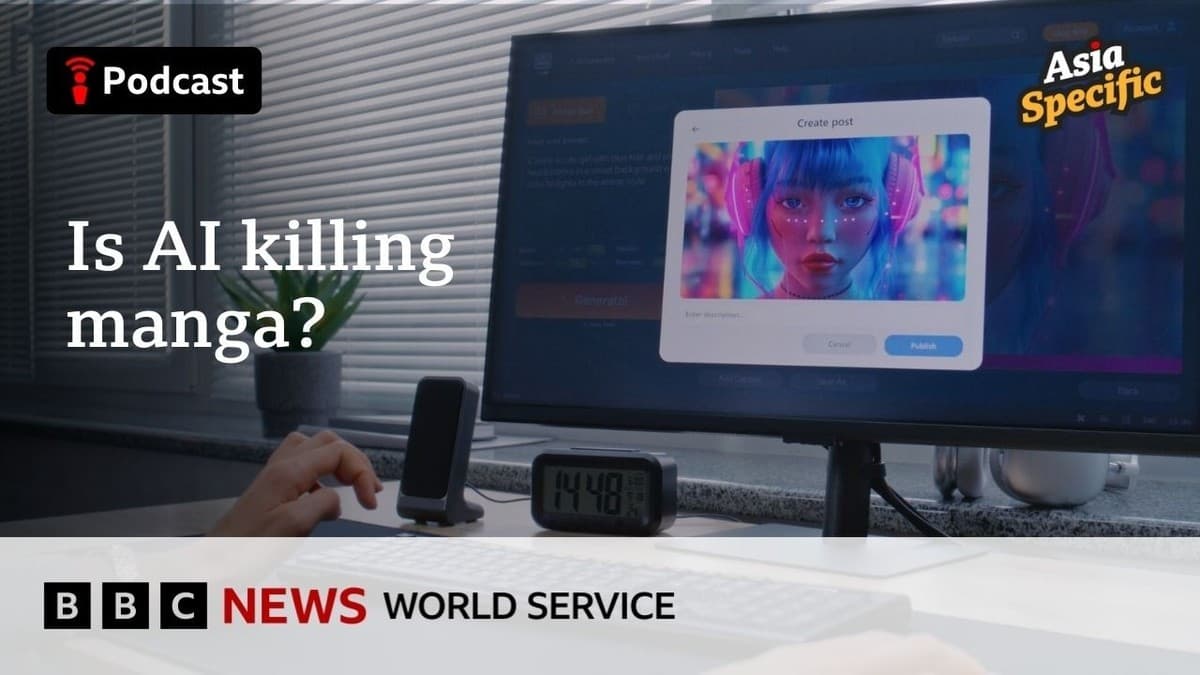
Mariko Oi, host of the BBC World Service podcast Asia Specific, brings together manga artist Peppe (Giuseppe Durato), AI consultant Darren Boey from UnMute, and Takeshi Kikuchi from the MANGA Research Institute to examine whether generative AI (AI that creates new content like images and text) is a threat or an opportunity for Japan's manga industry. The conversation reveals a creative community deeply divided between protecting artistic tradition and adapting to new tools.
The central claim: manga artists reject generative AI
The episode's most striking claim comes from Takeshi Kikuchi of the MANGA Research Institute. He states that he cannot think of any manga artists in Japan who openly support AI. While opinions among top creators are split on whether AI could wipe out their profession or become a useful tool, the vast majority hold negative views on generative AI, particularly because they fear their manga is being used to train AI models without permission.
The Sora 2 incident
Kikuchi points to a specific moment that crystallized the industry's anger. When OpenAI's Sora 2 video generator launched, it produced content resembling well-known Japanese characters and series like Nintendo's Mario, Pokemon, Dragon Ball, and Demon Slayer. Japan's major publishing companies responded by calling on OpenAI to stop using their creative works or face copyright infringement action.
The copyright push
CODA (Content Overseas Distribution Association), a Japanese organization that fights content piracy, is now leading a group of manga producers to demand transparency from AI companies about how they use manga to train their models. AI consultant Darren Boey notes that the approach is not about punishment so far. It is more of a "show cause" conversation. Meanwhile, companies like OpenAI and Anthropic are pursuing licensing deals, paying creators for the right to use their work as training data.
Opposing perspectives: AI as a tool, not just a threat
Some artists are already using AI
Despite the overwhelmingly negative sentiment, adoption is quietly happening. Peppe describes speaking to a manga artist group leader who already uses AI for drawing backgrounds and plans to expand to using it for everything, keeping only the story as human work. Peppe himself acknowledges the logic: if a tool can save three days of work, most people will use it.
Kikuchi adds that AI-generated content is already widespread in adult manga, where consumers are less concerned about whether a human created the work.
AI defending manga
The Japanese government and CODA are also exploring how AI can protect the industry rather than threaten it. CODA is training AI agents to find pirate sites and recognize pirated content (software programs that perform tasks on their own), replacing what used to be a labor-intensive manual process. The government is also looking at using AI to translate manga into other languages, potentially expanding the market.
The value of human creation
Peppe frames manga as one of the last art forms that can be done entirely by one person, from story to finished product. Darren Boey agrees, comparing it to the difference between a barista-made espresso and one from a machine, or hand-stitched shoes versus factory-made ones. Both suggest that consumers will pay more for work they know is human-made.
How to interpret these claims
The episode presents a balanced discussion, but several aspects deserve closer examination.
The "zero support" claim may be overstated
Kikuchi's assertion that no manga artists openly support AI is a strong claim. Peppe himself, sitting in the same conversation, describes AI as a potentially "useful tool" and mentions a colleague who plans to use AI for everything except writing. The gap between "supporting AI" and "using AI" matters. Artists can oppose how AI companies train their models while still using the technology in their own work.
Copyright concerns are global, not Japan-specific
Darren Boey makes an important point that this is "not only a highly localized issue". Creative industries worldwide are pushing back against AI training practices. The manga industry's response is part of a broader global pattern, which means the solutions found in Japan could set precedents for other creative fields.
The licensing gap
While OpenAI and Anthropic are pursuing licensing deals, Boey notes there is no public commitment from AI companies to stop using content without permission. The burden falls on creators to "police" how their work is used. This imbalance between the resources of AI companies and individual creators comes up again and again in the AI copyright debate.
Practical implications
For manga artists and illustrators
The episode suggests that illustrators face the highest risk of replacement, while story creators retain more value. Artists who can combine strong storytelling with artistic skill may have an advantage over those who focus only on illustration.
For consumers
The adult manga market shows what happens when consumers do not prioritize human creation. For readers who value human artistry, actively seeking out and buying human-made manga tells publishers and artists that there is still demand for the real thing.
Glossary
| Term | Definition |
|---|---|
| Generative AI | Artificial intelligence that creates new content such as images, text, or video by learning patterns from existing data. Tools like ChatGPT and image generators are examples. |
| Manga | Japanese comics and graphic novels, typically read right-to-left. A major cultural export worth billions of dollars annually. |
| Copyright infringement | Using someone's creative work without permission, violating their legal rights as the creator. A central concern when AI models are trained on copyrighted material. |
| Training data | The content (images, text, videos) that AI models learn from during development. The quality and legality of training data is a major point of debate. |
| CODA | Content Overseas Distribution Association, a Japanese organization that fights piracy of Japanese content internationally and is now pushing for AI transparency. |
| Licensing deal | An agreement where AI companies pay content creators for the right to use their work as training data. Some see this as a solution to the copyright problem. |
| AI agent | A software program powered by AI that can perform tasks autonomously, like scanning the internet for pirated content. |
Sources and resources
Want to go deeper? Watch the full video on YouTube →