Chinese AI Founders Are Flocking to Silicon Valley
Key insights
- Dify's open-source architecture is a deliberate political strategy: because customers host the code on their own servers, Zhang argues it falls outside 'sensitive sector' scrutiny and avoids the TikTok problem.
- Meta's $2 billion acquisition of Manus sets a template for the hybrid 'China origin plus overseas operations' model, combining Chinese engineering talent with Western market access.
- The talent dependency runs both ways: 7 of 11 immigrant founding members at Meta Superintelligence Labs were born in China, showing the US needs Chinese AI talent as much as these founders need Silicon Valley.
This is an AI-generated summary. The source video may include demos, visuals and additional context.
In Brief
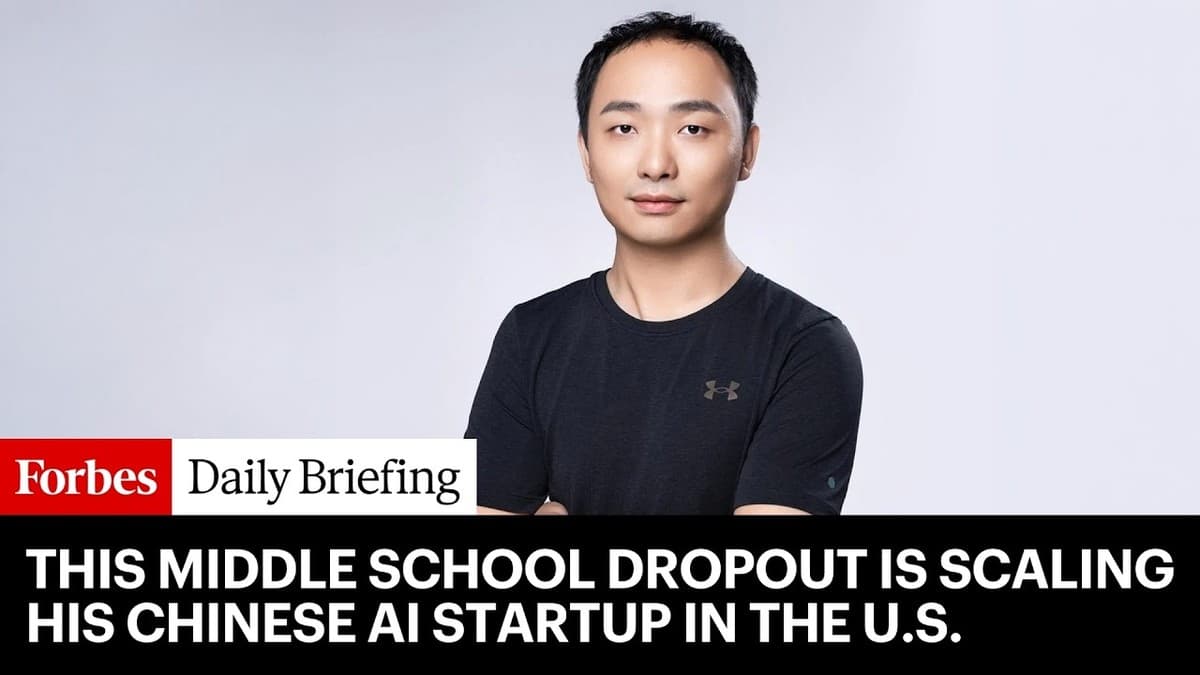
Luyu Zhang dropped out of middle school in China, taught himself to code, and built Dify into a profitable AI developer platform with 280+ enterprise customers. He moved to Silicon Valley last year, and he's not alone. Investor Lake Dai of Sancus Ventures says at least 100 Chinese entrepreneurs have contacted her about making the same move. Despite US-China trade tensions, export controls, and the TikTok precedent, a wave of Chinese AI founders is betting that Silicon Valley is where you have to be if you want to build a truly global company.
Related reading:
What happened?
Luyu Zhang barely speaks English, but that's not stopping him. When Forbes interviewed him through a translator, he explained: "I'm too busy with work right now to improve my English. That requires time, and right now, I don't have a day to lose." Zhang is chief executive officer (CEO) of Dify, an open-source platform that lets developers build AI applications using a low-code interface (point-and-click tools instead of writing everything from scratch) rather than extensive back-end programming. Dify ranks among the most starred repositories on GitHub, employs about 100 people, is profitable, and counts Volvo, Thermo Fisher Scientific, and Novartis as enterprise customers.
Zhang recently raised $30 million at a $180 million valuation from investors including HongShan. His reason for moving to the US is simple: "If you want to build a global AI infrastructure company, you build where the world is competing."
He points to Meta's $2 billion acquisition of Manus as the model to follow. Manus is an AI startup founded in China that relocated to Singapore before drawing Meta's attention. Zhang calls it the "China origin plus overseas operations" startup model. The idea is straightforward: keep the engineering team in China (Dify's ~60 core developers remain there) while building sales and customer operations abroad.
The model is not without challenges. Both US and Chinese regulators are scrutinizing the Manus deal: the US reviewed an investment by venture firm Benchmark, while Chinese authorities are reportedly examining whether to block Meta's acquisition.
The trend is broader than one company. Zhang says he personally knows about 20 Chinese founders currently relocating to the US. Lake Dai, formerly head of product at Alibaba and now founder of Sancus Ventures, puts the number much higher: in the past two years, at least 100 Chinese entrepreneurs have contacted her about moving, as foreign capital pulls back from China and venture funding tightens domestically. Other companies following similar hybrid structures include OpusClip and HeyGen, though some have relocated entirely outside China.
Why this matters
The political risks are real, but founders are navigating them carefully. The TikTok saga, which ended with the platform being forced to consider selling its US operations to avoid a ban, is fresh in everyone's minds. US policymakers worry about sensitive technology reaching China. Some American investors avoid startups with Chinese backers. Anti-Chinese sentiment persists in parts of Silicon Valley.
Zhang's response is to lean on architecture. Dify's code is open source, meaning anyone can inspect it, and customers typically run it on their own servers. He argues this places Dify outside what he calls the "sensitive sector" — unlike social platforms with algorithmic influence over users, or companies building export-controlled chips.
But the deeper point is about dependency. A Carnegie Endowment study found that most top Chinese AI researchers at US institutions in 2019 stayed in the country years later. And 7 of the 11 immigrant founding team members at Meta Superintelligence Labs were born in China. The US-China AI relationship isn't simply competitive — it's deeply intertwined.
Zhang's own view cuts through the geopolitical noise: "Entrepreneurs coming from China to the US are not political. We just want to build great products that people use."
Glossary
| Term | Definition |
|---|---|
| Low-code platform | Software that lets you build applications by clicking and configuring visual tools instead of writing code from scratch. Faster to use, but with less flexibility than full custom code. |
| Open source | Software where anyone can view, copy, and modify the code for free. Open-source projects are often hosted on platforms like GitHub. |
| Export controls | Government rules that restrict which technologies can be sold or transferred to other countries. The US has used these to limit China's access to advanced AI chips. |
| Valuation | What investors believe a company is currently worth, usually set during a funding round. A $180 million valuation means investors priced Dify at that figure when Zhang raised his $30 million. |
Sources and resources
Want to go deeper? Watch the full video on YouTube →