Palantir CEO: Support Defense or Face Nationalization
Key insights
- Karp frames the nationalization threat as bipartisan. Republicans care about military support, Democrats care about job losses. Both could unite against Silicon Valley if the industry ignores both concerns.
- The Hollywood ratings analogy positions self-regulation as self-preservation. Karp argues the tech industry should set its own rules before Washington does it badly.
- Karp reframes civil liberties as national security infrastructure. Protecting neurodivergent, unconventional talent is what gives America its competitive edge over China and Russia.
This is an AI-generated summary. The source video may include demos, visuals and additional context.
In Brief
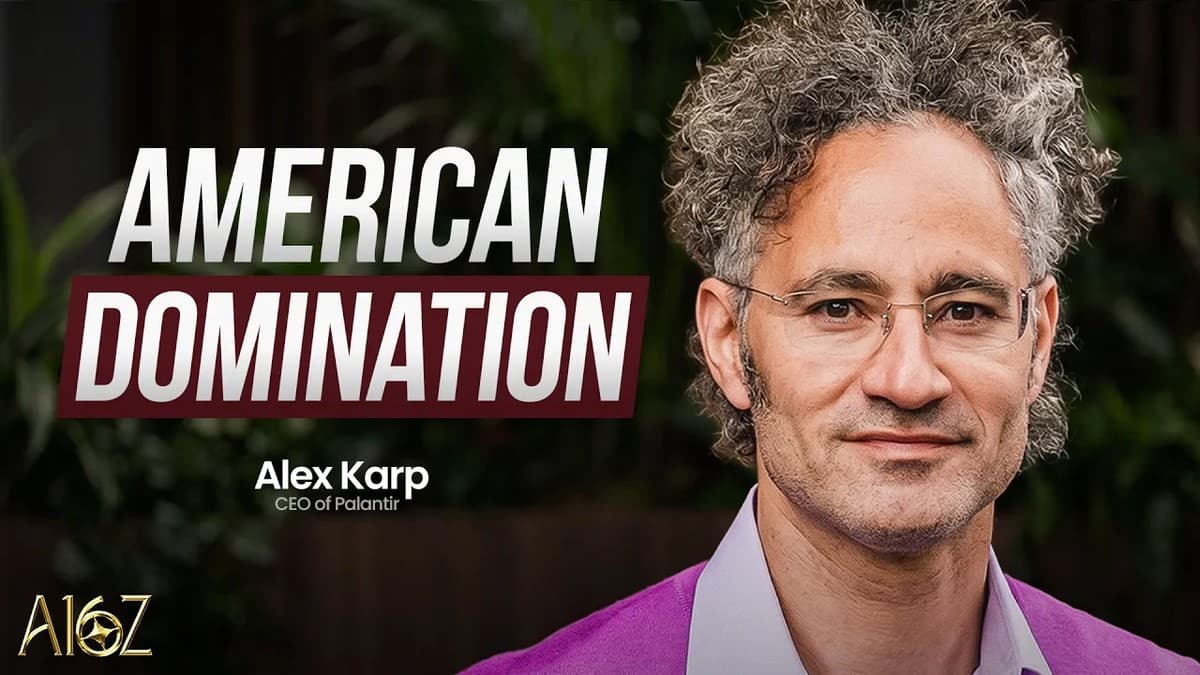
Alex Karp, CEO and co-founder of Palantir, delivered a blunt warning to Silicon Valley at the 4th annual a16z American Dynamism Summit in Washington, D.C. His core argument: if the tech industry eliminates white-collar jobs while refusing to support the U.S. military, politicians on both sides will nationalize tech companies. The conversation, hosted by Erik Torenberg, covered military technology, AI-driven job displacement, privacy rights, and why Karp believes America's real competitive advantage lies in its neurodivergent talent.
Related reading:
The nationalization warning
Karp's central claim is that Silicon Valley faces a political threat it does not yet understand. The tech industry is building AI systems that could replace millions of white-collar jobs. At the same time, many tech companies have historically avoided working with the U.S. military. Karp argues this combination will trigger nationalization.
The reasoning follows what he calls a "famous horseshoe effect", where opposite ends of the political spectrum converge on the same conclusion. Republicans, who tend to prioritize military strength, will turn against an industry that refuses to support the war fighter. Democrats, whose constituents hold the white-collar jobs being displaced, will turn against an industry that threatens their voters' livelihoods. The result, Karp suggests, is bipartisan momentum to seize control of tech companies.
"If Silicon Valley believes we are going to take away everyone's white collar job... If you don't think that's going to lead to nationalization of our technology, you're crazy," he argues. He paints a stark picture of where this leads: "there's going to be 50 unlikable people with all the money."
Technology as military advantage
Much of the conversation centers on Palantir's role in U.S. military operations. Karp describes how software and AI have become central to American military superiority, referencing recent operations in Iran and Venezuela. He frames this technology advantage as the foundation of global deterrence, meaning the military capability that discourages adversaries from attacking.
"We are the power that actually has the decisive vote and that is with military superiority," Karp states. He credits a combination of experienced war fighters, meritocratic military culture, and software systems like Palantir's Foundry, Apollo, and Maven for giving the U.S. capabilities that rival nations cannot match.
Karp frames Palantir's mission in personal terms: "the most important thing Palantir is doing is to make sure that American war fighters are much more likely to come home." The company has spent 20 years building the software, hardware, and AI orchestration (coordinating multiple AI systems to work together) needed for modern warfare.
The Hollywood analogy: self-regulate or be regulated
Karp offers a specific model for how Silicon Valley should respond. He points to Hollywood's voluntary ratings system as a precedent. "Hollywood realized if we don't do ratings, Washington's going to and Washington is going to butcher it," he explains.
The parallel he draws is direct. The tech industry should create its own frameworks for AI governance before Congress does it for them. In Karp's view, this is not idealism but survival. Politicians do not understand the technical nuances between large language models, machine learning, and traditional software. Letting them write the rules would produce blunt regulation that harms the industry.
He identifies two specific areas where the industry needs to act. First, how to honestly address what AI will do to white-collar employment. Second, how to protect Fourth Amendment rights (the constitutional protection against unreasonable searches) in a world where technology can infer what someone is doing at home.
Neurodivergent talent as competitive edge
In the final segment, Karp makes a broader argument about American competitiveness. He contends that America's single greatest advantage over China and Russia is its ability to cultivate unconventional, neurodivergent people, meaning those whose brains work differently, including people with autism, dyslexia, and ADHD.
"Our single advantage is to augment neurodivergent highly individual people to be their absolutely unique best," he argues. He connects this directly to constitutional rights, stating that protecting first, second, fourth, and fifth amendment freedoms is what allows these individuals to thrive.
Karp, who describes himself as dyslexic, says this principle is how he leads Palantir. Rather than forcing employees into a single playbook, he claims to help each person develop their own unique approach. Each of Palantir's key products, he claims, was "built by the one person in the world that could have done it."
Opposing perspectives
Nationalization is unlikely in practice
The nationalization scenario Karp describes would require extraordinary political consensus and legal action. The U.S. has not nationalized a major private industry since the World War II era. Even during the 2008 financial crisis, government interventions in banking were structured as temporary bailouts and equity stakes, not permanent seizures. The legal and constitutional barriers to nationalizing technology companies would be substantial.
Defense work raises its own ethical questions
Karp presents working with the military as a straightforward moral good. But the ethical landscape is more complex. Google employees famously protested Project Maven (the Pentagon program using AI for military targeting) in 2018, and many AI researchers continue to raise concerns about autonomous weapons systems. The question of whether tech companies should build military AI is genuinely debated, not settled.
Job displacement is not unique to this moment
The fear that technology will eliminate jobs has recurred with every major technological shift, from mechanization to the internet. While AI may be different in scale, the framing of "take away everyone's white collar job" may overstate the speed and completeness of displacement. Many economists argue AI will transform jobs rather than eliminate them wholesale.
How to interpret these claims
Karp presents a compelling argument, but several factors deserve consideration before accepting his framing at face value.
Karp has a direct business interest
Palantir is one of the largest defense technology contractors in the United States. When Karp argues that Silicon Valley must support the military, he is also making the case for his own company's business model. This does not mean he is wrong, but it means his framing naturally emphasizes the conclusions that align with Palantir's interests.
The venue shapes the message
This conversation took place at the a16z American Dynamism Summit in Washington, D.C., an event explicitly dedicated to promoting technology companies that serve national interests. The audience consisted of defense-adjacent founders and investors. Karp's arguments were tailored to a receptive audience, not stress-tested against skeptics.
The Hollywood analogy has limits
Hollywood's ratings system is a useful precedent, but it has significant limitations as a model for AI governance. Movie ratings classify existing content into categories. AI governance requires making decisions about technologies whose capabilities and impacts are still emerging. The complexity is several orders of magnitude greater, and the stakes involve national security and economic disruption rather than age-appropriate content.
Missing from the conversation
Karp does not address how ordinary workers affected by AI displacement would benefit from his proposed framework. The conversation focuses entirely on what Silicon Valley should do to protect itself politically. There is no discussion of retraining programs, social safety nets, or how the economic gains from AI should be distributed.
Practical implications
For tech founders and CEOs
Karp's warning about political backlash is worth taking seriously regardless of whether nationalization is realistic. Public sentiment toward Big Tech has shifted significantly in recent years. Founders who ignore the political dimension of AI-driven job displacement risk being caught off guard by regulation. Building relationships with policymakers and developing clear positions on job impact is practical preparation, not political theater.
For policymakers
The conversation highlights a gap between Silicon Valley's technical understanding and Washington's regulatory instincts. Karp's Hollywood analogy, while imperfect, points to a real challenge: effective AI governance requires technical expertise that most legislators lack. Finding ways to bridge that knowledge gap is essential for producing regulation that actually works.
For workers in affected industries
The nationalization framing may be dramatic, but the underlying concern about white-collar job displacement is real. Workers in roles that involve routine analysis, document processing, or pattern recognition should be paying attention to how AI tools are being adopted in their industries.
Glossary
| Term | Definition |
|---|---|
| Defense tech | Technology companies that build products for military and national security use. |
| Nationalization | When a government takes control of private companies or industries, typically through legislation or executive action. |
| Deterrence | Military capability strong enough to discourage adversaries from attacking. The idea is that the cost of conflict outweighs any potential gain. |
| Horseshoe effect | When extreme positions on opposite ends of the political spectrum end up agreeing on the same conclusion, despite different reasoning. |
| Fourth Amendment | The part of the U.S. Constitution that protects people against unreasonable searches and seizures. In the AI context, it relates to digital privacy. |
| Neurodivergent | People whose brains work differently from the typical population, including those with autism, dyslexia, ADHD, and similar conditions. |
| Orchestration | Coordinating multiple AI models and systems to work together on complex tasks, rather than relying on a single model. |
| Project Maven | A Pentagon program that uses AI for military targeting and intelligence analysis. It became controversial when Google employees protested their company's involvement in 2018. |
| Zero-sum game | A situation where one side's gain comes directly at another side's expense. Karp argues the global AI race is zero-sum between the U.S. and its rivals. |
| LLM (Large Language Model) | AI systems trained on vast amounts of text data to understand and generate language. Examples include GPT and Claude. |
Sources and resources
Want to go deeper? Watch the full video on YouTube →