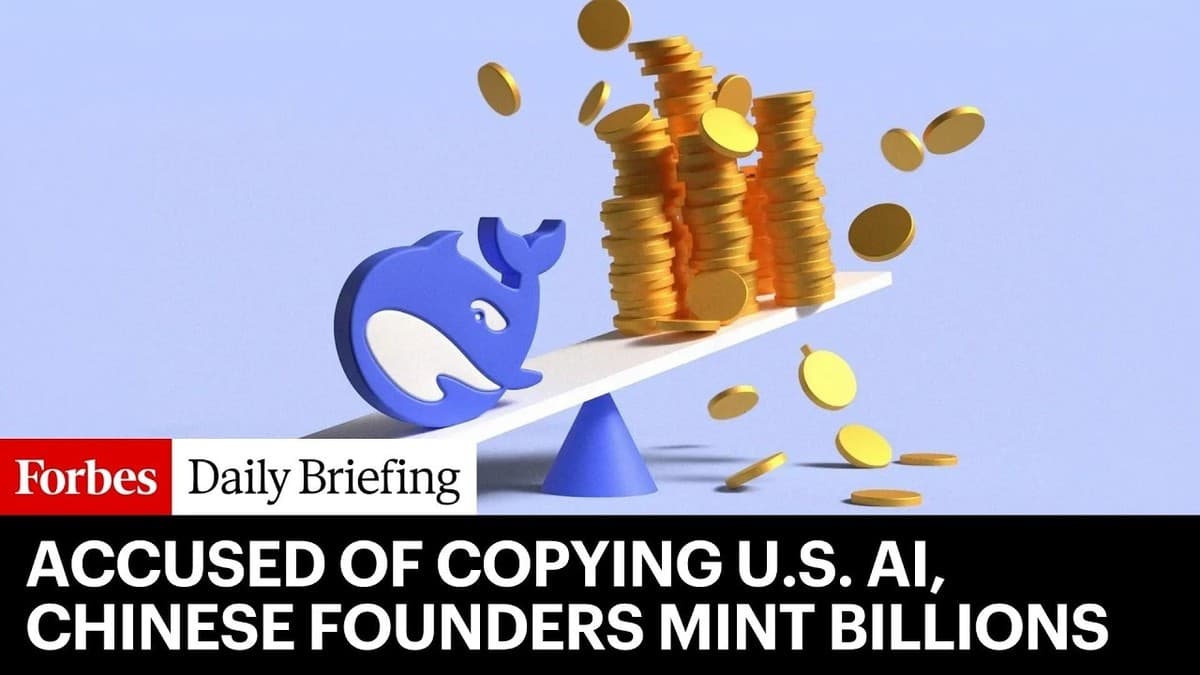
Accused of Copying US AI, Chinese Founders Mint Billions
Key insights
- Distillation lets a small model capture 80-90% of a frontier model's performance at a fraction of the cost, which undermines the billions spent building large proprietary models.
- Chinese investors are ignoring the copying allegations entirely. MiniMax and Zhipu AI trade at 400-550x revenue multiples, far above what OpenAI or Anthropic have ever commanded.
- About 80% of American startups using open models rely on Chinese ones, and switching between models costs almost nothing. That is a structural threat to closed-source pricing power.
- Jenny Xiao's point is blunt: average enterprise tasks do not need the smartest model. When performance is comparable, price wins every time.
This is an AI-generated summary. The source video may include demos, visuals and additional context.
In Brief
Anthropic says Chinese AI companies sent 16 million prompts through 24,000 fake accounts to extract capabilities from its Claude models — a technique called distillation. OpenAI made similar allegations to US lawmakers, and Google warned about attacks targeting Gemini. The accused companies have not publicly responded. Instead, their founders are becoming billionaires.
Related reading:
What is distillation?
Think of it like a student who skips the homework and just studies the answer key. Instead of training an AI from scratch, you feed a smaller model the outputs of a larger one. The smaller model learns to mimic the larger one's answers without doing all the original work.
The result is striking. A distilled model can achieve roughly 80-90% of a frontier model's performance at a fraction of the computing cost. That is why John Hultquist, chief analyst at Google's Threat Intelligence Group, describes the appeal so directly:
"It's not easy to build these models, and distillation is a way to leapfrog that process."
Jenny Xiao, a partner at Leonis Capital who previously worked on trust and safety at OpenAI, goes further. She calls open models an existential threat to premium pricing:
"Open models are essentially a kill line."
Distillation is not magic. A capable base model and skilled engineering are still required. But if you can shortcut billions of dollars in training costs, the incentive is enormous.
The allegations
In February 2026, both Anthropic and OpenAI went public with accusations against several Chinese AI companies.
Anthropic said in a press release that DeepSeek, MiniMax, and Moonshot AI had prompted its Claude models 16 million times through roughly 24,000 fraudulent accounts. OpenAI sent a letter to US lawmakers with similar allegations about DeepSeek. And Google's threat intelligence team warned about rising distillation attacks targeting Gemini.
None of the accused companies responded publicly.
New billionaires — despite the accusations
Investors are not waiting for the legal dust to settle. MiniMax and Zhipu AI (Z.ai) went public in Hong Kong earlier this year, and the listings minted several new billionaires.
Yan Junjie, chairman and CEO of MiniMax, is now worth about $7.1 billion. Liu Debing, chairman of Zhipu AI, has a fortune of $8.7 billion — roughly comparable to the wealth of Anthropic's billionaire co-founders. Tang Jie, a co-founder of Zhipu AI and professor at Tsinghua University, is worth around $1.9 billion.
More founders are joining the list. Liang Wenfeng, founder of DeepSeek, debuted as the richest newcomer on Forbes Asia's China Rich List with an estimated fortune of $11.5 billion. Yang Zhilin, founder of Moonshot AI, is expected to become a billionaire once Moonshot closes its latest funding round at a reported $10 billion valuation. Wang Xiaochuan of Baichuan Intelligence and Jiang Daxin of StepFun may also have entered the billionaires club based on comparable valuation metrics.
On the American side, private investors value Anthropic at roughly $380 billion and OpenAI at $840 billion. Neither company has gone public yet, so those valuations have not been tested in public markets.
The real question is pricing power
Here is the uncomfortable truth underneath the headlines. Chinese AI models are now nearly as capable as their American counterparts. Many are open source (meaning anyone can download and use them freely). Most are cheaper.
Zhipu AI's recently released GLM5 model reportedly costs five times less per input and ten times less per output than Anthropic's Claude Opus 4.6. Enterprise buyers notice a price difference that large.
Xiao makes the commercial logic explicit:
"You don't need the smartest model to do average enterprise workloads."
Most business tasks do not require the very best AI. A model that is nearly as good, at a fifth of the price, wins.
According to Martin Casado, general partner at Andreessen Horowitz (a16z), roughly 80% of American startups using open models already rely on Chinese ones. And switching between models is nearly frictionless. Developers can toggle between providers through major cloud platforms or services like OpenRouter in just a few lines of code.
Shares of Zhipu AI and MiniMax have traded at extraordinary revenue multiples: around 400x and 550x respectively, more than double the private valuations ever assigned to OpenAI or Anthropic. Both stocks have pulled back sharply from their peaks. That kind of volatility suggests the market has not yet decided what these companies are actually worth.
The deeper question, as Forbes reporter Phoebe Liu frames it, is where long-term value will reside in a world where open models are free and good enough. Closed-source players like OpenAI and Anthropic still need to prove their economic advantage. And open models, driven in part by Chinese labs, are raising the bar every month.
Glossary
| Term | Definition |
|---|---|
| Distillation | A technique where a smaller AI model learns by studying the outputs of a larger one, like a student who memorizes the answer key. Faster and cheaper, but skips some of the deep training. |
| Open source | Software (or an AI model) whose code is freely available for anyone to download, use, and modify. |
| IPO (Initial Public Offering) | When a company sells shares to the public for the first time. Before an IPO, only private investors can buy in. |
| Revenue multiple | A company's valuation divided by its annual revenue. A 400x multiple means investors value the company at 400 times what it earns. Most tech companies trade at 5-15x. |
| Pricing power | The ability to charge more than competitors because your product is better or unique. Lose it, and customers switch to the cheaper option. |
Sources and resources
- Forbes — Accused Of Copying U.S. AI, Chinese Founders Mint Billions (YouTube) — Source video
- Forbes — Phoebe Liu: Copying AI, Chinese Founders Mint Billions — Full written article
Want to go deeper? Watch the full video on YouTube →