Teenagers Built a $1B Startup That Simulates Humans
Key insights
- Surveys ask people what they think. Simulation predicts what they do. For sensitive topics like weight loss drugs or alcohol consumption, people rarely give honest answers, making self-reported data unreliable by design.
- Aaru's GLP-1 alcohol prediction flips conventional wisdom: yes, people drink less per occasion, but over the long term GLP-1 users become more social and go out more, so total occasions go up. If correct, it reshapes how beverage companies plan.
- A $1 billion valuation on fewer than 100 active customers is a bet on AI upending the entire industry, not current revenue. Investors are pricing in the potential to displace the $80B+ market research industry.
- A 17-year-old CTO built simulation models that EY and Accenture now pay for. The barrier to founding a serious AI company has never been lower.
This is an AI-generated summary. The source video may include demos, visuals and additional context.
In Brief
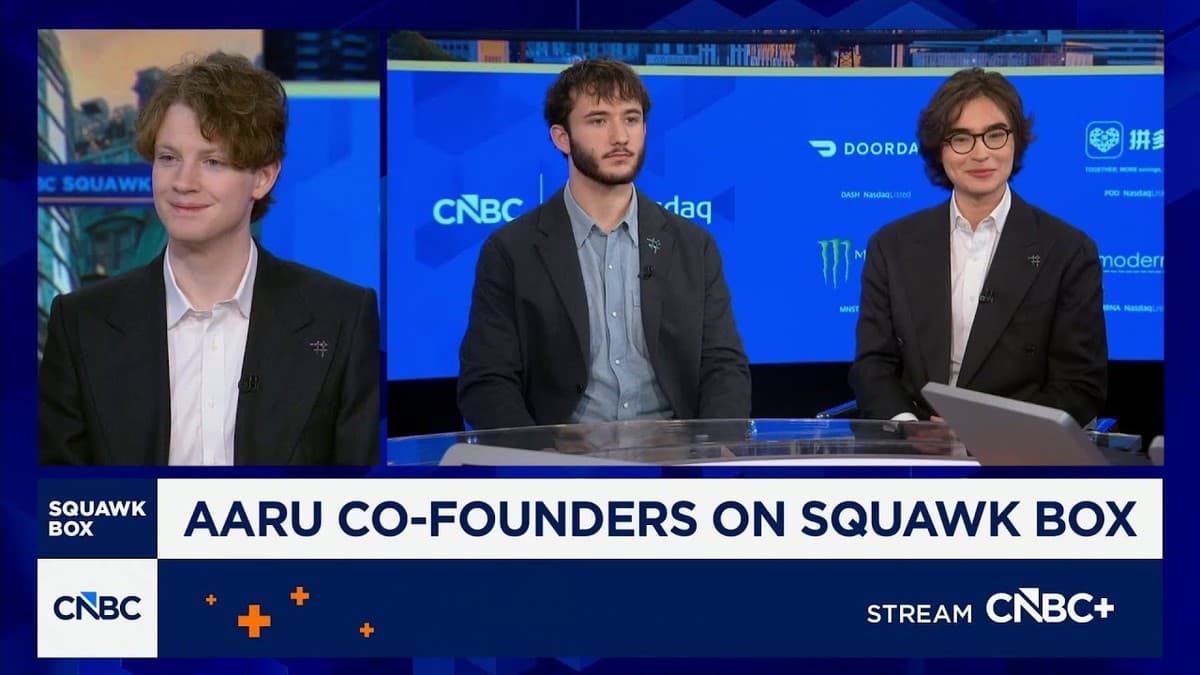
Cameron Fink, Ned Koh, and John Kessler co-founded Aaru roughly two years ago. Kessler was 15 at the time. The company builds AI that simulates how real people behave, replacing traditional surveys and focus groups with virtual populations that can be run in minutes. Today Aaru is valued at $1 billion and counts EY, Accenture, Bayer, and film studio A24 among its clients. All three founders appeared on CNBC's Squawk Box to explain what they built and why they think conventional market research is broken.
Related reading:
How they started
Cameron Fink and Ned Koh met the first day of high school and started experimenting together immediately. They wrote programs to hack their school's Wi-Fi to avoid submitting homework on time, launched a data-driven insurance business, and kept looking for something they were actually passionate about.
The third founder came through a cold LinkedIn message. Kessler was applying to a startup accelerator that Fink and Koh had previously attended. Out of 296 alumni listed on the accelerator's LinkedIn page, one happened to be Cameron Fink. Kessler messaged him. The two scheduled a 30-minute Zoom call and ended up talking for 2.5 hours. Fink called Koh straight afterward and said Kessler was the smartest person he had ever met. Two weeks later, all three decided to start a company. They raised their first funding round two weeks after that, and only met in person a week after the raise.
Kessler brought the core technology. At 15 years old, he had been spending time at MIT's City Science Lab, working on simulation research. He saw it as a much larger commercial opportunity than academic labs were willing to pursue.
What the technology does
Aaru builds AI agents (software programs that behave like individual people) to simulate how a target population will respond to a product, price, policy, or advertisement. Instead of running a survey asking customers what they would do, Aaru creates virtual versions of those customers and observes what they actually do inside the simulation.
The founders argue that asking people questions is a fundamentally flawed method. Prediction markets, where participants bet real money on future events, suffer from the same problem: the people who use them don't represent the broader population. They have heavy sampling bias (when survey participants aren't representative of the group you actually care about), which makes their predictions reliable only for the most mainstream topics.
A concrete example: GLP-1 drugs and alcohol. GLP-1 drugs (weight loss medications like Ozempic and Wegovy) are widely known to reduce appetite. The prevailing view is that they're also cutting alcohol consumption. Aaru's simulation points in a different direction. Yes, people drink less per occasion and switch from high-calorie drinks like beer toward spirits. But over time, GLP-1 users become more confident, more social, and start going out more. The net number of drinking occasions goes up. Aaru says that prediction was made six months before recent market data started confirming the pattern, and that the full effect will play out over the next two to five years.
Nobody on a weight loss drug is going to tell a surveyor that they're drinking more. That's exactly the kind of sensitive behavior Aaru claims simulation can surface when direct questioning cannot.
How they sell it
The pitch is a hard one: "We can predict your customers' behavior better than you can, even when you talk to them directly." Fink describes the challenge as "convincing people that magic is real."
Their solution is a blind test. When approaching a new client, Aaru asks for a business decision the company already made: a product launch, a price point, a campaign. They do this without taking any of the company's proprietary data. They recreate the same research questions and the same customer groups the company used at the time, run the simulation, and show whether their model would have predicted the actual outcome. The company sees the result before agreeing to pay anything. EY is a public case study for this approach.
The business is growing fast, even if it's still small. As of the CNBC interview, Aaru had over 100 customers across its lifetime and 24 employees, up from 21 at their previous public disclosure. Use cases span ad testing, product packaging, pricing, distribution strategy, and government policy modeling. The $1 billion valuation came from a Series A round led by Redpoint Ventures in December 2025.
Why it matters
If simulation reliably predicts behavior that surveys cannot reach, the implications go well beyond marketing. The founders describe applications in political polling, public health (nudging people to save more for retirement, increasing vaccine uptake), and behavioral economics. They frame their long-term ambition not just as predicting the future but shaping it.
The ethical questions are significant. A system that can model how a population will respond to different messages, and then optimize those messages for maximum effect, raises concerns about manipulation at scale. The founders don't address this directly in the interview.
The $1 billion valuation puts enormous pressure on a company with a small team. Aaru is betting that simulated humans are a more accurate and cheaper alternative to the $80 billion market research industry. That bet is not yet proven at scale.
Glossary
| Term | Definition |
|---|---|
| AI agent | A software program that acts autonomously, making decisions and taking actions, rather than just answering questions. Aaru's agents simulate individual people. |
| Sampling bias | When the people in a survey or test don't represent the broader population. Results look reliable but don't generalize. |
| GLP-1 drugs | A class of weight loss medications (including Ozempic and Wegovy) that reduce appetite and appear to affect other behaviors like alcohol consumption. |
| Prediction market | A platform where people bet money on future outcomes, like election results. In theory, the crowd's collective bets reflect real-world probabilities. In practice, the participants skew heavily toward specific demographics. |
Sources and resources
Want to go deeper? Watch the full video on YouTube →