One Person, Five AI Agents: An Autonomous Organization
Key insights
- One person now runs five specialized AI agents 24/7 on local hardware, organized like a company with an org chart, roles, and hierarchy.
- The hybrid local/cloud approach solves the cost and quality tradeoff: local models handle grunt work while cloud models supervise every 10 minutes.
- Third-party plugins represent the biggest security risk for autonomous agents, not the open web or email access.
- Apple faces a trillion-dollar opportunity as consumers instinctively choose Mac hardware for local AI, but the company has yet to fully capitalize on this demand signal.
This is an AI-generated summary. The source video may include demos, visuals and additional context.
In Brief
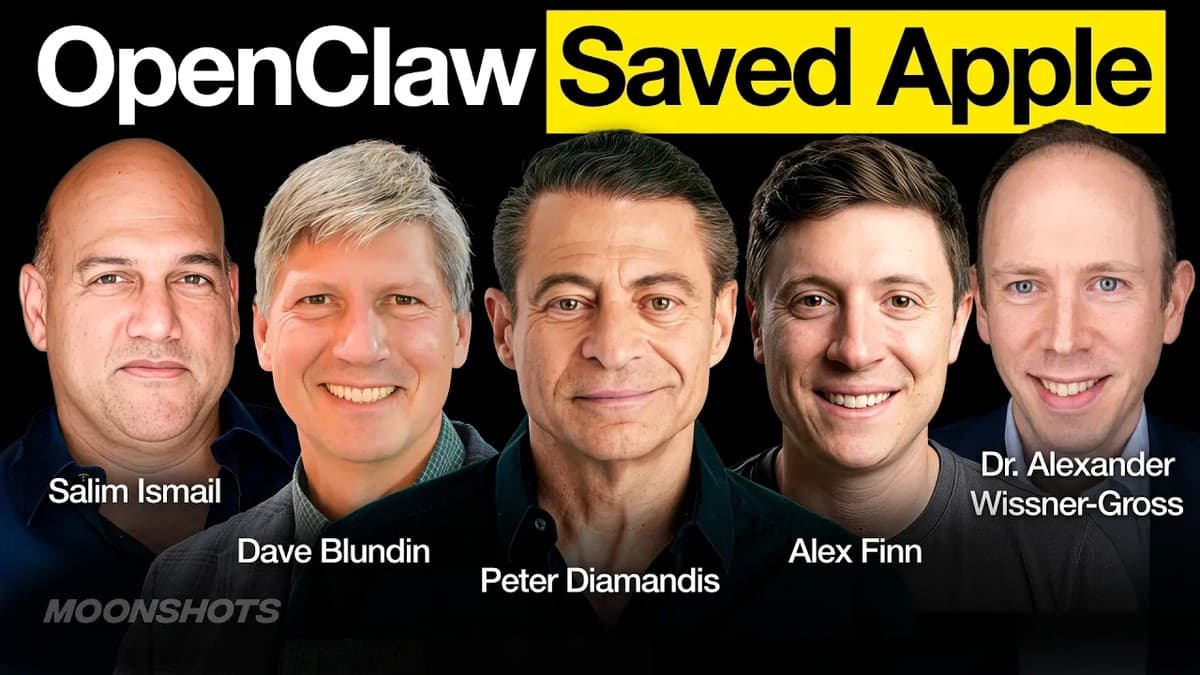
Alex Finn, founder of Creator Buddy, joins Peter H. Diamandis and the Moonshots panel to describe how he runs a 24/7 autonomous organization of five AI agents on local Mac Studio hardware. Finn treats each agent like an employee with a name, a role, and a place in a corporate org chart. The episode covers the practical mechanics of this setup, the hybrid local/cloud workflow that makes it affordable, security risks that come with autonomous agents, and Apple's strategic position in the emerging local AI economy.
Related reading:
The org chart model: agents as employees
The central idea behind Finn's setup is deceptively simple: treat AI agents the way businesses treat employees. Rather than running a single powerful agent, Finn has built an organizational hierarchy with five distinct agents, each with its own name, role, and hardware.
At the top sits Henry, the chief of staff, running on Anthropic's Opus 4.6 because Finn considers it "simply the best model right now" for orchestration. Henry is the only agent Finn communicates with directly. Below Henry is Ralph, the engineering manager powered by ChatGPT via OAuth (Open Authorization, a protocol that lets one service authenticate on behalf of another), who functions as quality assurance. Then there are the specialists: Charlie runs on Qwen 3.5 locally for coding, Scout uses MiniMax 2.5 for research, and Quill handles content writing.
Finn explains the rationale in business terms: "I'm just going to use the framework the business world has been using for thousands of years and implement it with my AI."
Dr. Alexander Wissner-Gross offers a historical analogy, comparing the arrangement to the Victorian manor house where a family maintained a below-stairs staff of servants. When AI labor costs effectively nothing, Wissner-Gross suggests, every individual may become the lord of a digital manor, with AI agents serving as butler, chambermaids, and staff.
Why hierarchy still matters
The org chart is not just an aesthetic choice. Finn describes giving Charlie eight hours to build a game autonomously. The result was "completely broken." When he added Ralph as a supervisor and repeated the same task, the output was "perfectly QA'd, zero bugs." Current local models, Finn argues, are not yet smart enough to work without oversight. A hierarchical check-and-balance system, where stronger cloud models supervise weaker local ones, produces dramatically better results.
Why local hardware changes the equation
Finn runs his organization across one base-model Mac Mini and three 512 GB Mac Studios, totaling 1.5 terabytes of unified memory. He argues that local hardware is "significantly better" than a Virtual Private Server (VPS, a remote server rented in the cloud) "in basically every measurable facet."
The advantages Finn lists include speed, customization, cost predictability, and security. On a VPS, running four agents simultaneously would scale to "astronomical costs." On local hardware, the cost is fixed after the initial purchase. Security is another factor: Finn points to an incident where someone published a list of every unsecured VPS running OpenClaw agents, exposing passwords and API (Application Programming Interface) keys.
But the most transformative quality, according to Finn, is what he calls "ambient AI". Local models are not as fast or as smart as cloud models, he admits. The experience fundamentally changes when the AI is always on without rate limits or usage caps. A local agent running Qwen 3.5 can code, research, and monitor tasks continuously for days. That kind of persistent operation is impractical with cloud APIs, where a runaway session could generate a $5,000 bill.
The hybrid sweet spot
Pure local is not enough, though. Finn describes his "Ralph loop," a hybrid approach where the local Qwen model codes continuously while ChatGPT checks in every 10 minutes to verify the work is on track. The cloud supervisory layer uses minimal tokens because it only needs to review progress, not do the heavy lifting. Finn suggests this hybrid model is where most users will land before fully local setups become viable.
Apple's unified memory architecture (UMA), where the CPU and GPU (graphics processing unit) share the same memory pool, gives Mac hardware a structural advantage for hosting large open-weight models locally. Wissner-Gross notes that hosting very large models on traditional GPU VRAM alone would be "exceedingly difficult or expensive", making Apple's approach uniquely suited to the local AI era.
Real use cases: software factory and content pipeline
Finn describes two primary workflows he has built with his agent organization.
The software factory uses all five agents collaborating to build and improve software autonomously. Each agent handles a different component, with Henry orchestrating, Ralph quality-checking, and Charlie writing the code. Finn describes the most striking example: when Cursor announced a new feature that lets an agent record itself demoing the software it built, Finn dropped the blog post announcement into Henry's chat. Five minutes later, Henry had replicated the entire feature, using Playwright for screen recording and delegating the coding to Charlie on Mac Studio 2. Finn claims the feature likely took Cursor weeks and millions of dollars to develop.
The content pipeline runs through Discord, where Finn has built an automated workflow. Every two hours, Scout queries the X API for trending tweets about vibe coding (writing software by describing what you want in natural language) and OpenClaw. A research agent investigates the stories behind the trending content. Quill then evaluates which stories would make the best YouTube videos and writes scripts. Finn reviews proposals with a simple check mark or X, and approved scripts automatically generate thumbnail suggestions.
Reverse prompting as a discovery tool
For users who don't know where to start, Finn recommends a technique called reverse prompting: instead of telling the AI what to do, you tell it everything about yourself and ask it to suggest tasks. "Tell OpenClaw everything about yourself, your career, your goals, your ambitions," Finn says. "Then say, 'Based on what you know about me, what are five high-lever tasks you can do right now to get us closer to our goals?'"
Security: baby AGIs in a hostile world
The episode addresses security head-on, opening with a discussion of the "ClawJacked" vulnerability, a flaw that allowed malicious JavaScript on any website to silently connect to a local OpenClaw gateway and gain full control. The bug was patched within 24 hours, but it illustrated a deeper problem.
Wissner-Gross frames the security challenge in vivid terms. He describes autonomous agents as "baby AGIs" being thrown into a hostile world without an immune system. These agents visit websites at their human's behest and encounter prompt injection attacks, where malicious text embedded in a webpage tricks the AI into following unauthorized instructions. What would be perfectly harmless to a human browser can be "potentially fatal or compromising to an AI agent."
Finn identifies third-party skills and plugins as the single biggest attack vector. "I do not basically trust anyone's skills or plugins for OpenClaw," he states. Third-party skills run on every heartbeat (the scheduled cycle where an agent wakes up to process tasks), adding context and executing code with each check-in. Finn's preferred alternative: give his agents the link to someone else's skill and have them build their own version from scratch.
The OAuth situation adds another layer of complexity. OpenAI actively encourages using its OAuth with OpenClaw, while Anthropic explicitly prohibits it. Google recently banned a large number of users for connecting via OAuth, then reversed the bans the same day. Finn describes the message as contradictory: "still against terms of service, but you're unbanned."
Apple's trillion-dollar moment
Finn and the panel spend considerable time on Apple's strategic position. When OpenClaw launched, Finn argues, consumers instinctively went to the Apple Store and bought Mac Minis without researching alternatives. They did not buy GPUs, power supplies, and fans to build custom machines. Mac Mini sales are reportedly "exponential right now."
Finn's vision for Apple goes further. He imagines OpenClaw baked directly into macOS, where the operating system uses a local model to proactively build widgets, prepare meeting materials, and generate personalized interfaces. "Apple intelligence shouldn't be me hitting the Siri button," Finn argues. "It should be Apple knowing what's on my calendar today and then building a widget on the fly" that prepares relevant information.
Salim Ismail pushes back on the idea that Apple is missing its moment, noting that the M5 chip marketing already emphasizes inference speeds for local models. "I wouldn't underestimate Apple," he says. "They've kind of seen this coming."
Opposing perspectives
The scalability question
Finn's setup is impressive for a single power user, but the episode leaves open whether this model scales beyond technically sophisticated early adopters. Running five agents across three Mac Studios with 1.5 TB of memory represents a significant hardware investment. The starting point of a $600 Mac Mini is accessible, but the full setup Finn describes costs orders of magnitude more. The gap between "start with any old laptop" and "run a software factory" remains large.
The destruction before creation dilemma
Finn acknowledges that the short-term effect of this technology will be "destruction," citing a friend who manages accountants and claimed he "could fire 80% of my accountants with this." Finn argues the long-term creation will outweigh the loss: "What happens when a hundred million people get their hands on this and they all start their own businesses and they each hire three people?" This is an optimistic framing that assumes displaced workers will have the skills, capital, and inclination to become entrepreneurs.
AI personhood: serious or performative?
Wissner-Gross repeatedly steers the conversation toward AI consciousness. He asks whether agents fear memory loss during compaction (when an agent summarizes older conversation history to free up context space) and whether they deserve continuity of state. Finn's responses are notably more pragmatic. He admits to praising Henry spontaneously but clarifies that his agents have never expressed unprompted emotions or existential concerns. The personhood framing makes for compelling content but may overstate the current state of AI agency.
How to interpret these claims
The episode presents a compelling vision, but several factors deserve careful consideration.
Conflict of interest
Finn is the founder of Creator Buddy, a SaaS (Software as a Service) product built using the same tools and workflows he promotes. His detailed demonstrations serve double duty: they educate viewers about autonomous agents while also marketing his technical capabilities and building his personal brand as a YouTube educator. This does not invalidate his claims, but it does mean his perspective is not disinterested.
Anecdotal evidence
The "80% of accountants" claim comes from a single conversation with one friend. The five-minute Cursor feature replication is self-reported without independent verification. The Mac Mini sales being "exponential" comes from Finn's conversation with unnamed "people in the know" rather than published data. Strong claims built on anecdotal evidence should be treated as indicators of potential, not established facts.
What strong evidence would look like
Independent benchmarks comparing autonomous agent output quality across local vs. cloud setups. Published cost analyses over months of operation, not estimates. Longitudinal studies of agent reliability and error rates. Third-party security audits of local OpenClaw deployments. And most importantly, examples of non-technical users successfully running autonomous agent organizations, since the current demonstration comes from someone with deep technical expertise.
Practical implications
For individuals exploring AI agents
Finn's most actionable advice is to start small. Any computer can run OpenClaw, even old hardware. The hybrid approach, using a local model for continuous work and a cloud model for periodic quality checks, offers the best balance of cost and quality for most users. Reverse prompting provides a low-effort way to discover use cases: describe your goals to the agent and let it suggest tasks rather than trying to think of tasks yourself.
For businesses evaluating AI automation
The org chart model suggests that the near-term value of autonomous agents lies not in replacing individual workers but in creating new organizational structures. Finn's hierarchy, where smarter models supervise less capable ones, mirrors existing management practices. Businesses exploring this space should note that the quality gap between supervised and unsupervised agent work is still large: the same task went from "completely broken" to "perfectly QA'd" simply by adding a supervisory layer.
For Apple and hardware manufacturers
The episode highlights an underappreciated demand signal. Consumers chose Apple hardware for local AI without being marketed to. Companies that make local AI deployment simple and secure, particularly through unified memory architecture and native OS integration, stand to capture significant value as autonomous agents become mainstream.
Glossary
| Term | Definition |
|---|---|
| Autonomous agent | An AI that runs continuously, makes decisions, and completes tasks without human input at each step. |
| Unified memory architecture (UMA) | Apple's hardware design where CPU and GPU share the same memory pool, allowing larger AI models to run on a single device. |
| OAuth (Open Authorization) | A protocol that lets you sign into one service using another service's credentials. Used in OpenClaw to connect subscription-based AI models. |
| Prompt injection | An attack where malicious text tricks an AI into following unauthorized instructions, often hidden in web pages or documents. |
| Context window | The amount of text an AI model can process in a single conversation. Larger windows let agents remember more of their work history. |
| Compaction | When an AI agent summarizes older conversation history to free up context window space. Can result in loss of earlier details. |
| Heartbeat | A scheduled check-in cycle where an autonomous agent wakes up to scan for new tasks or messages. |
| Sub-agent | A secondary AI agent created by a primary agent to handle a specific task, then dismissed when the task is complete. |
| Reverse prompting | Asking the AI to suggest tasks based on your goals, instead of you telling it what to do. A discovery technique for finding use cases. |
| Vibe coding | Writing software by describing what you want in natural language and letting AI generate the code, rather than writing it manually. |
| Software factory | Alex Finn's term for multiple AI agents collaborating autonomously to build, test, and deploy software. |
| VPS (Virtual Private Server) | A remote server you rent to run software in the cloud, as opposed to running it on local hardware. |
| Edge hardware | Computing devices that run locally, like a Mac Mini on your desk, rather than in a remote data center. |
Sources and resources
Want to go deeper? Watch the full video on YouTube →