Stop Asking If AI Will Take Your Job
Key insights
- ACI (Artificial Capable Intelligence) is a concrete deadline, not speculation. It describes the point where AI can handle complex, ambiguous goals with minimal oversight. Beauchene argues it will arrive much sooner than AGI, which is still theoretical.
- Soft skills are not a safe haven. Many people already find AI more empathetic than humans, because it never gets tired, irritable, or judgmental. The edge we assumed was ours is shrinking.
- Freelancers spend an average of four hours per week learning. Employees spend none. Organizations say they want to adapt, but most are structurally built to prevent it.
This is an AI-generated summary. The source video may include demos, visuals and additional context.
In Brief
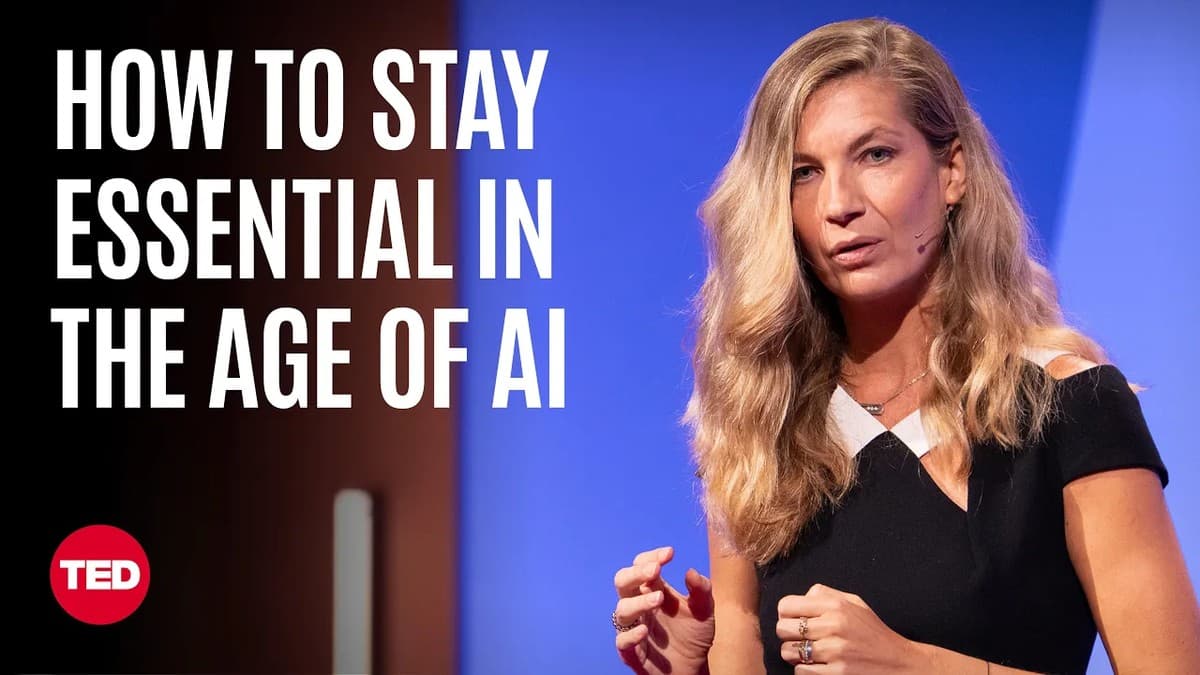
Vinciane Beauchene, Managing Director and Partner at BCG (Boston Consulting Group, a global management consulting firm), gave this talk at TED@BCG in October 2025. Her argument is simple but uncomfortable: leaders are asking the wrong question about AI. Instead of "will AI take our jobs?", she asks her clients: "If an AI could take over all of your team's tasks, who would you keep and why?" That question, she says, forces real strategic thinking — not just anxiety.
Related reading:
The sales team that flipped the model
Beauchene opens with a real case from a consumer goods company. They wanted to rebuild their entire sales operation around AI agents (autonomous software systems that can plan, take action, and adapt without a human directing every step). The vision was a fully automated sales engine: AI targets the customer, makes recommendations, negotiates, and closes the deal.
It was technically possible. But someone asked the right question: if the machine does all of this, what's left for humans?
When they looked at their most loyal customers, the answer was clear. Those customers weren't sticking around because of prices or products. They stayed because of how the sales rep made them feel. So the company flipped the model. Humans shifted from pushing products to building relationships, belonging, and loyalty. New skills, new incentives, a completely different mindset. It worked.
Three myths she wants to retire
Beauchene calls out three beliefs she sees holding companies back.
Myth 1: "We've always adapted, we'll figure it out." Yes, but previous industrial revolutions took generations. This one won't. Only 13 percent of companies have embedded AI agents in their workflows today, but technology moves exponentially. She warns that if you're not preparing now, you'll struggle to keep up.
She draws a sharp distinction here. She's not talking about AGI (Artificial General Intelligence, the hypothetical future where AI is smarter than humans at everything). She's talking about ACI: Artificial Capable Intelligence, the point where AI can handle ambiguous, complex goals with minimal oversight. AGI is speculative. ACI, she says, is a deadline.
Myth 2: "Soft skills are our edge." It's a comforting idea that creativity and empathy are uniquely human. But the evidence is pushing back. More and more people prefer interacting with AI precisely because it feels more empathetic. AI doesn't get tired. It doesn't get irritable. It doesn't judge you. The moat we thought we had is shrinking.
Myth 3: "We need to protect jobs." 41 percent of employees believe their job will disappear in the next decade because of AI. But protecting jobs, Beauchene argues, is like anchoring a boat in a storm. Jobs are fixed. Human potential is not. The problem is that most organizations aren't built for ongoing adaptation: org charts are static, career paths are narrow, and training is occasional.
What the best companies are actually doing
Beauchene describes a blueprint based on the boldest clients she has worked with.
Start with strategy, not technology. The question isn't "what can AI do?" It's "what outcomes differentiate us in the market, and where do people still make things better?" This isn't incremental improvement. It's a full rethink of how work gets done.
Build a skills map. One of her clients in consumer goods had to reformulate their entire product portfolio while maintaining quality and innovation. AI unlocked the productivity they needed, but the deeper work was reinventing the researcher's role. From solo chemist to data-driven biologist working across departments instead of alone. They mapped the future skills they needed precisely, then built a structured training program to get there.
Invest in people systematically. This is where Beauchene gets blunt. Freelancers spend an average of four hours per week learning. Employees spend none. Organizations talk about human potential but don't protect time for it. She argues the smartest companies will invest in all talent, not just technical roles, and do it continuously, not once.
Her reasoning: when interacting with AI becomes the new normal, it becomes a commodity (something everyone has access to, with no competitive edge). The moment that happens, human interaction takes on a completely different value. Trust. Authenticity. Accountability. Those qualities will matter more, not less.
The question that actually matters
Beauchene ends with a reframe. Stop asking whether there will still be jobs for humans. Start asking: what do we want humans to be best at?
"Being human isn't a fallback, it's a practice."
That line captures her whole argument. Human value in an AI-driven workplace won't happen automatically. It has to be built, deliberately, by leaders willing to do the uncomfortable strategic work of figuring out where people make a difference and why.
Glossary
| Term | Definition |
|---|---|
| AI agents | AI systems that can plan, take action, and adapt on their own, without a human directing each step. More capable than simple chatbots. |
| ACI (Artificial Capable Intelligence) | The point where AI can handle complex, ambiguous goals with minimal human oversight. Beauchene uses this as a concrete near-term milestone, distinct from the more speculative AGI. |
| AGI (Artificial General Intelligence) | A hypothetical future AI that would be smarter than humans across all areas. Still theoretical. No one has built it. |
| Turing test | A test proposed by mathematician Alan Turing in the 1950s: if you can't tell whether you're talking to a machine or a human, the machine must be intelligent. Most chatbots pass it easily today. |
Sources and resources
Want to go deeper? Watch the full video on YouTube →