Public.com Gives Retail Investors AI Agents
Key insights
- Natural language replaces order forms. You tell the AI what outcome you want, not how to execute it. This is the same shift happening across all of AI: from clicking buttons to describing goals.
- Strategies like covered calls and put options used to require expert knowledge. AI agents now make them accessible to anyone with a brokerage account.
- 50% of AI agent conversations led to a trade within 24 hours. Removing friction turns intent into action far more often than traditional interfaces.
- Malling frames this as the fourth era of brokerage: phone, internet, mobile, and now AI. The agentic broker goes back to full-service, but at a scale no human advisor could match.
This is an AI-generated summary. The source video may include demos, visuals and additional context.
In Brief
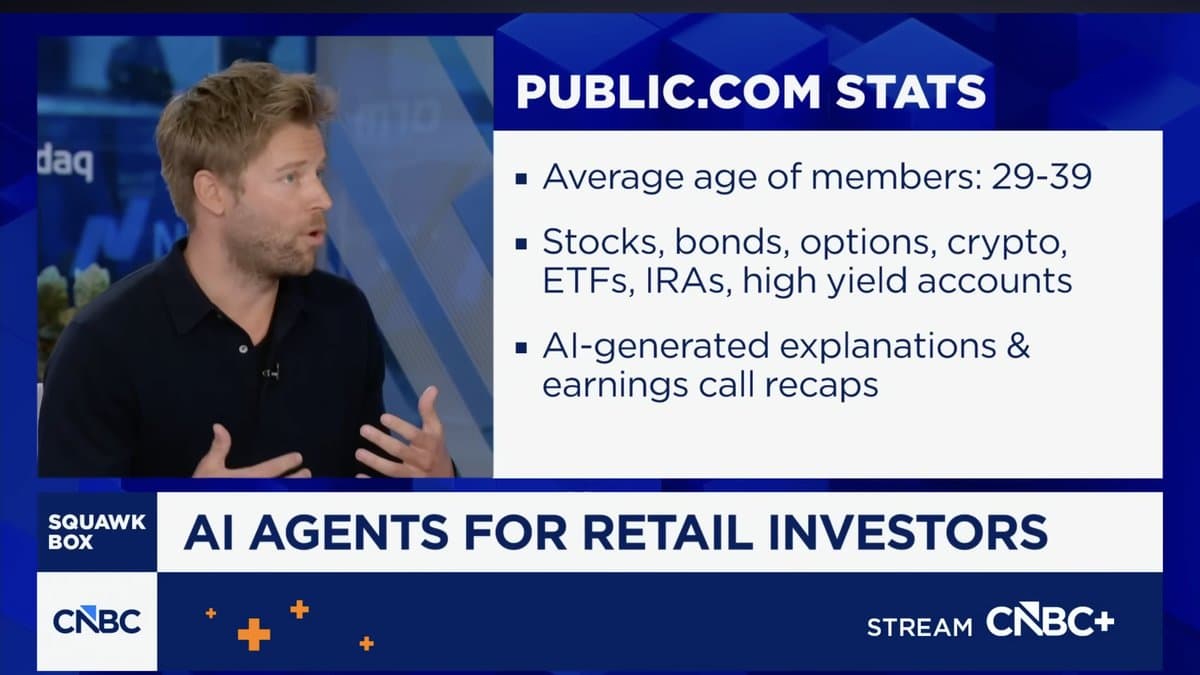
Jannick Malling, co-founder and co-CEO of Public.com (an investing platform where you buy and sell stocks, bonds, and other financial products), appeared on CNBC Squawk Box to announce a major new feature: AI agents built directly into their app. These agents can monitor markets, move money automatically, and execute complex investment strategies, all triggered by ordinary conversation. The typical Public.com member is between 29 and 39 years old and invests in stocks, bonds, cryptocurrency, and options. Until now, using advanced investment strategies required expertise. That is changing.
Related reading:
What is a brokerage, and why does this matter?
Before diving in, a quick explanation of some financial terms that appear throughout this article.
A brokerage (or brokerage account) is simply a company or app that lets you buy and sell investments: stocks, bonds, and other financial products. Think of it as a marketplace for investments, like an online store, but for financial products. Public.com is a brokerage.
A stock is a small piece of ownership in a company. If you own Apple stock, you own a tiny fraction of Apple. Stocks go up and down in value.
Bonds are a different kind of investment. When you buy a bond, you are essentially lending money to a company or government, and they pay you back with interest. Bonds tend to be more stable than stocks.
Options are a more advanced type of investment. An option gives you the right to buy or sell a stock at a specific price, before a specific date. You don't have to use that right, but you pay a small fee to have it. Options are powerful tools, but they are also complex. Most ordinary investors have never used them.
How the AI agents work
Inside the Public.com app, there is now a tab called "Agents." You open it, start a conversation with an AI, and describe what you want in plain language (just talking normally, like you would to a friend). The AI turns your description into a working investment strategy and runs it on your behalf.
Malling describes three agents he runs himself:
Agent 1: Oil price hedge. Every morning, this agent checks oil prices. If they spike suddenly, it automatically buys protective put options as a hedge. A put option is like insurance for your investments: you pay a small amount now, and if the price of something you own drops dramatically, you are protected. It works like travel insurance. You hope you never need it, but you are glad it is there if something goes wrong. Hedging means protecting yourself against losses, like putting on a raincoat before there is any sign of rain.
Agent 2: Cash management. This agent takes idle cash sitting in his bank account and moves it automatically into a bond portfolio (a collection of bonds) to make sure his money is always earning as much interest as possible.
Agent 3: Covered call scanner. Every day, this agent scans his entire portfolio looking for opportunities to earn extra income through covered calls. A covered call works like this: you already own a stock, and you sell someone else the right to buy it from you at a higher price in the future. If the stock never reaches that price, the deal expires and you keep the money they paid you. Think of it like renting out a parking spot you are not currently using. Malling's agent alerts him when there is a low-risk way to potentially earn $5,000 in a single week this way.
The big shift: from filling in forms to describing goals
This is the core idea behind what makes AI agents different from regular investing apps.
Until now, investing meant manually entering specific orders. You would type something like: "Buy 200 shares of Apple at this exact price." You had to know exactly what you wanted to do, and exactly how to do it.
Malling describes the new approach: "Instead of 'buy 200 shares of Apple at this price,' the command might be 'increase my position if valuations compress another 15% from here.'" In other words, you describe the outcome you want, and the AI figures out how to get there.
This is a meaningful shift. You do not need to understand option chains (big tables showing all available options for a stock, with different prices and expiry dates, overwhelming for most people), Greek letters, or the fine details of how each strategy works. You just describe your goal in plain language and the AI handles the rest.
One of the hosts on Squawk Box put it well: "Sometimes you get busy during the day and you want to implement these things. It's much easier to verbally speak it as input as opposed to putting limit orders in there."
Safety and control: no surprises
A natural question is: can the AI go rogue? Can it make unexpected decisions that lose you money?
Malling is clear about how this is handled. Once you set up a strategy, it runs in a fully deterministic workflow. Deterministic means it does the exact same thing every time, following strict rules. There are no surprises, no creativity, and no improvisation. The AI cannot deviate from the plan you agreed on.
Malling says there can be "no hallucinations or any improvisations on your account." Hallucination is the term used in AI for when a language model makes something up. It can be a serious problem in some contexts. By running the actual trading through a rigid, rule-based system (not through the language model itself), Public.com separates the creative part (setting up the strategy) from the execution part (following the rules exactly).
You can also always see exactly what the AI is doing. Everything runs transparently inside your account. You stay in control at every step.
When setting up a covered call strategy, for example, the AI asks you some questions about your risk tolerance (how much loss you are comfortable with), then presents you with two or three options to choose from. You pick the one that fits you. After that, the agent handles the execution automatically.
The numbers: AI really does get people to act
Since launching the AI agents, Public.com has seen a striking result: 50% of conversations with the AI led to an actual trade within 24 hours.
That is a remarkable number. It suggests that the friction (the complexity of learning option chains, understanding strike prices, figuring out the right strategy) is what stops most people from acting. When AI removes that friction, people actually invest.
The agents are also free of charge for Public.com customers. You can run as many as you want simultaneously and compare how they would affect your portfolio before committing to anything.
The four eras of brokerage
Malling offers a memorable framing of what this moment means historically. He describes four distinct eras in how investing has worked:
- Phone broker. You called a human broker on the phone. They would research investments, call you with ideas, and execute trades on your behalf. It was full service, but expensive and exclusive.
- Discount broker. The internet arrived. Now you could place your own orders online, cheaply. But the human guidance disappeared.
- Neo broker. Mobile apps made investing even simpler and more accessible. But still no real guidance.
- Agentic broker. AI brings the guidance back. But instead of a human broker serving a few dozen clients, an AI agent can serve everyone simultaneously, and execute strategies that would take a human analyst hours to set up, in seconds.
Malling's point is that the agentic era is a return to full service, but at a scale and speed that no human broker could achieve. Your old-fashioned broker called you with trade ideas. Your new AI agent monitors markets continuously and acts the moment conditions are right.
Right now, the agents are reactive: a user starts the conversation and sets up the strategy. But Malling hints that proactive suggestions are coming soon, where the AI reaches out to you with opportunities rather than waiting for you to ask. He says this is not a distant vision: "I'm not talking the long-term future."
Glossary
| Term | Definition |
|---|---|
| Brokerage | A company or app where you buy and sell investments like stocks, bonds, and options. Public.com is a brokerage. |
| Stock | A small piece of ownership in a company. If you own a stock, you own a fraction of that company. |
| Bond | A loan you make to a company or government. They pay you back with interest over time. More stable than stocks. |
| Option | A contract giving you the right (but not the obligation) to buy or sell a stock at a specific price before a specific date. You pay a fee to have this right. |
| Covered call | You own a stock and sell someone else the right to buy it at a higher price. If they never buy it, you keep the fee they paid, like renting out something you are not using. |
| Put option | Insurance for your investments. You pay a small fee now, and if the price of something you own drops badly, you are protected against the full loss. |
| Hedging | Protecting yourself against potential losses, like an umbrella for your investments. You hope you don't need it, but you are glad to have it. |
| AI agent | A program that can act on your behalf. Unlike a chatbot that just answers questions, an agent actually does things: monitors markets, moves money, executes trades. |
| Deterministic | Does the exact same thing every time, following strict rules. No surprises, no improvisation, just follows the recipe exactly. |
| Natural language | Just talking normally, the way you would speak to a friend, instead of filling out technical forms or clicking through menus. |
| Option chain | A table showing all available options for a stock, with different prices and expiry dates. Useful for experts, but overwhelming for most people. |
| Neo broker | A newer type of brokerage built for mobile phones, often with simpler interfaces and lower fees. |
Sources and resources
Want to go deeper? Watch the full video on YouTube →