Apple Lost the First AI Round. That May Help
Key insights
- Apple's AI delay may double as capital discipline. Rivals are spending heavily on data centers and models while Apple can let others absorb the most expensive phase.
- The same privacy and control instincts that made Apple strong in consumer tech also slowed it in an AI race driven by data scale, scraping, and cloud spending.
- Opening Siri to rival chatbots and leaning on Gemini points to a distribution strategy: Apple may try to own the interface even if it does not own the best model.
This is an AI-generated summary. The source video may include demos, visuals and additional context.
In Brief
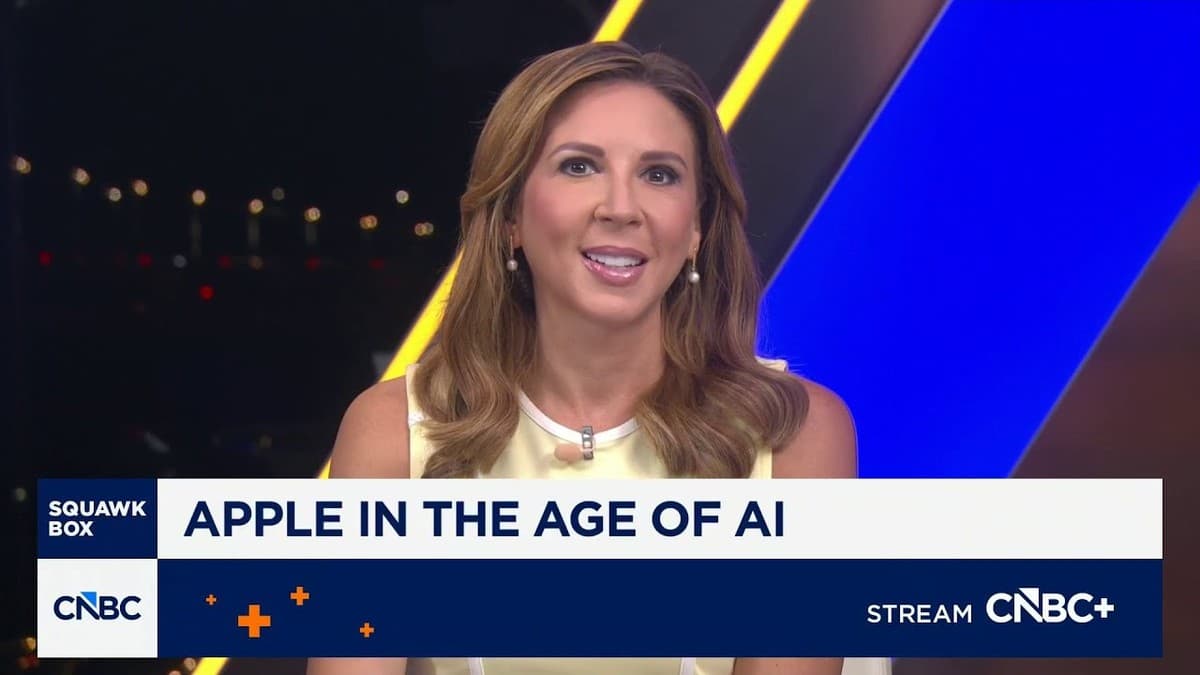
CNBC's MacKenzie Sigalos frames Apple's 50th birthday as an awkward milestone: the company is losing the AI race, opening Siri to rival chatbots, and leaning on Gemini to catch up. But the report also makes a sharper point: Apple's delay may be protecting it from the most expensive part of the AI boom while rivals burn cash on infrastructure and model wars.
Related reading:
Apple missed the first phase
Sigalos says people who helped build Apple all told her the same thing: Apple lost the first round of AI. That is a strong claim for a company that usually insists on controlling its own stack, meaning the hardware, software, and services that make the product work together.
The report's explanation is blunt. Apple's privacy mantra also made it slower in an AI market that rewarded scale, scraping, and massive cloud spending. Those traits helped Apple build trust in the smartphone era, but they were a disadvantage once generative AI started rewarding whoever could train fastest on the biggest infrastructure.
That matters because it suggests Apple's problem is not just Siri. It is cultural and structural. A company built to move carefully, protect user data, and polish integrated products now has to compete in a field that has rewarded fast iteration, loose experimentation, and enormous capital expenditure.
The pivot is already visible
The most obvious sign of that shift is opening Siri to rival chatbots. Instead of insisting that its own assistant do everything, Apple appears more willing to let outside models handle more of the intelligence layer.
Sigalos also says Apple is leaning on Google's Gemini models to help close the gap. That is a meaningful sign Apple is willing to compromise. When Apple relies on a rival's model family, it signals that being fully in-house matters less than delivering something useful quickly.
Seen that way, Apple's strategy looks less like surrender and more like repositioning. If the best models come from elsewhere, Apple can still try to control the front door: the device, the operating system, the assistant entry point, and the commercial relationship with users.
Why investors may still like the setup
The segment's most interesting twist is financial, not technical. Sigalos notes that Meta, Alphabet, and Microsoft have been punished by investors for pouring hundreds of billions into capital expenditure, meaning long-term spending on chips, servers, and data centers, while OpenAI and Anthropic are spending the cash they raise on compute and talent.
Then comes the contrast: Apple closed the quarter as the best performer in the Mag 7, the group of seven giant US tech companies. That creates a strange possibility: Apple can look behind in AI and careful about how it spends money at the same time.
This does not mean Apple is winning. It means the market may now be separating two questions that were blurred together in 2025: who builds the best models, and who captures the most durable business value from AI. Apple may still have an answer to the second question even if it stumbled on the first.
The real bet
The final quote in the clip says Siri needs a "brain transplant" before it becomes genuinely useful again. That is an apt summary of Apple's current position. Apple does not just need better features. It needs a better intelligence layer underneath them.
But the company has survived this kind of criticism before. Apple often enters late, watches other firms take the first wave of risk, and then uses distribution, design, and ecosystem control to turn a late arrival into a mass-market advantage. The AI era may test that playbook harder than previous cycles, but this short CNBC report makes clear that Apple is still playing a recognizable Apple game.
Glossary
| Term | Definition |
|---|---|
| Stack | The layers of hardware, software, and services a company controls to make a product work. |
| Capital expenditure (capex) | Long-term spending on infrastructure such as chips, servers, and data centers. |
| Model wars | The race between AI companies to build and fund the strongest foundation models. |
Sources and resources
Want to go deeper? Watch the full video on YouTube →