AI Embryo Screening Blurs Medicine and Design
Key insights
- Bundling disease prevention and cosmetic trait selection on the same platform makes it nearly impossible to regulate one without the other
- $32 million in funding shows investor appetite is running ahead of the scientific consensus on predicting complex traits like IQ from DNA
- The platform markets probabilistic guesses about polygenic traits with the same confidence as high-certainty single-gene disease screening, blurring a critical scientific distinction
This is an AI-generated summary. The source video may include demos, visuals and additional context.
In Brief
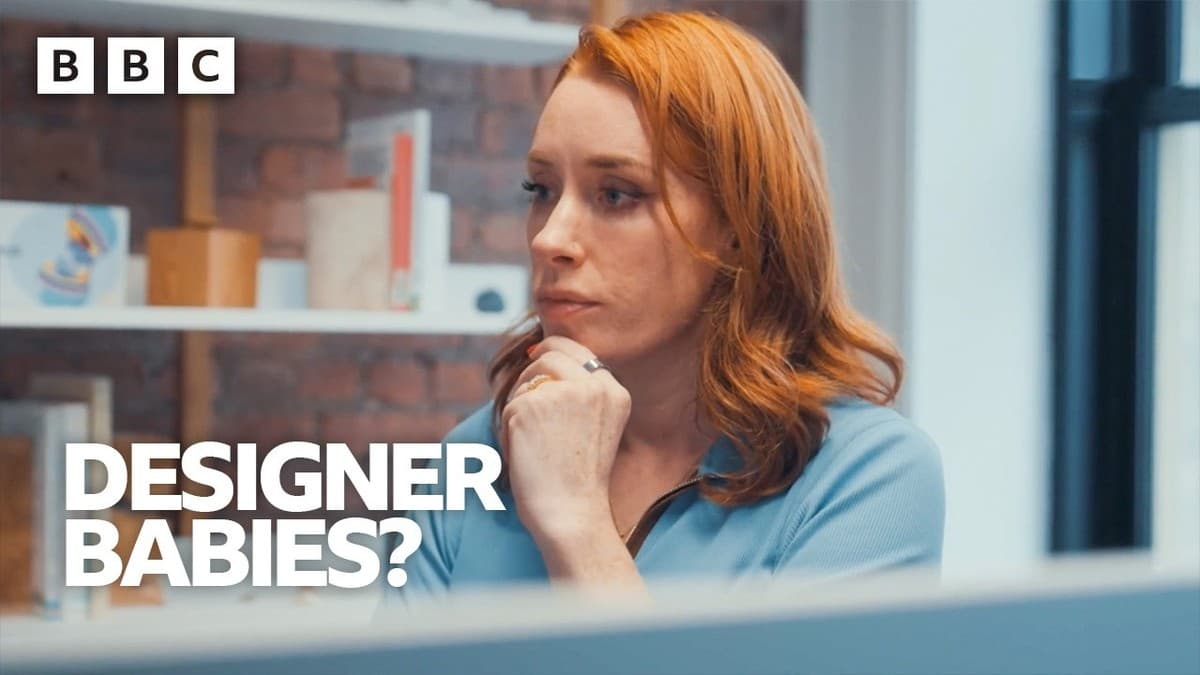
In a new episode of BBC's AI Confidential, mathematician Hannah Fry visits Nucleus Genomics. The startup, founded by 25-year-old Kian Sadeghi, uses AI to analyze embryo DNA for parents going through IVF (in vitro fertilization, where eggs are fertilized outside the body). The company has raised $32 million and offers screening not just for genetic diseases, but also for traits like height, eye color, and IQ. Fry challenges Sadeghi directly, calling it "designer babies" and drawing a parallel to eugenics, the historically discredited practice of selective breeding. Sadeghi rejects the label and frames it as parental choice.
Related reading:
The pitch: genetic optimization as parental empowerment
Sadeghi's company sits at the intersection of AI and reproductive medicine. Nucleus Genomics uses AI algorithms to map each embryo's DNA, comparing it against large DNA databases to predict a baby's future disease risk. Some conditions caused by a single gene can be predicted with high certainty. For complex traits influenced by many genes (called polygenic traits), the predictions are more like statistical probabilities than diagnoses.
The company's new advertising campaign leans into the language of personal freedom. "Every parent deserves the power to decide what possibility feels right for their family," the ad states. "Some people don't think you should have this choice, but it's not their choice to make. It's yours."
Sadeghi frames the service as a natural extension of existing medical practice. When parents have a family history of Alzheimer's or cancer, he argues, genetics can help them make informed decisions. The moment a child is born, hospitals already run multiple health tests and administer vaccines. In his framing, embryo screening is simply "another tool in the toolkit."
Where Fry draws the line
Fry is clear about where the medical case ends and something more troubling begins. She acknowledges that screening for preventable or treatable genetic diseases is "amazing." But she presses Sadeghi on why the platform also includes IQ and eye color.
"It's a little bit eugenicsy," Fry tells him. By letting parents select for height or intelligence, the platform implicitly says taller or smarter is better. "You are reinforcing the ideas of preferences that some people are more valuable than others," she argues.
Sadeghi pushes back. Parents already make countless choices that shape a child's life, he says. If a parent "wants a baby with lower disease risk" or one that's "slightly taller or even with a specific eye color," that's their right.
Fry is unconvinced. "This is designer babies, though," she says bluntly. Sadeghi denies it. The exchange captures a disagreement that runs deeper than marketing language. It's about whether giving parents genetic information is meaningfully different from letting them design a child.
The science gap Fry worries about
Beyond the ethics, Fry raises a practical concern about accuracy. Even the best scientists don't fully understand how genes and environment combine to shape a person. DNA contributes to complex traits like intelligence, but so do nutrition, upbringing, stress, education, and thousands of unpredictable life events.
Fry asks whether the technology is "mature enough, accurate enough" to be giving people the "illusion that they have control." Sadeghi responds that the platform shows uncertainty. It makes clear that "DNA is not destiny," he says.
That response highlights an internal tension in Nucleus Genomics' own positioning. The advertising talks about "the power to decide," while the founder says DNA will never be destiny. Both things cannot be equally true. If DNA is not destiny, then choosing an embryo based on a polygenic trait score offers far less control than the marketing implies.
How to interpret these claims
This segment raises several questions worth considering before forming a strong opinion.
The bundling problem
Nucleus Genomics puts single-gene disease screening and cosmetic trait selection on the same platform. Screening for cystic fibrosis (caused by one gene, highly predictable) and screening for IQ (influenced by thousands of genes, weakly predictable) are scientifically very different things. By packaging them together, the company makes it harder for regulators or consumers to accept one while rejecting the other. If you approve the disease screening, the trait selection comes along for the ride.
The funding signal
The company has raised $32 million from investors. That level of funding suggests the market is moving regardless of whether the ethical debate is settled. Products like this are already commercially available, which means regulation is playing catch-up rather than setting boundaries in advance.
What the segment doesn't show
The episode is under five minutes, so several important questions go unaddressed. How accurate are the polygenic trait predictions in practice? What do independent geneticists think about the platform's claims? Are there peer-reviewed studies validating the approach? Fry raises the right questions, but the segment doesn't have time to dig into the evidence. Viewers should look for independent scientific reviews before drawing firm conclusions.
The analogy problem
Sadeghi compares embryo screening to vaccines and postnatal health checks. But vaccines don't ask parents to choose between children based on predicted traits. They protect whoever the child turns out to be. The analogy breaks down precisely where the ethical tension is highest.
Glossary
| Term | Definition |
|---|---|
| Genetic optimization | Using DNA analysis to select embryos with desired genetic traits before implantation. |
| IVF (in vitro fertilization) | A fertility treatment where eggs are fertilized outside the body and the resulting embryos are implanted in the uterus. |
| Embryo screening | Analyzing an embryo's DNA before implantation to assess its genetic traits or disease risk. |
| Polygenic trait | A characteristic influenced by many genes at once (like height or intelligence), making it much harder to predict than single-gene conditions. |
| Single-gene disease | A disease caused by a mutation in one specific gene, such as cystic fibrosis or sickle cell disease, which can be predicted with high certainty. |
| Eugenics | The historically discredited practice of selective breeding to "improve" human traits, associated with forced sterilization and Nazi ideology. |
| Designer babies | A colloquial term for babies whose genetic traits have been selected or modified before birth. |
| Genetic predisposition | Having genes that increase the likelihood of developing a condition, without guaranteeing it will occur. |
Sources and resources
Want to go deeper? Watch the full video on YouTube →