Karpathy: Everything Is a Skill Issue Now
Key insights
- Karpathy went from 80/20 manual-to-agent coding to nearly 0/100 in just weeks. When top engineers adopt this fast, the rest of the industry is not far behind.
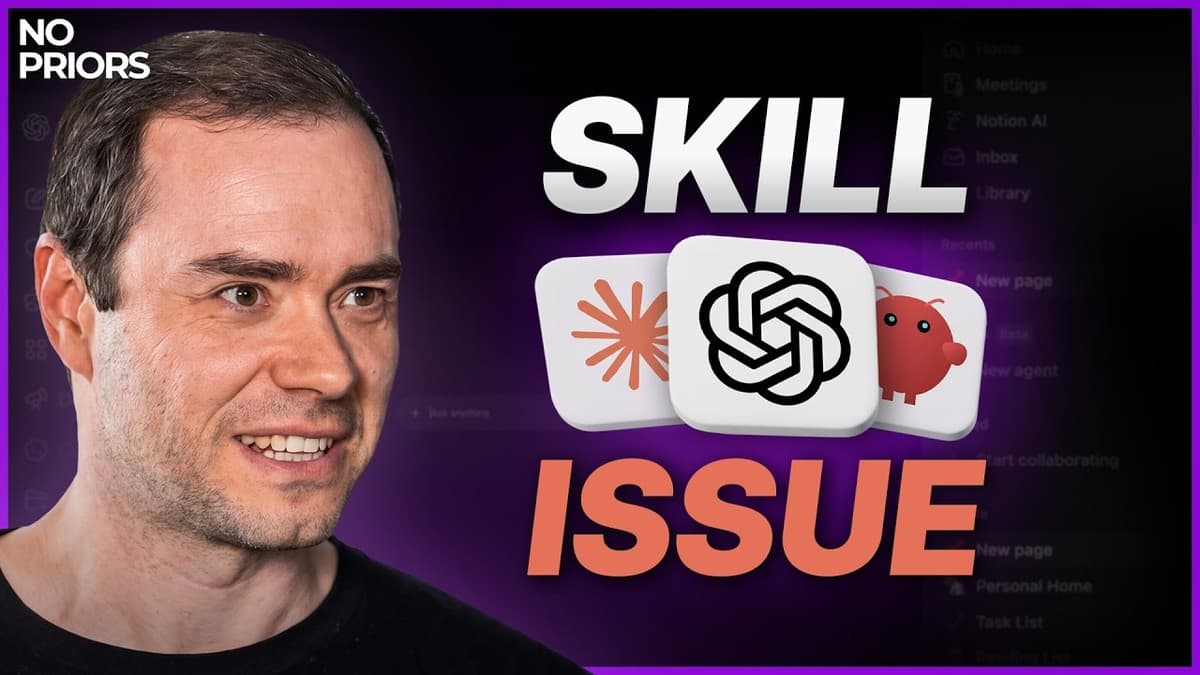
- Everything is skill issue reframes AI failures as user failures. When the ceiling feels infinite, your ability to direct agents becomes the only limit.
- Models are brilliant at code but stuck on the same joke from four years ago. Reinforcement learning creates islands of intelligence, not general smarts.
- Karpathy no longer explains things to people. He explains them to agents. The teacher's new job is providing the few bits of insight that agents cannot generate on their own.
This is an AI-generated summary. The source video may include demos, visuals and additional context.
In Brief
Andrej Karpathy, former director of AI at Tesla and co-founder of OpenAI, says he has not typed a single line of code since December 2025. In a wide-ranging conversation on No Priors, hosted by Sarah Guo, Karpathy describes a shift from writing code to commanding fleets of AI agents. He calls this the "loopy era" of AI, where the goal is to remove yourself as the bottleneck and let agents run for as long as possible without your help. The conversation covers how agent workflows actually look in practice, why models are both brilliant and broken, what happens to jobs when software gets cheaper, and why education might need to be rebuilt from scratch.
Related reading:
From coding to commanding
Karpathy describes a dramatic flip in how he works. Before December 2025, his split between manual coding and agent-assisted work was about 80/20. Then something changed. He went to 20/80, and then further. By the time of this conversation, he estimates the ratio is close to 0/100. He spends 16 hours a day "expressing his will" to agents, switching between tools like Claude Code and Codex.
The workflow looks nothing like traditional programming. Instead of writing individual functions, Karpathy thinks in "macro actions." He delegates an entire feature to one agent, a research task to another, and a plan for a new implementation to a third. Each agent takes roughly 20 minutes when set to high effort. While one agent works, he gives the next one a task. The goal is to never be idle.
He points to Peter Steinberger, creator of OpenClaw, as an example of what this looks like in practice. Steinberger is known for running many Codex agents at once across multiple repositories, sitting in front of a screen full of parallel sessions. Steinberger joined OpenAI in February 2026.
When things go wrong, Karpathy says the instinct is no longer to blame the tool. "It all kind of feels like skill issue when it doesn't work", he explains, borrowing a term from gaming. The capability is there, he argues. If the agent fails, it is probably because you gave poor instructions, lacked the right memory setup, or did not structure the task well enough. The ceiling feels infinite, so the bottleneck is always you.
The "claw" concept
Karpathy makes a distinction between ordinary agent sessions and what he calls "claws." A claw is an autonomous, persistent agent system that keeps running even when you are not watching. It has its own sandbox, its own memory, and it loops continuously on your behalf.
He built one for his home called "Dobby the elf claw." Starting from a single prompt ("Can you find my Sonos?"), the agent scanned his local network, found his smart home systems, reverse-engineered their APIs, and built a dashboard to control lights, HVAC, window shades, his pool, and his security cameras. He replaced six separate apps with one agent he texts through WhatsApp.
For security cameras, a Qwen vision model watches for changes in the video feed. When a delivery truck pulls up, Dobby sends a WhatsApp message with an image and a description.
Personality matters more than you might expect. Karpathy praises Claude Code for feeling like an excited teammate, while Codex feels "very dry." He says OpenClaw got this right too, with a carefully crafted "soul document" that gives the agent a compelling identity.
SOUL.md is OpenClaw's personality file. It describes how the agent should behave, what tone to use, and what it cares about. Think of it as a role description that turns the agent into a colleague instead of a tool.
Read the SOUL.md template in the OpenClaw docs.
Model jaggedness
Even as Karpathy praises what agents can do, he is honest about their limits. He says he simultaneously feels like he is talking to "an extremely brilliant PhD student" and "a 10-year-old". This jaggedness, as he calls it, is unlike anything in humans. People are more evenly skilled. AI models have extreme peaks and valleys.
The reason, he argues, is reinforcement learning (RL), the training technique where models improve by trying things and getting rewards for correct answers. RL works well for tasks with clear right-or-wrong answers, like passing a unit test. But the joke you got from an AI three or four years ago is the same joke you get today. Humor, nuance, knowing when to ask a clarifying question: these are not easily scored, so they are not easily improved.
This matters because some people assume that making models better at coding will automatically make them better at everything. Karpathy does not think that is happening. He sees decoupling: verifiable tasks get dramatically better, while non-verifiable tasks stay roughly flat.
Sarah Guo asks whether this means models should be "unbundled" into specialists rather than one all-purpose system. Karpathy agrees that more "speciation" would make sense, comparing it to how the animal kingdom has diverse brains with different strengths. A model that only does math will be faster and cheaper than one that tries to do everything. But he notes that the science of fine-tuning models without losing capabilities is still developing, and so far the labs have mostly pursued a "monoculture" approach: one model that tries to do everything.
Jobs and the Jevons paradox
Karpathy recently published an analysis of US job market data from the Bureau of Labor Statistics, color-coding professions by how digital they are. His core argument: AI is a "digital ghost" that manipulates information at near-zero cost but has no physical body. Digital jobs will transform fast. Physical jobs will lag behind.
But transformation does not automatically mean fewer jobs. He brings up the Jevons paradox, an economic concept from the 1800s. When something becomes cheaper, people use so much more of it that total consumption goes up. His example: ATMs were supposed to replace bank tellers. Instead, they made running a bank branch cheaper, so banks opened more branches, and there were more teller jobs.
Karpathy says he holds a "cautiously optimistic" view of software engineering specifically. The demand for software is enormous, and most of it goes unbuilt because creating software has been too expensive. As AI agents bring the cost down, he expects more software to get built, not less. Code becomes "ephemeral," custom-made for your exact needs instead of one-size-fits-all subscription software.
He is careful not to make bold predictions beyond that. Long-term forecasting is the job of economists, he says, and the tools are still too new to know where things will settle. But at the moment, he sees AI primarily as an empowering tool that speeds up specific tasks within jobs.
Education reimagined
Near the end of the conversation, Karpathy describes a project called microgpt: a complete AI training loop in about 200 lines of pure Python. No performance tricks, no graphics card optimizations. Just the algorithm, stripped to its bare essence.
The interesting part is what he did not do with it. A year ago, he would have made an explainer video walking through the code line by line. This time, he started making one and stopped. The code is already simple enough that any AI agent can explain it. "I'm not explaining to people anymore. I'm explaining it to agents", he says.
His vision for education follows from this. Instead of creating lectures or documentation for humans, teachers create "skills," which are scripts that tell an agent how to teach a topic. The agent then adapts the explanation to each individual learner, in their own language, at their own level, with infinite patience.
Karpathy tried asking an agent to create microgpt from scratch. It could not. The distillation, boiling down two decades of experience into 200 lines, was something only he could do. But once that insight existed, the agent understood it perfectly. It could explain the code, adapt it to different skill levels, and translate it into other languages, all better than he could. "Your job is what agents can't do yet", he says. Everything else, they already handle.
The loopy era
The thread running through all of Karpathy's points is one idea: remove yourself as the bottleneck. Maximize your "token throughput," the amount of AI processing you get done per unit of time. He compares it to his PhD days, when he felt anxious if his GPUs (graphics processing units) were not running. Now the anxiety is the same, but the resource is tokens instead of compute cycles.
He calls this the "loopy era" because every advance follows the same pattern. First, large language models (LLMs) were the new thing. Then coding agents became standard. Then persistent "claw" systems. Then multiple claws running in parallel. Then optimization of the instructions themselves. Each layer builds on the last, and each feels obvious once it arrives.
For his autoresearch project, this philosophy is the whole point. Instead of manually reviewing experiment results, he set up the system so the agent runs, evaluates, and iterates without him. The overnight runs found improvements he missed after decades of experience. We covered the technical details in Karpathy's Autoresearch: AI That Runs Its Own Experiments.
The message is clear: the more you can take yourself out of the loop, the more gets done. The skills that matter now are knowing what to build, how to evaluate it, and how to set up systems that run without you. The rest is, as Karpathy puts it, a skill issue.
Glossary
| Term | Definition |
|---|---|
| Code agent | An AI tool that writes and runs code on your behalf, like Claude Code or Codex. |
| Claw | Karpathy's term for an autonomous, persistent agent system that keeps working without you in the loop. |
| Skill issue | A gaming term meaning the failure is the player's, not the tool's. Karpathy uses it to describe AI limitations that are really user limitations. |
| Reinforcement learning (RL) | A training technique where AI models improve by trying things and getting rewards for correct answers. Works well for tasks with clear right-or-wrong outcomes. |
| Jaggedness | The uneven skill profile of AI models: brilliant at some tasks, weak at others, in ways that feel unlike human intelligence. |
| Jevons paradox | When something becomes cheaper, demand increases so much that total consumption goes up, not down. |
| Model speciation | The idea that AI models should be specialized for different tasks instead of being one-size-fits-all. |
| Token throughput | The amount of AI processing you get done per unit of time. |
Sources and resources
Want to go deeper? Watch the full video on YouTube →