Why AI Could Create More Jobs
Key insights
- The video's central idea is economic, not technical: if AI cuts the cost of doing knowledge work, organizations may buy more of it rather than less.
- Crume's radiologist example matters because it challenges the lazy assumption that strong automation in one task means an entire profession disappears.
- The practical shift is upward: AI handles routine work while humans become more valuable for framing problems, supervising outputs and carrying trust.
- This remains a strategic argument rather than hard labor-market proof, which is why the article should be read as a lens for thinking, not a guarantee of net job growth.
This is an AI-generated summary. The source video may include demos, visuals and additional context.
In Brief
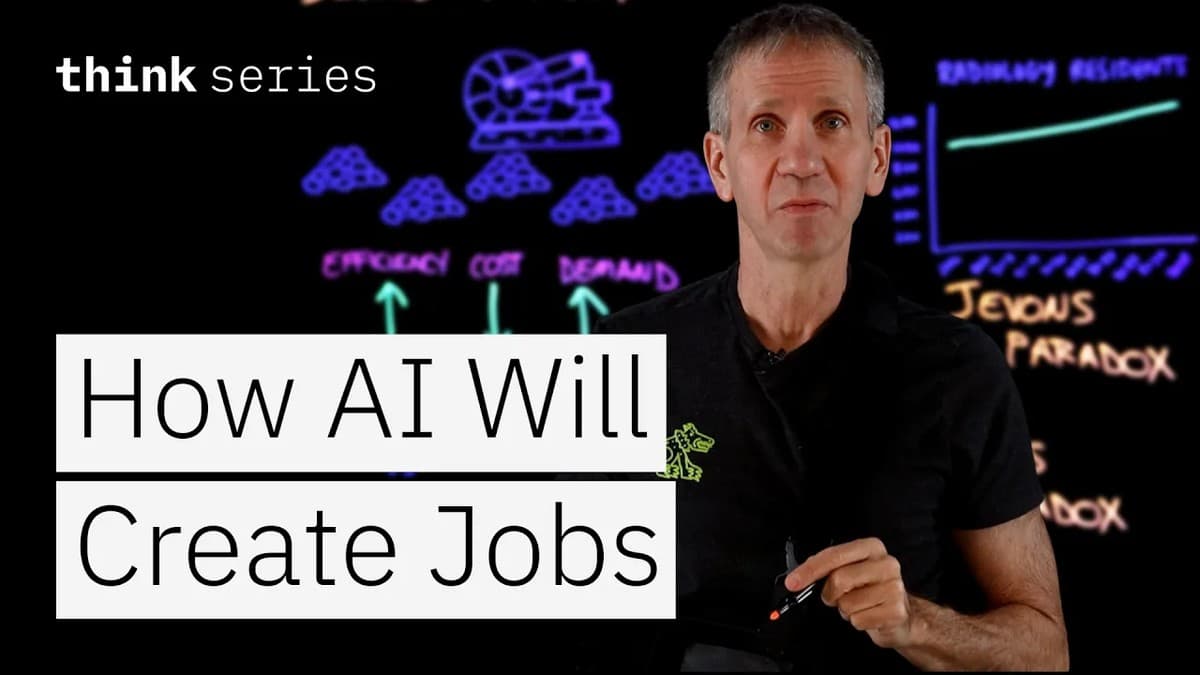
Jeff Crume of IBM Technology makes a clear, optimistic argument: AI should be treated as a way to make people more capable, not just as job-killing automation. His case rests on Jevons Paradox, the economic idea that when something becomes more efficient and cheaper, total demand can rise instead of fall.
That logic, he argues, helps explain why professions such as radiology and accounting did not disappear when software got better. AI may reduce routine labor per task while increasing the total amount of human work needed around supervision, trust, compliance, and creative problem framing.
Related reading:
What Jevons Paradox means for AI
Crume builds the whole video around Jevons Paradox, named after economist William Stanley Jevons. The idea is simple: when a technology becomes more efficient, the cost of using it drops, and that lower cost can drive total demand up rather than down. Jevons observed this with coal and steam engines in 1865. Better engines used less coal per machine, but they made steam power so useful that total coal consumption rose.
Applied to AI, the claim is not that one worker will do less. It is that organizations may find many more economically viable things to do once AI lowers the cost of analysis, drafting, support, research, or coordination.
Why the "AI replaces jobs" story can be too simple
Crume opens by contrasting a common fear with a historical example. He quotes Geoffrey Hinton, who said in 2016 that people should stop training radiologists because deep learning would soon outperform them. Ten years later, Crume says, radiologists have not vanished and more are being trained.
His point is not that AI failed. It is that demand for medical imaging, review, validation, and interpretation remained strong even as software improved. The job changed. The tools improved. But the profession did not simply disappear.
He makes the same argument with spreadsheets. Once arithmetic became automated, accountants were no longer stuck doing manual calculations all day. That did not remove the need for finance work. It increased demand for higher-level analysis, planning, and business decision support.
What kinds of human work may grow
The strongest part of the video is not the slogan that AI will help people. It is the more specific claim that AI could shift labor away from routine tasks and toward work that needs more judgment and responsibility. Crume points to new work categories such as AI product managers, safety engineers, and people who design good instructions for models. He also argues that cheaper AI can expand "long-tail" services like custom tutoring, niche legal help, and personalized healthcare support.
That matters because it changes what counts as valuable human work. If AI makes first-draft output cheap, then the scarce part becomes defining the goal, checking the result, handling edge cases, and carrying responsibility when something goes wrong. Trust, judgment, and coordination become more important, not less.
This is where the video is most useful. It does not claim everyone keeps the same job. It suggests that the labor market may reorganize around human accountability even as machine capability improves.
Practical implications
- If you lead a team, treat AI as a capacity multiplier. The main opportunity is not just cutting headcount but expanding what your team can realistically deliver.
- If you are an employee, build skills above the automation layer. Crume highlights adaptability, lifelong learning, critical thinking, and creativity as the capabilities that become more valuable.
- If you are evaluating AI forecasts, separate logic from proof. Jevons Paradox is a useful frame, but it does not automatically guarantee net job growth in every industry.
Glossary
| Term | Definition |
|---|---|
| Jevons Paradox | When efficiency improvements make something cheaper, demand can rise so much that total use goes up instead of down. |
| Augmented intelligence | A way of using AI to make people more capable rather than removing them from the work entirely. In simple terms, AI acts as a helper instead of only as a replacement. |
| Human in the loop | A setup where a person still checks, guides, or approves important decisions made with AI. |
| Long-tail services | Specialized services that become affordable at scale when technology lowers the cost of delivering them. |
Sources and resources
Want to go deeper? Watch the full video on YouTube →