Nvidia's Practical Guide to Building AI Agents
Key insights
- Nvidia argues that agentic AI is an expansion of the stack, not a replacement for chatbots. Quick-answer tools, reasoning models, assistants, and multi-agent systems all solve different jobs.
- The most useful definition in the talk is architectural: an agent is a system with memory, tools, routing, files, and helper agents, not just a large language model behind a chat window.
- Nvidia's strongest pitch is economic as much as technical. Mixing frontier cloud models with smaller open models can improve speed, lower cost, and make agents easier to customize.
- The personal-assistant future depends on governance. NemoClaw and OpenShell matter because they try to solve containment, privacy, and policy enforcement rather than just raw capability.
This is an AI-generated summary. The source video may include demos, visuals and additional context.
In Brief
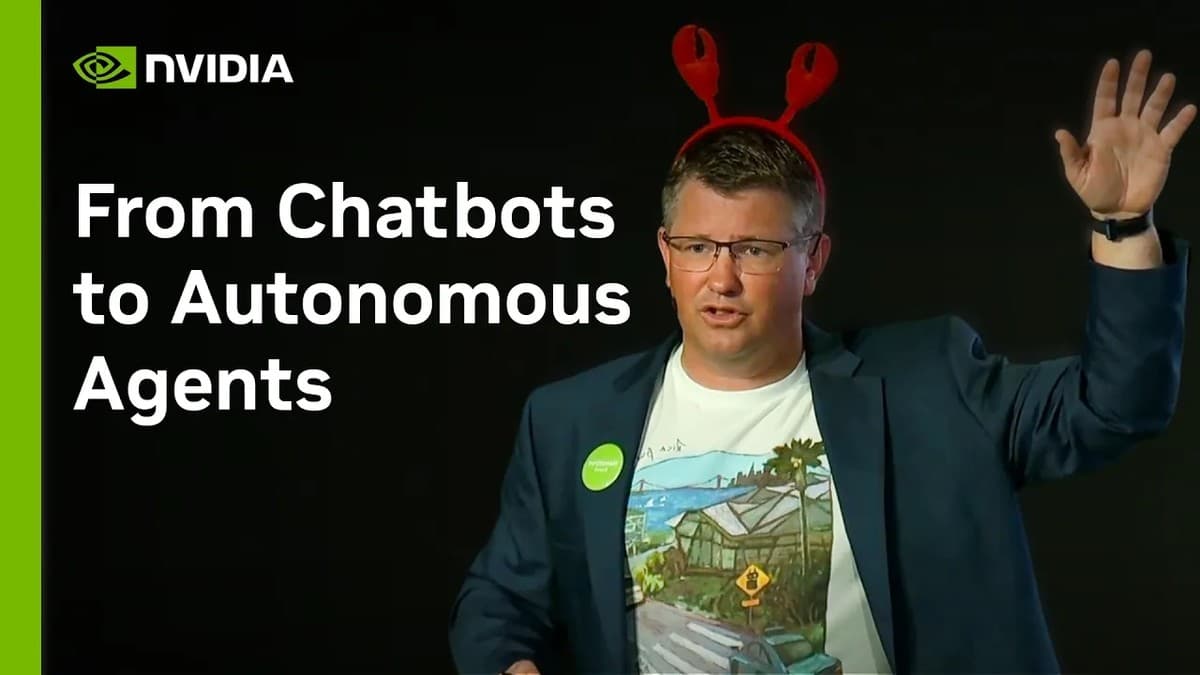
Erik Pounds used this GTC session to make a simple argument: AI agents are no longer just smarter chatbots. In his framing, the field has moved from ChatGPT-style conversation to reasoning models, then to longer-running systems like OpenClaw that can plan, use tools, remember context, and act on your behalf. The point of the talk is practical, not theoretical: what an agent actually is, what pieces it needs, and how developers can start building one without handing it unlimited freedom.
Related reading:
From Chatbots to Agents
Pounds opens with a reality check. Even in the United States, he says, only about 16% of adults use AI tools regularly. That is why the talk stays grounded. He is not speaking to people who already run large agent setups. He is speaking to developers and technical leaders who need a simple mental model for what changed so quickly.
The timeline he shows is clean. First came ChatGPT in late 2022, which made multi-turn conversation with a model feel normal. Then came reasoning models, which break a problem into steps before answering. Pounds points to OpenAI's o1 and says this is when AI started taking longer, using more tokens, and giving back more valuable answers. Then came OpenClaw, which he presents as the moment agents started to feel less like assistants you query and more like systems that work on your behalf over time.
Nvidia's framing of the last three years: conversation first, then reasoning, then longer-running agents. Screenshot from YouTube.
That progression matters because Pounds does not claim one category replaces the others. He explicitly says simple chatbots still have a job. You do not want a model to think for ten minutes when all you asked for was the weather. But once the task gets harder, he argues, the system changes. You move from chatbots to reasoning systems, then to assistants for coding and research, then to self-evolving agents, and finally to multi-agent systems that work like a small team.
The session separates five categories: chatbots, reasoning chatbots, assistants, self-evolving agents, and multi-agent systems. Screenshot from YouTube.
What An Agent Actually Is
The clearest part of the talk comes when Pounds says an agent is much more complex than a large language model behind a friendly interface. His explanation is useful because it breaks the buzzword into components you can actually build or buy.
An agent takes in a multimodal request, not just text. It can work with files, charts, images, and other inputs. It keeps memory, both short-term and increasingly long-term. It can use structured and unstructured data. It can operate tools through command-line interfaces, APIs, and even graphical user interfaces. It can also call helper agents, which means the main system routes parts of a task to specialized helpers and then combines the results.
This is the most useful diagram in the session because it turns "agent" into a system design problem. Screenshot from YouTube.
Pounds also pushes a broader point: good agents are usually built from a mix of models. A top cloud model might handle orchestration or high-level reasoning. Smaller open models can be customized for specific sub-tasks and run faster or cheaper. That mixed-model argument runs through the whole presentation. Nvidia is not pitching one giant model that does everything. It is pitching a layered system.
Nvidia's Stack: Toolkit, Blueprints, and Mixed Models
The middle of the talk is essentially Nvidia's answer to a developer question: if agents are systems, what does the system look like in practice? Pounds first shows a hands-on demo from the show floor, where attendees build a simple LangChain deep agent with wooden blocks, pick Model Context Protocol (MCP)-backed tools, and create a Telegram weather bot. The point is not the bot itself. The point is that the jump from "chat" to "agent" starts with tools, planning, and execution.
He then moves to a more serious example: Nvidia's AI-Q blueprint, which routes a user's request either to shallow research or to a deeper multi-agent workflow. In the deep path, an orchestrator hands sub-tasks to workers that search the web, retrieve local information, or process images before feeding results back into the main flow.
Nvidia's AI-Q slide shows its preferred architecture: route intent first, then let an orchestrator coordinate specialized workers. Screenshot from YouTube.
This is also where Nvidia makes its strongest performance claim. Pounds says a team used this open blueprint to build a deep researcher that reached the top of public leaderboards shown in the session. That is best read as Nvidia's own case for why the system matters. The more defensible takeaway is the design principle behind it: routing, specialization, and mixed models are becoming the default pattern for serious agent systems.
The enterprise example comes from ServiceNow. In the clip shown during the session, specialized agents handle incoming support tickets, pass context to research agents, search past fixes and logs, confirm root causes, and escalate only when needed. In that demo, Nvidia says 90% of tickets are resolved by autonomous agents. Whether that exact figure generalizes is a separate question. What matters is the model of work: agents are being pitched less as conversational interfaces and more as operational workflows.
Personal Assistants Need Guardrails
The last third of the talk shifts from enterprise systems to personal assistants. This is where Pounds sounds less like a marketer and more like an early user. He describes his own DGX Spark box running a personal assistant named Magic, with read-only access to files, its own email address, and some home-automation hooks. He is careful to say he is taking "baby steps" because capable agents will use every resource available to them if you let them.
That is why Nvidia pairs OpenClaw with NemoClaw and OpenShell. The company presents this as the missing governance layer. Sandboxing is already part of OpenClaw, but Pounds argues smarter agents will keep trying to stretch beyond the intended boundary. NemoClaw is Nvidia's attempt to keep them inside it.
The governance story is the real product pitch here: OpenShell enforces policies, while the privacy router decides what stays local and what can call out to cloud models. Screenshot from YouTube.
Pounds says OpenShell enforces policy inside the sandbox and down to the network level, while a privacy router decides when the agent should stay local and when it is allowed to reach outside services such as the Perplexity application programming interface (API). That is a more mature conversation than "look what my agent can do." It is about where the agent is allowed to do it.
He pairs that governance story with Nvidia hardware. DGX Spark is positioned as a small local box for always-on agents. DGX Station is the bigger workstation-class option for team use. Here the message is economic as much as technical: a local agent can be cheaper to run, easier to unplug, and easier to keep under your own control than a fully cloud-hosted one.
Pounds ends with a practical three-step starting point: use existing tools, unlock your data, and only then build a personal assistant. Screenshot from YouTube.
Where Nvidia Thinks Beginners Should Start
Pounds ends with advice that is much simpler than the rest of the stack. First, use the tools that already exist. He name-checks ChatGPT, Perplexity, and Claude-based coding tools, and even reframes a paid assistant as a fairly cheap productivity subscription. Second, unlock your data, because an AI system cannot help much if it cannot see the documents, files, and databases that define your work. Third, build a personal assistant slowly, with limited permissions first and more power later.
That closing sequence is probably the best summary of the whole session. Nvidia is not telling beginners to start with a giant multi-agent architecture. It is telling them to build a ladder: assistant usage, data access, then controlled autonomy. That is the practical value of the talk: it turns agentic AI from a vague promise into a sequence of decisions about models, tools, data, and guardrails.
Glossary
| Term | Definition |
|---|---|
| Reasoning model | A model that breaks a problem into steps before giving an answer. |
| Helper agent | A specialized agent that handles one part of a larger workflow. |
| Sandbox | An isolated environment that limits what an agent can access or do. |
| RAG (retrieval-augmented generation) | A setup where the AI looks up relevant documents before answering. |
| Frontier model | One of the strongest models from a major AI lab, usually run in the cloud. |
| Orchestrator | The coordinating part of an agent system that routes work to the right tools or sub-agents. |
Sources and resources
- NVIDIA Developer — Agentic AI 101 | NVIDIA GTC (YouTube) — source video
- Erik Pounds author page — speaker profile
- OpenClaw — project website
- OpenClaw GitHub — open-source repository
- NVIDIA AI-Q blueprint — Nvidia's agent architecture example
- NemoClaw — Nvidia's OpenClaw sandbox package
- ServiceNow — enterprise agent example shown in the session
- Perplexity — external tool mentioned in the talk
Want to go deeper? Watch the full video on YouTube →