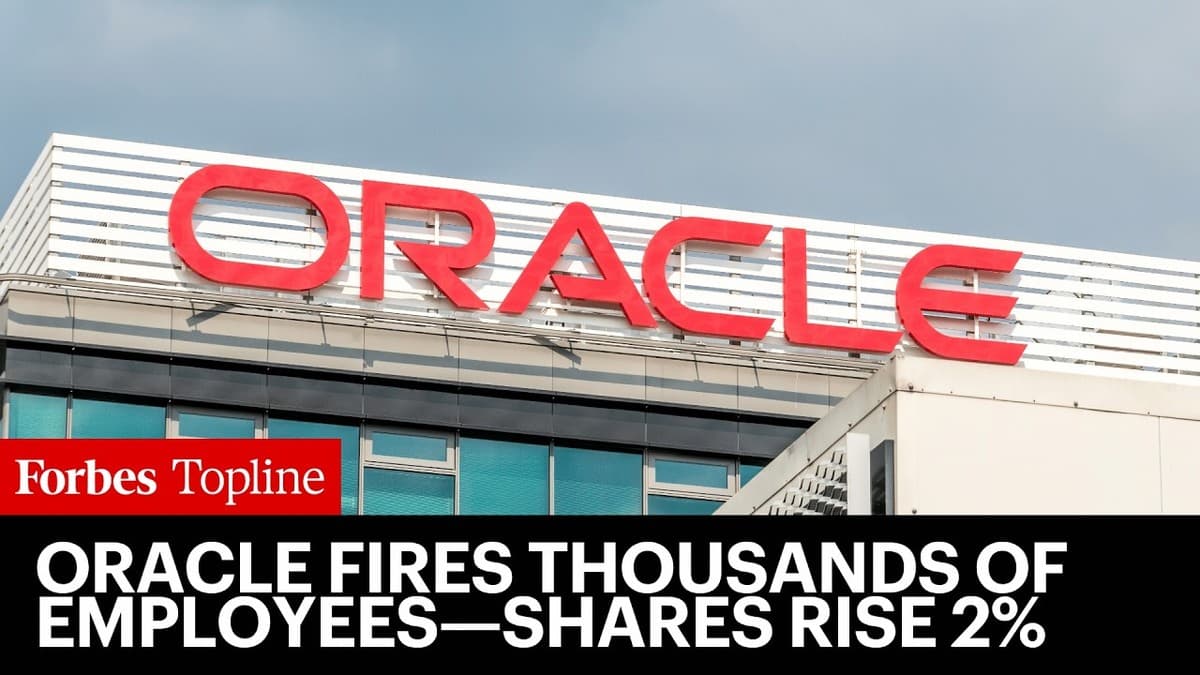
Oracle Fires Thousands as AI Spending Hits $50 Billion
Key insights
- Oracle's stock rose 2.5% the same day it announced mass layoffs. Wall Street is actively rewarding companies that cut headcount to free up capital for AI.
- A TD Cowen analyst estimated Oracle could unlock up to $10 billion in cash flow by cutting 30,000 of its 162,000 employees. Investors and analysts are now literally pricing people against machines.
- Oracle, Amazon, and Meta are all running the same playbook: shrink the workforce, grow the AI budget. This is not a series of isolated decisions but an industry-wide reallocation from salaries to data centers.
This is an AI-generated summary. The source video may include demos, visuals and additional context.
In Brief
Oracle (a major software and cloud computing company) laid off thousands of employees on Tuesday, citing "current business needs." The same day, Oracle's stock rose 2.5% — investors clearly liked the news. The company is planning to pour $50 billion into AI infrastructure in 2026, up from an earlier plan of $35 billion, and Wall Street sees cutting headcount as one way to fund it.
Source: Forbes (YouTube)
Related reading:
What the memo said
Oracle did not explain publicly why specific employees were let go. But a company memo obtained by Business Insider pointed to "careful consideration of current business needs" as the reason. CNBC also reported the layoffs, citing people familiar with the situation.
Source: Forbes (YouTube)
A stock in recovery mode
Oracle's shares have had a rough year. The stock had fallen more than 27% in 2026 before Tuesday. The layoff announcement helped reverse that trend, with shares rising 2.5% by noon.
This is worth pausing on. A company fires thousands of workers and the market responds by pushing the stock up. That tells you something about what investors care about right now: not the size of the workforce, but the size of the AI budget.
Source: Forbes (YouTube)
What Wall Street thinks the math looks like
In January, an analyst at TD Cowen (an investment bank) wrote that Oracle could free up as much as $10 billion in cash flow if the company cut up to 30,000 employees. Oracle employed 162,000 people as of May 2025, the last time the company reported employment figures in a securities filing.
That analyst note is blunt in what it implies: workers have a dollar value, and so does replacing them with AI. Wall Street is now openly modeling the tradeoff.
The $50 billion plan
Oracle is not cutting jobs while standing still. The company projects $50 billion in spending for 2026, up from an earlier guidance of $35 billion, driven by growing demand for cloud and AI services.
Source: Forbes (YouTube)
To understand how much business Oracle has locked in: in September, the company's RPO (remaining performance obligations — meaning revenue agreed to in contracts but not yet collected) jumped 359% to $55 billion after a $300 billion deal with OpenAI. That is an enormous pipeline of future revenue. The layoffs are, in part, Oracle streamlining its cost base to match the new shape of its business.
Oracle is not alone
This is not an Oracle story. It is a tech industry story.
Amazon announced in January it would cut 16,000 corporate roles, while planning $200 billion in AI spending this year. Meta expects up to $135 billion in capital expenditures (large, long-term investments in infrastructure) and last week cut hundreds of employees from Reality Labs, its virtual and augmented reality division.
The pattern is clear: the biggest tech companies are all making the same bet at the same time. Shrink the payroll. Grow the data center.
What this means
For people who work in tech, this is the central tension of the moment. AI is generating enormous business opportunity — but that opportunity is being funded partly by cutting the jobs that existed before AI arrived. The budgets are not disappearing. They are moving, from salaries to servers.
Glossary
| Term | Definition |
|---|---|
| Remaining performance obligations (RPO) | Revenue that a company has already agreed to earn through contracts, but has not yet collected. A high RPO means a lot of future income is already locked in. |
| Capital expenditures (capex) | Money a company spends on large, long-term assets like data centers, servers, and physical infrastructure. |
| Cash flow | The actual money moving in and out of a company, as distinct from its reported profits. Cutting staff directly increases cash flow. |
Sources and resources
Want to go deeper? Watch the full video on YouTube →