How Norway's Wealth Fund Uses AI: 10 Real Examples
Key insights
- NBIM treats AI adoption as a culture problem first and a technology problem second. Mandatory training, ambassador networks, and relentless nudging drove adoption more than any tool.
- The fund searched for one transformative AI use case and came up empty. It found 171 smaller projects instead, proving that broad organizational adoption beats chasing a single moonshot.
- Non-developers are building production software. A communications team built its own media monitoring platform and accountants automated quarterly reports using Claude Code and Cursor, with no engineering background required.
- NBIM is replacing Scrum with tiny, autonomous teams of two developers and one business person. This may be one of the first major institutions to formally abandon agile methodology because AI makes it obsolete.
This is an AI-generated summary. The source video may include demos, visuals and additional context.
In Brief
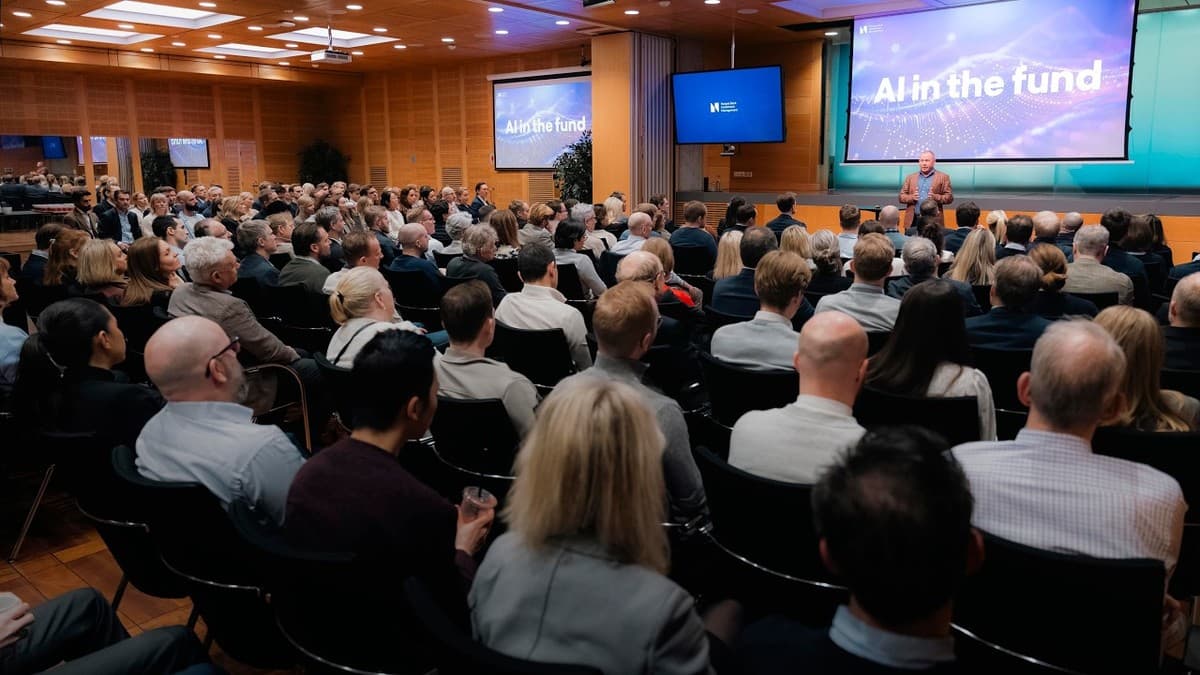
On March 24, 2026, NBIM (Norges Bank Investment Management, the manager of Norway's Government Pension Fund Global, the world's largest sovereign wealth fund at $1.8 trillion) held its first AI Summit. Chief executive officer Nicolai Tangen opened the event by welcoming hundreds of guests and walking through 10 concrete ways the fund uses AI today: from analyzing block trades under a one-hour deadline to a legal team negotiation simulator that predicts more than 80% of what the other side will argue. Deputy CEO Trond Grande and more than a dozen NBIM employees took the stage to present each use case in detail.
Related reading:
The Foundation: Cloud, Data, and a Culture Shift
Before any of the use cases were possible, NBIM spent years building the infrastructure to support them. The fund insourced its entire operations (brought work back in-house that was previously managed by an external vendor), moved everything to public cloud (remote servers managed by providers like Amazon or Microsoft, replacing physical hardware), and migrated its data into a modern warehouse it calls Martium Core, built on Snowflake (a cloud data platform). Cleaning all that data was, as Birgitte from IT infrastructure put it on stage, "no fun at all." But it created a single reliable source of data for AI to work with.
The AI team itself started at three people and grew to ten. Their job is not to build AI for the whole organization, but to act as a catalyst: provide tools, run training, and enable everyone else.
Adoption had to be forced. Stian, who led the AI journey, was direct: mandatory training works because "the people who don't want to do it are the people who need it the most." NBIM ran seven 30-minute training sessions for every employee covering topics from prompting (writing instructions for AI) to responsible AI. They created a network of 20 volunteer ambassadors, one from each team, who identified one high-value AI project for their area and built it. Anthropic trained these ambassadors twice a week for two months.
The result: "everyone in NBIM is using Claude on a daily basis" (Claude is an AI assistant made by Anthropic), and more than half of all employees are using Claude Code (an AI-powered coding tool) to build their own solutions. That last number is striking because most of these people are not professional software developers.
When the organization searched for the one transformative AI use case that would explain a mandated 20% efficiency gain, they found nothing. What they found instead were 171 separate smaller projects, each delivering incremental value. That turns out to be what broad AI adoption actually looks like.
The 10 Use Cases
1. Block Trade Analysis (Investing)
A block trade is a very large buy or sell order negotiated privately, outside the normal stock exchange. NBIM receives about 200 of these requests per year. The scenario: Goldman Sachs calls to say that Ferrari's largest shareholder wants to sell shares worth 30 billion Norwegian kroner. That is more than three weeks of normal trading volume. Goldman needs an answer within one hour.
To decide, the team needs to know who is selling and why, whether the market anticipated it, what fair pricing looks like, and whether the transaction will trigger forced buying by index funds (funds that automatically buy and sell to match a market index) tracking the stock. The data is scattered across databases, web sources, internal records, and real-time feeds.
NBIM built a multi-agent system (multiple AI programs, each with a specific task, working together) to gather all of this in minutes. One agent searches the web to identify the real owner behind a holding company. Another pulls key data points from the deal document. A third runs an algorithm to calculate the index effect. The result: a full decision brief, ready faster and with more data than before.
2. Media Monitoring: Echo (Communications)
NBIM was mentioned in almost 50,000 articles in 2025. The press team has two people. Manually reading everything is impossible.
Saf, from the communications team, explained how they built Echo: a live dashboard that tracks all the fund's media coverage across channels. They are not developers, but they built it themselves using Claude Code. An agent-based system classifies each article's sentiment (positive, negative, or neutral), priority of the outlet, article type, and how prominently the fund is mentioned. All data flows directly into Snowflake.
Echo also includes a chatbot that can answer questions like "analyze engagement on social media." It pulls data from LinkedIn, Instagram, and YouTube on the spot and generates a report, something that previously required logging into each platform separately.
3. Cybersecurity Triage (Security)
NBIM collects roughly 1 trillion data points about its operations every year. That gets filtered down to somewhere between 100,000 and 1 million potentially suspicious events, and then further to a small number of high-value alerts for human analysts to investigate.
The cybersecurity analyst on stage described getting woken up in the middle of the night by an alert. An AI agent starts at the exact same moment. By the time the analyst is out of bed, the agent has already pulled together the same context a human would — what data is relevant, what hypothesis fits, what looks benign versus suspicious. It does in 5 minutes what would take a human roughly 30. And unlike a human, it does it with the same level of care every single time.
4. Company Meeting Preparation (Investing)
NBIM held more than 3,000 company meetings in 2025. Each meeting takes about three hours to prepare. That adds up to roughly 10,000 hours per year spent on preparation.
Christina, from the London office, showed how a multi-agent system now handles much of that prep. One agent builds a research plan. Three to five sub-agents go out and gather information from different sources. A final agent, trained on NBIM's best historical meeting prep examples and internal interview technique materials, evaluates the output and decides whether it is good enough. The portfolio manager can then refine the agenda in a chat interface.
The system also checks sources, so the manager can verify there is no hallucination (when an AI confidently states something that isn't true). A simulation component is coming that will predict what the company representative is likely to say.
5. Trade Surveillance: Eva (Compliance)
With millions of transactions across more than 60 markets every year, NBIM needs to ensure all trades comply with market regulations. Previously, an external system flagged suspicious trades and compliance staff investigated manually. The problem: the system didn't know NBIM's context, so it produced many false positives (alerts that look suspicious but turn out to be harmless). Manual review is repetitive, and repetition causes fatigue.
Oscar from compliance introduced Eva (Enhanced Vigilant Agent): a master agent fed by six specialized sub-agents, each examining a different dimension of every alert: trade context, index rebalancing, company news, industry news, timing patterns, and company interactions. Eva is always on, never gets tired, and produces a full audit trail (a complete record of every step taken and every decision made) for every case. When a case is genuinely ambiguous or requires human ownership, it passes to the compliance team.
6. Forensic Accounting (Risk)
Forensic accounting means analyzing financial statements to detect manipulation. The target: companies that use accounting tricks to look more profitable than they are. NBIM's benchmark portfolio contains roughly 7,000 companies. Traditionally, each one required an analyst spending about two weeks doing a deep dive through financial statements and footnotes.
Martin from the forensic accounting team explained how AI agents now search through millions of pages of financial documents, spot keywords, extract relevant sentences, and flag specific numbers (such as a company that extended its accounts payable (money owed to suppliers) by $745 million). A machine learning model (software that learns patterns from data rather than following fixed rules), trained on thousands of real cases where companies were later exposed for manipulation, outputs the probability that any given company is heading for a similar outcome. The model is in production today.
7. Financial Reporting Automation (Finance)
Every quarter, NBIM produces its full financial statements, notes, and analysis. The old process relied on complex Excel workbooks with long formula chains and many manual adjustments. Torus from the financial statements team described how one person spent an entire week producing a single note: Note 14, on collateral and offsetting.
Working with Claude Code and Cursor, a team of two non-developers rebuilt the entire process from scratch, starting from clean underlying data. Now Note 14 is done in a couple of hours. FX and tax calculations run at the push of a button on business day two of the quarter. The same work that previously occupied 2.5 people for eight days now frees those people to focus on analysis and quality assurance instead.
8. ESG Screening (Responsible Investing)
ESG stands for Environmental, Social, and Governance. These are the non-financial factors investors use to assess whether a company is being run responsibly. NBIM must screen all 7,000+ companies in its portfolio for issues like forced labor, child labor, deforestation, and corruption. If human analysts did this alone, Christina estimated the team would need 3,000 analysts working for an entire weekend. The actual team is eight people.
The AI-powered process runs in two phases. Phase one uses a lighter, faster model to do a broad scan — most companies clear it. Those that raise any concern move to phase two, where multiple agents research the company from different angles simultaneously: supply chain links, direct operations, financial relationships. Human analysts then review every high-risk company the AI flagged, verify the sources, and make the final call.
9. Negotiation Simulator (Legal and Tax)
Christi from the legal and tax department built a negotiation simulator after noticing that if AI can model language patterns, it can model negotiation patterns too. The tool has two modes.
In planning mode, it analyzes a counterpart's likely arguments and suggests an optimal combination of terms and concessions. So far, it has predicted more than 80% of the counterpart's arguments in real negotiations. In simulation mode, it runs a live voice-based practice session where Christi can negotiate against an AI playing the other side, ask for coaching feedback, or switch roles entirely.
The tool also helps NBIM analyze patterns across its entire contracts portfolio at scale, including how force majeure clauses (contract provisions that excuse performance during extraordinary events like pandemics or wars) cluster and how different triggers might affect the fund's access to credit.
10. Trading Optimization (Execution)
Jel from the trading and execution team explained a problem unique to funds of NBIM's size: the fund is so large that its own trades move the market. When it buys, prices go up. When it sells, prices go down. NBIM estimated this market impact (the price change caused by the fund's own trading) at 14 billion Norwegian kroner (NOK) in 2025.
Two AI-powered responses to this problem. First, AI predictions about which stocks are likely to rise or fall let traders decide when to be aggressive and when to be patient. Second, an internal "parking" system matches offsetting orders across the fund's 250 portfolios before going to the market. Last year, 120 billion NOK in orders were parked internally rather than traded externally. Combined, these changes contributed an estimated 4 to 6 billion NOK in savings in 2025.
Where It Is All Heading
Trond Grande closed the use case section with a clear target: cut all manual processes in half by the end of 2028. The way NBIM organizes development work is also changing. Traditional Scrum (a popular agile project methodology from the 1990s built around eight developers, one business person, and a full calendar of ceremonies like daily standups and sprint reviews) is being replaced. NBIM's new default is two developers and one business person, working autonomously with full decision-making authority, using AI to move at a pace that larger teams no longer match.
The broader lesson is not about any single use case. It is about what happens when an organization stops treating AI as a specialist tool and starts expecting every employee to use it, build with it, and keep improving.
Glossary
| Term | Definition |
|---|---|
| Block trade | A very large buy or sell order negotiated privately, outside the regular stock exchange. Typically involves hundreds of millions or billions in value. |
| Multi-agent system | Multiple AI programs, each assigned a specific task, that work together to solve a complex problem faster than any single program could. |
| Sentiment analysis | Using AI to determine whether text (news articles, social media posts) carries a positive, negative, or neutral tone. |
| Forensic accounting | Analyzing financial statements in depth to detect manipulation or fraud, looking for where companies have used accounting tricks to appear more profitable. |
| Market impact | The price change caused by the fund's own trading. When a buyer is large enough, the act of buying itself pushes prices up. |
| ESG screening | Checking companies for risks related to environmental, social, and governance factors, such as labor conditions, deforestation, or corruption. |
| Hallucination | When an AI confidently states something that is factually wrong. In high-stakes contexts, checking AI sources is essential. |
| Scrum | A popular agile project management methodology from the 1990s, built around fixed-length work cycles, daily team meetings, and regular reviews. |
Sources and resources
- How we use AI in practice | AI Summit 2026 | Norges Bank Investment Management (YouTube) — Full recording of NBIM's first AI Summit, March 24, 2026
- Norges Bank Investment Management — About us — Overview of NBIM's mission and leadership
- Nicolai Tangen, CEO — NBIM — Profile of the fund's chief executive officer
- Trond Grande, Deputy CEO — NBIM — Profile of the fund's deputy chief executive officer
Want to go deeper? Watch the full video on YouTube →