AI Euphoria Fades as Wall Street Gets Real
Key insights
- Software moats now hinge on whether a function is deterministic (always gives the exact right answer) or probabilistic (gives a roughly right answer). Payroll and invoicing can't tolerate AI's error margin.
- Boards are replacing sales-oriented CEOs with product-oriented leaders as AI forces software companies into 'wartime' mode.
- Unlike the dot-com bubble, today's hyperscalers (massive cloud providers like Amazon, Google, Microsoft) have top-tier credit ratings and massive base businesses to absorb trillion-dollar AI spending.
- The safest AI bets may be picks-and-shovels suppliers (companies that sell tools to the industry rather than competing in it): memory, optical networking, and semiconductor equipment.
This is an AI-generated summary. The source video may include demos, visuals and additional context.
In Brief
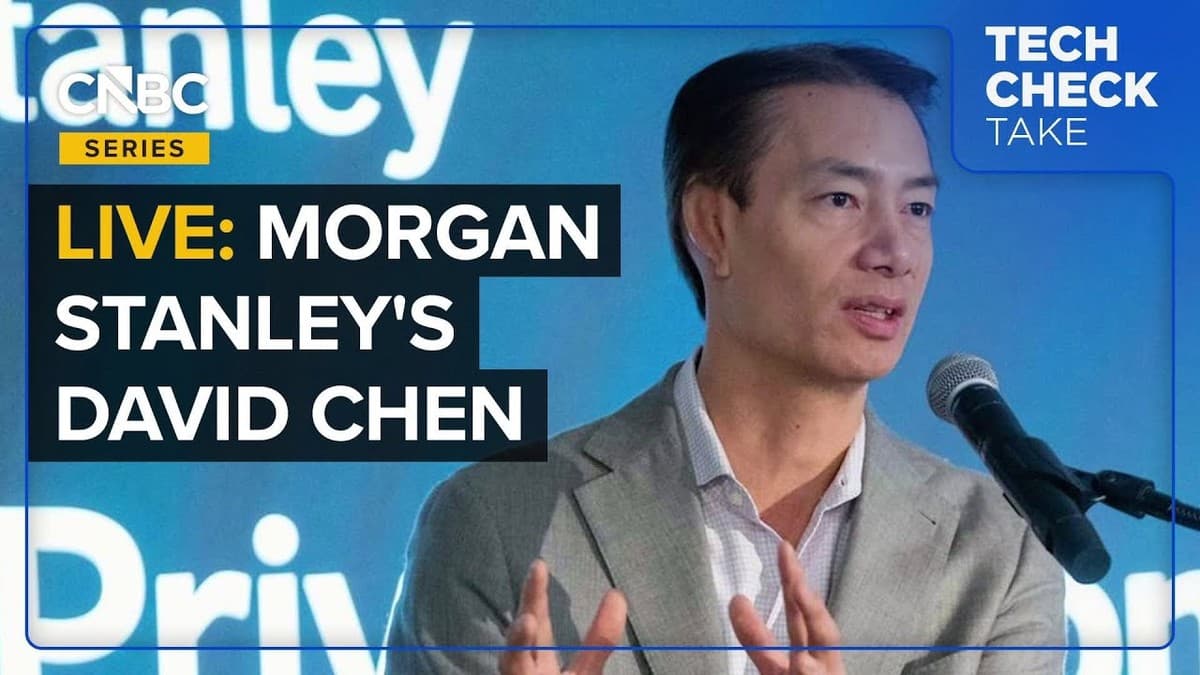
At Morgan Stanley's annual TMT (Technology, Media & Telecommunications) conference in San Francisco, the mood has shifted. Last year, every conversation centered on AI's potential. This year, in a conversation with Deirdre Bosa on CNBC, David Chen, Morgan Stanley's global head of technology investment banking, says the debate is over: AI is here, but the euphoria is gone. Dario Amodei told the room that Anthropic is approaching a $19 billion revenue run rate. Jensen Huang announced that both OpenAI and Anthropic are going public. Yet software stocks have sold off, Amazon is going free cash flow negative to fund its AI buildout, and the U.S. government has blacklisted Anthropic as a supply chain risk. The hard questions are just beginning.
The central claim
Chen argues that the AI conversation has fundamentally changed. Last year, companies talked about using AI to cut costs and improve margins. This year, investors don't want to hear about efficiency anymore (3:09). The question on everyone's mind is blunter: is your business a beneficiary of AI, or does AI threaten your survival?
For enterprise software companies, this is more than a theoretical exercise. As Deirdre Bosa puts it during the interview, "sometimes the question isn't are you threatened, it's are you going to survive?" (4:08).
Deterministic vs. probabilistic: the new dividing line
Chen introduces a framework that cuts through the noise. The survival of a software company may come down to whether its core function is deterministic (always gives the exact right answer) or probabilistic (gives a roughly right answer) (5:48).
He uses a concrete example from his own work at Morgan Stanley: if a copilot summarizes a meeting and gets something 2% wrong, that won't ruin his day. But if software is calculating payroll, computing taxes on an invoice, or processing a customer payment, there is zero tolerance for error (6:08). Those deterministic applications require 20 years of accumulated domain expertise that AI-native startups can't easily replicate.
This framework suggests that incumbents with deep systems of record (the authoritative databases that businesses run on) have a natural moat. The companies most at risk are those that simply moved paperwork to a website, or wrapped public data in a SaaS (Software as a Service) subscription dashboard (7:19).
Wartime CEOs and the software shakeout
The reshuffling extends beyond products to leadership. Chen describes a shift in boardroom conversations: directors are asking whether their CEO is a sales-and-marketing leader or a product-oriented one. In "wartime," product-oriented CEOs have the advantage (8:26). Companies that can't rebuild their backends to be AI-native risk falling behind permanently.
Aaron Levie, CEO of Box, added another dimension at the conference: agents are now his new customer base, and he could see that being 10 times bigger than his existing human customer base (9:02). The implication is striking. Software isn't just being used by people anymore. It needs to be built for AI agents to interact with. CNBC's producer coined a name for this shift: "Software for Agents as a Service."
The infrastructure question
Trillion-dollar capex and the dot-com comparison
Wall Street is watching nearly a trillion dollars flow into AI infrastructure from the hyperscalers (the massive cloud providers like Amazon, Google, and Microsoft), plus another trillion from OpenAI's announced plans (14:35). The natural comparison is the dot-com bubble, when massive capital outlays ended in collapse.
Chen pushes back on that comparison. Today's big spenders have top-tier credit ratings and huge existing businesses that already generate cash (15:03). Amazon's retail and cloud business, Google's search advertising, Microsoft's enterprise software: these are real revenue streams, not dot-com-era promises. Even as Amazon goes free cash flow negative and Alphabet issues a 100-year bond, Chen argues the underlying businesses can support the debt.
Still, Bosa presses: the pristine balance sheets are eroding. The question is whether AI demand materializes fast enough to justify the spending.
Picks and shovels: the safer trade?
Chen identifies the supply chain as the part of the AI trade that has held up best while other segments face nervousness (19:09). Memory suppliers, hard drive makers, optical networking firms, and semicap companies (the companies that build the machines that make chips) have been among the biggest winners over the past 12 months. For investors who don't want to bet on which AI application wins, these infrastructure suppliers offer a way to benefit regardless.
The IPO question and AMD's unusual deals
Can AI labs go public with billions in losses?
Both OpenAI and Anthropic are reportedly on the path to IPOs (initial public offerings, the first time a company sells stock to the public). Chen believes both could go public successfully, even with billions in losses, because the market they're going after is enormous and very few companies can do what they do (23:38).
The Anthropic path is complicated by the government blacklisting it as a supply chain risk (1:07). Chen acknowledges this as a factor but remains optimistic about both companies' futures.
AMD's equity deals: value exchange or desperation?
AMD made headlines by giving up roughly 10% of its equity each to Meta and OpenAI in back-to-back deals (19:42). Bosa asks the obvious question: if compute is in such high demand, why is AMD the one giving up equity?
Chen frames it as a two-sided value exchange. AMD needs to lock up customers in a market where NVIDIA dominates, while Meta and OpenAI get a strategic alternative for their compute needs. Both sides get something, but the deal shows just how competitive the chip market is, even when chips are in short supply.
How to interpret these claims
Chen is a senior investment banker at the firm hosting the conference. His perspective is valuable, but he has skin in the game.
The conference setting shapes the narrative
Morgan Stanley's TMT conference is designed to bring together companies and investors. The "vibe shift" Chen describes comes from a room full of investors who have real money riding on these stocks. Their nervousness is personal. When software stocks drop, their portfolios lose value.
The deterministic vs. probabilistic framework has limits
Chen's framework is useful for today, but AI accuracy is a moving target. Bosa herself pushes back on this: a year ago, nobody could vibe code (describe what you want in plain language and let AI write the code) anything close to a monday.com replica (6:56). What counts as "deterministic" may shrink as models improve. The moat that protects payroll software today could narrow faster than incumbents expect.
Missing from the conversation
The discussion focuses almost entirely on enterprise software and infrastructure. Consumer AI, international competition, regulation, and labor impact get minimal attention. Sam Altman's comment about a billion-dollar business run by 10 people (10:31) went unchallenged, but it begs an obvious question: what happens to everyone else?
Practical implications
For software investors
The deterministic vs. probabilistic framework offers a useful filter. Companies whose product must be exactly right every time (payroll, tax, compliance) are likely safer bets than companies that mostly sort and show data. But watch how quickly AI accuracy improves in deterministic tasks.
For enterprise software companies
Chen's "wartime" framing is a signal. If you're a software company without unique data, a loyal user base, or deep expertise in a specific industry, investors are already betting against you. The winners will be platforms that embed AI into existing systems of record rather than getting replaced by AI-native alternatives.
For AI watchers
The fact that Morgan Stanley's tech banker uses Claude, ChatGPT, and Perplexity daily (12:43) and vibe codes personal tools says something about adoption at the highest levels of finance. AI isn't a future bet for Wall Street. It's already part of the daily workflow.
Glossary
| Term | Definition |
|---|---|
| TMT conference | Technology, Media & Telecommunications investor conference, hosted annually by Morgan Stanley. |
| Revenue run rate | Annualized revenue based on current performance. A $19B run rate means the company would earn $19B if the current pace continued for a full year. |
| Free cash flow (FCF) | Cash left over after a company pays its operating expenses and capital investments. Going FCF-negative means spending more than you're bringing in. |
| Hyperscaler | Massive cloud computing providers (Amazon Web Services, Google Cloud, Microsoft Azure) that operate at enormous scale. |
| Capex | Capital expenditure. Money spent on infrastructure, equipment, and long-term assets like data centers and chips. |
| Deterministic software | Software that always produces the exact same output for the same input. Payroll calculations must be deterministic: $50,000 salary always equals $50,000. |
| Probabilistic software | Software where outputs are based on statistical models and may vary. AI chatbots are probabilistic: ask the same question twice, get slightly different answers. |
| Systems of record | The authoritative database a business relies on for critical operations. Think of it as the single source of truth for payroll, inventory, or customer data. |
| Competitive moat | A sustainable advantage that protects a company from competitors, like a castle moat protects against invaders. |
| Agentic AI | AI systems that can take independent actions to complete tasks, not just answer questions. An agent might book flights, write code, or process invoices on its own. |
| SaaS | Software as a Service. Instead of buying software outright, you pay a subscription to access it through the internet. |
| Picks and shovels | An investing strategy: instead of betting on which gold miner wins, invest in the companies selling picks and shovels to all of them. |
| Semicap | Semiconductor capital equipment. The machines that manufacture computer chips. Companies like ASML and Applied Materials. |
| IPO | Initial Public Offering. When a private company first sells shares to public investors on a stock exchange. |
| Vibe coding | Describing what you want software to do in plain language and letting AI generate the code. |
Sources and resources
Want to go deeper? Watch the full video on YouTube →