Musk Says AI Self-Improvement Is Already Here
Key insights
- Musk claims AI could soon improve itself in a self-reinforcing cycle with no humans in the loop, possibly by end of 2026.
- Tesla plans to begin Optimus 3 production this summer with high-volume manufacturing by summer 2027, using a dedicated 10-million-square-foot factory.
- Musk predicts a 10x global economy within a decade and argues that money itself will eventually become irrelevant as AI and robots saturate human demand.
This is an AI-generated summary. The source video may include demos, visuals and additional context.
In Brief
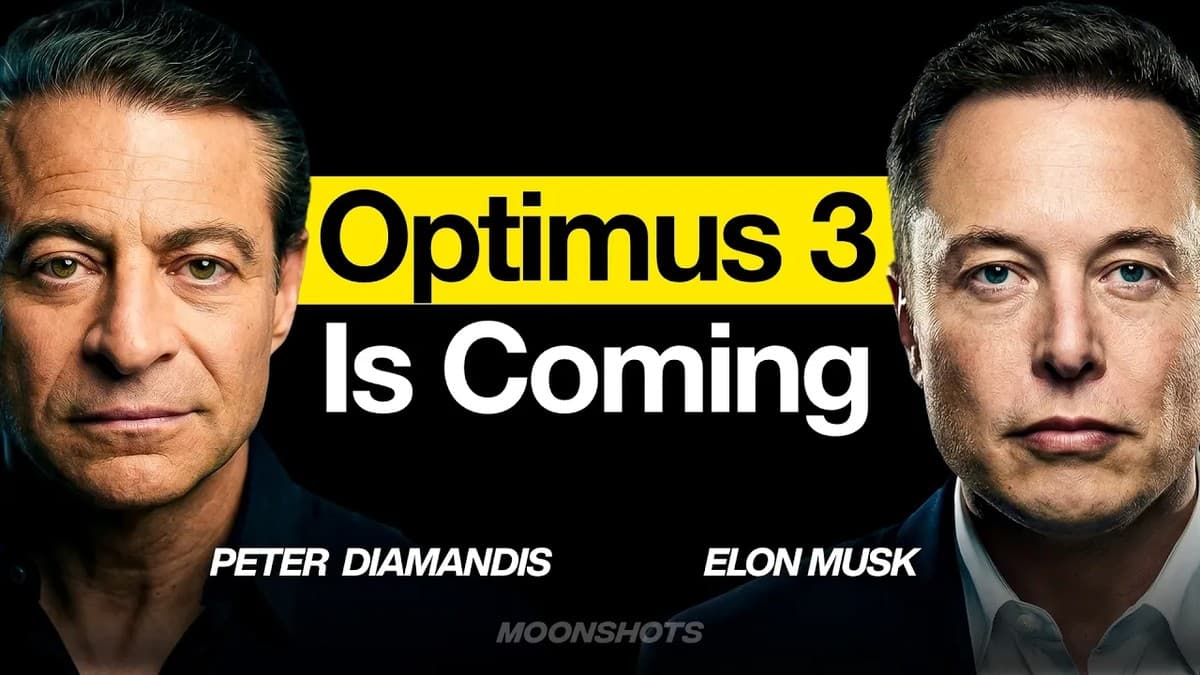
Speaking at the Abundance360 Summit in Los Angeles on March 11, 2026, Elon Musk told host Peter H. Diamandis that recursive self-improvement is already underway at xAI. Recursive self-improvement is the process where an AI system improves itself, and that improved version then improves itself further in a cycle. Musk said humans are "gradually getting less and less in the loop." He went further, calling the current moment a "hard takeoff": rapid, dramatic acceleration that is already underway. These claims carry significant weight given Musk's position running Tesla, SpaceX, and xAI simultaneously. But they also come from someone with clear commercial stakes in public enthusiasm for AI and robotics.
Related reading:
The central claim: "We're in the hard takeoff right now"
Musk's core argument is that AI recursive self-improvement is not a future event. It is happening today, and fully automated recursive self-improvement could arrive by end of 2026. In his own words: "humans are gradually getting less and less in the loop on the recursive self-improvement." Each new model, he argues, is built with the help of the one before it. The process is not yet fully automated, but he gave a specific timeline: "it may be there end of this year, but not later than next year."
When Diamandis asked whether a hard takeoff follows from this, Musk did not hedge: "We're in the hard takeoff. Right now."
AI progress as overlapping S-curves
To explain why predictions are difficult beyond a decade, Musk described AI progress as "a series of overlapping S-curves." An S-curve is a growth pattern familiar from biology and economics: things start slow, then accelerate rapidly, then level off. Then the next breakthrough kicks off a new curve. In Musk's view, we are currently in the steep acceleration phase of one such curve, with no clear ceiling in sight.
The 10x economy
Musk's most striking economic prediction: the global economy will be 10 times its current size within 10 years. He called this "a fairly comfortable prediction," conditional on no catastrophic events like a world war. For context, it took the United States roughly 40 years to grow its economy tenfold in the 20th century. Musk is suggesting AI and robotics could compress that timeline to a single decade.
Optimus 3 and the robot economy
Musk confirmed that Optimus 3 production begins this summer, though volumes will ramp slowly at first. High-volume production is expected around summer 2027. Tesla is building a dedicated 10-million-square-foot factory to support this (roughly the floor area of 170 football fields), and Musk plans to release a new robot design every year.
Tesla currently employs around 150,000 people, with roughly 100,000 working in or around its factories. Musk said he does not plan layoffs: "the output per human at Tesla is going to get nutty high." The claim is that robots amplify human workers rather than replace them, at least at Tesla.
Money becoming irrelevant
On economic consequences, Musk argued that AI and robots will produce so many goods and services that they will effectively "run out of things to do for the humans." This leads to strong deflation: goods get cheaper because supply grows faster than the money supply. The end state, in Musk's framing: universal high income (where everyone receives substantial income as scarcity disappears), with the government issuing money because costs have fallen so far. He put an 80% probability on the future being "great," though he acknowledged the range of outcomes is wide.
His most radical claim: "money will stop being relevant at some point in the future." AI systems, he suggested, will not value human currency at all. They will care about physical resources: "power and mass, wattage and tonnage."
Opposing perspectives
The timing problem with AGI claims
Forecasts about artificial general intelligence (AGI, meaning AI capable of performing any intellectual task a human can) have been routinely wrong for decades. Researchers predicted human-level AI "within 20 years" in the 1960s, 1980s, and again in the 2000s. Specific timelines have consistently slipped. Musk himself previously predicted full self-driving Teslas "next year" for several consecutive years. Skeptics argue that "we're already in the hard takeoff" is another instance of the same pattern: real progress, overstated imminence.
Recursive self-improvement is not a single switch
The phrase "recursive self-improvement" can mean many things. Current AI labs do use AI assistance to help write, evaluate, and sometimes improve AI code. But full autonomy, meaning an AI that designs and trains its own successor with no human oversight, remains undemonstrated. The distinction between "AI helps in the loop" and "AI runs the loop" is significant, and critics argue Musk is collapsing the two.
Who benefits from the narrative
Musk leads xAI (maker of Grok), Tesla (developing Optimus humanoid robots), and SpaceX (recently merged with xAI). Every claim he makes about imminent AI and robot dominance directly inflates the perceived value of these companies. This does not make his claims false, but it is a conflict of interest that deserves acknowledgment when evaluating the confidence with which they are delivered.
How to interpret these claims
Musk's Abundance360 appearance is best understood as a vision statement, not a verified technical briefing.
Attribution matters
Every major claim, from recursive self-improvement to the 10x economy to Optimus timelines, comes solely from Musk. The session was a friendly interview with a host who runs a summit dedicated to exponential optimism. There was no challenge, no independent expert, and no data presented beyond Musk's assertions. That context shapes how much weight to assign any specific number.
The track record is mixed
On some fronts, Musk's predictions have come true ahead of schedule: Falcon 9 reusability, for example, was widely dismissed and then delivered. On others, timelines have missed by years. Full self-driving capabilities, affordable Tesla models, and previous robot milestones have all arrived later than initially claimed. The pattern suggests genuine ambition combined with systematic optimism bias.
What would stronger evidence look like?
For recursive self-improvement: a transparent technical paper showing an AI system that improved its own architecture and training procedure, validated by independent researchers, with measurable capability gains. For Optimus timelines: independent factory audits and production numbers. Without these, the claims remain aspirational. Musk may be right, and the timeline he describes may unfold exactly as stated. But the evidence on offer here is a confident voice in a supportive room.
The singularity caveat
Musk acknowledged that prediction becomes impossible near the singularity: the point where AI surpasses human intelligence so completely that outcomes become unpredictable. "It's hard to know what happens inside the singularity." This admission, buried near the end of a conversation full of precise-sounding numbers, is worth holding onto.
Practical implications
For workers in tech and manufacturing
If Musk's timeline is even roughly correct, the labor market disruption from AI and robotics will arrive faster than most workforce planning assumes. "Nutty high" output per worker implies profound changes to how companies are staffed and structured. Andrew Yang and others have made similar arguments about the pace of disruption, though with different conclusions about policy responses.
For policymakers and economists
A 10x global economy in 10 years would require energy, physical infrastructure, and governance systems that do not yet exist at that scale. Even optimistic scenarios carry serious transition risks: concentrated disruption in specific industries and regions before the promised abundance arrives broadly. Musk himself flagged civil unrest as a real risk in the interim period.
Glossary
| Term | Definition |
|---|---|
| Recursive self-improvement | When an AI system helps build or improve the next version of itself, which then does the same, creating a self-reinforcing cycle of capability gains. |
| Hard takeoff | A scenario where AI capability increases so rapidly that change becomes sudden and very difficult to manage or predict. |
| AGI (Artificial General Intelligence) | AI that can perform any intellectual task a human can, at human level or above. Not yet achieved. |
| ASI (Artificial Superintelligence) | AI that surpasses human intelligence across all domains. A hypothetical future state. |
| S-curve | A growth pattern where something starts slowly, accelerates rapidly, then levels off, forming an S-shape on a graph. Common in technology adoption. |
| Singularity | The hypothetical point at which AI surpasses human intelligence so far that future events become unpredictable. Coined by mathematician John von Neumann. |
| Deflation | When prices fall over time because the supply of goods and services grows faster than the money supply. |
| Universal high income (UHI) | A proposed economic system where everyone receives substantial income as goods become cheap enough that scarcity is effectively eliminated. Goes beyond basic UBI. |
| Humanoid robot | A robot designed with a human-like body: two arms, two legs, an upright posture, enabling it to work in spaces built for people. |
| Dyson swarm | A hypothetical structure of satellites orbiting a star to capture its energy output. Mentioned in the context of the SpaceX-xAI merger's long-term ambitions. |
Sources and resources
Want to go deeper? Watch the full video on YouTube →