Harvey's $8B Bet: Legal AI Can Outrun GPT
Key insights
- Harvey positions itself as a model-agnostic legal platform, routing each subtask to whichever AI model performs best rather than building its own foundation model.
- CEO Winston Weinberg frames AI as 'task automation, not job displacement,' but sidesteps how automating billable tasks reshapes law firm economics.
- The startup is shifting from subscription pricing to outcome-based pricing for custom builds, betting that improved coding models make forward-deployed solutions profitable.
This is an AI-generated summary. The source video may include demos, visuals and additional context.
In Brief
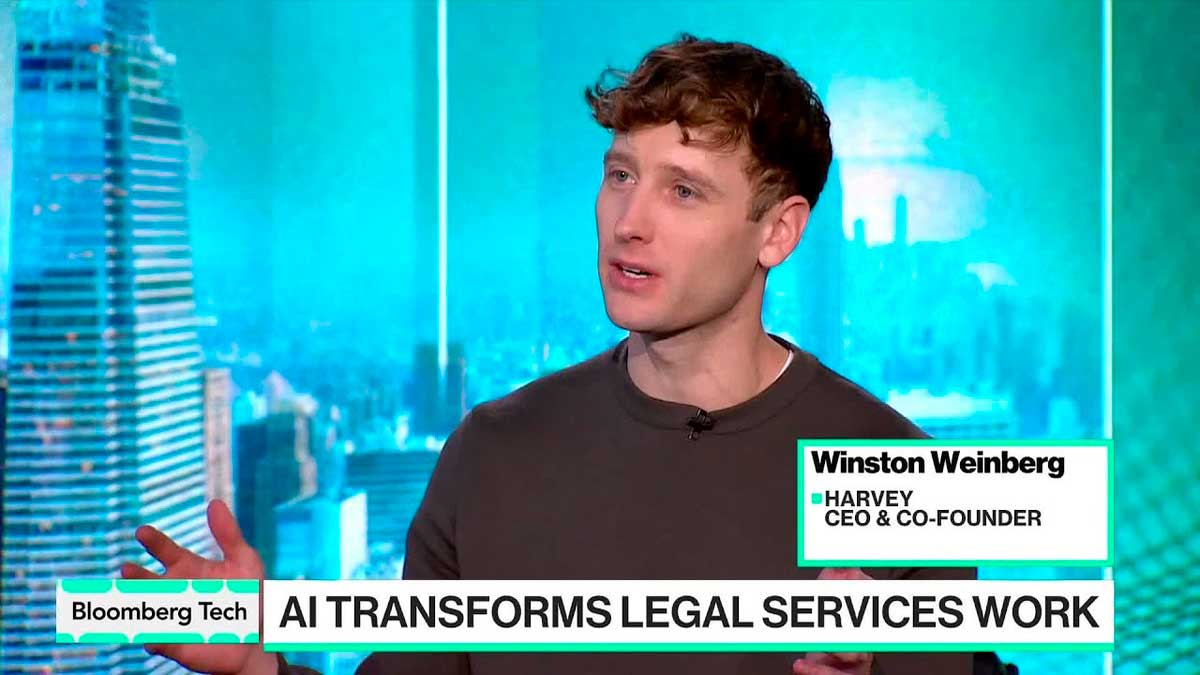
Winston Weinberg, chief executive officer (CEO) and co-founder of Harvey, joins Bloomberg Technology during Legal Week in New York to announce a new tool that lets law firms build custom AI agents. Weinberg argues that legal work is too complex for general-purpose models like GPT or Claude. Harvey's specialized, model-agnostic platform can "race faster in the legal vertical" than providers like OpenAI or Anthropic can expand generally, he claims. Model-agnostic means the system uses whichever AI model works best for each task, rather than being locked to one. The startup, valued at $8 billion as of December 2025, is betting that domain expertise, security compliance, and data integrations create a moat that general models cannot easily cross.
Related reading:
The platform bet: vertical AI over general models
Harvey's central argument comes down to one claim: specialized AI for law will outperform general-purpose models in complex legal work. Weinberg describes legal work as "incredibly complex" and "multiplayer," involving multiple law firms, Fortune 500 companies, and regulatory frameworks all operating on the same deal or case (0:16).
Rather than building its own foundation model, Harvey takes a model-agnostic approach. The platform routes different parts of a legal task to whichever AI model performs best for that specific subtask (1:23). This means Harvey can swap in new models as they improve, without rebuilding its product. Harvey's competitive advantage, then, is not the AI itself. It is everything around it: the integrations with law firm data, security architecture, ethical walls (information barriers that prevent conflicts of interest within firms), and domain-specific evaluation layers.
Weinberg frames this against competitors like LexisNexis and generic AI tools. "Everything else out there is a point solution," he claims, "and what we're building is a platform" (4:16). In his framing, point solutions solve one narrow problem. A platform handles the full workflow: pulling the right data, routing to the right model, keeping humans in the loop when needed, and handing off between specialists.
The 10-year prediction
Weinberg makes a bold claim about the future of legal review. As AI produces more contracts, MSAs (master service agreements), and legal documents, he argues that within 10 years, "a human cannot do this without AI systems" to review the output (1:45). The logic: if AI dramatically increases the volume of legal output, human reviewers simply will not be able to keep up without their own AI tools. It is a self-reinforcing argument. More AI-generated documents create more demand for AI-powered review.
"Task automation, not job displacement"
When pressed directly on whether Harvey replaces lawyers or makes them more productive, Weinberg is emphatic. "This is task automation," he states, "and it will always be task automation" (2:16).
He uses a concrete example. In a complex fund formation involving 50 limited partners (investors in a fund), certain tasks like writing comment memos get automated (2:20). But the high-value work, the strategic advice that sits on top of those tasks, remains human. "As these tasks get automated, the job of a lawyer is just going to level up over time," Weinberg argues.
The billable hours tension
Bloomberg's Ed Ludlow raises the question Weinberg sidesteps: what happens to billing? Ludlow notes that lawyers have traditionally billed in 15-minute increments, scanning barcodes for each unit of work. If AI automates the tasks that generate those billable hours, the pricing model that sustains most law firms faces pressure.
Weinberg's answer pivots to Harvey's own pricing evolution. Currently subscription-based, the company is moving toward outcome-based pricing for custom builds (3:15). Harvey works with large banks, private equity firms, and telecoms alongside their partner law firms. The goal: "redesign or transform how they deliver those services entirely." Improved coding models give these forward-deployed solutions stronger gross margins, according to Weinberg. Forward-deployed means custom AI systems built directly within a client's own infrastructure.
This shift reveals something about Harvey's real business model. The company is not just selling software to law firms. It is positioning itself as the infrastructure layer between corporations and their legal service providers, taking a cut of the value created by automating legal workflows.
Opposing perspectives
The "GPT wrapper" criticism
The most persistent criticism of companies like Harvey is that they are wrappers around foundation models. If Harvey routes tasks to OpenAI, Anthropic, and other providers, what stops those providers from building their own legal tools? Weinberg acknowledges this head-on: "You really just have to outrun these model providers that are trying to build the general system" (4:40). His confidence rests on speed. "We can race faster in the legal vertical than they can generally," he claims.
This is a familiar argument in enterprise AI. Vertical players bet that domain knowledge, compliance requirements, and client relationships create switching costs that general platforms cannot easily replicate. History offers mixed evidence. Some vertical software companies have thrived for decades (Bloomberg itself in financial data). Others were absorbed when platform providers decided the vertical was worth entering.
Is "task automation" just rebranded displacement?
Weinberg's framing of "task automation, not job displacement" deserves scrutiny. When the automated tasks are what junior lawyers spend most of their time doing, the distinction becomes blurry. Writing comment memos, reviewing standard contracts, conducting due diligence research: these are the training ground for young lawyers. If AI handles them, the "leveling up" Weinberg describes may also mean fewer entry-level positions.
The history of automation in other industries suggests a pattern. Productivity tools rarely eliminate entire professions. They do, however, change the ratio of senior to junior workers, often dramatically. A law firm that needed 10 associates to support one partner might need three. The partner's job "levels up." The seven displaced associates face a different calculation.
How to interpret these claims
The interview presents Harvey's vision clearly, but several factors deserve consideration before accepting the narrative at face value.
Source bias
Every claim in this interview comes from Harvey's CEO, speaking on a major financial news program during Legal Week, the legal technology industry's biggest annual gathering. This is a sales pitch delivered in interview format. Weinberg has every incentive to frame Harvey's position as strong, its moat as deep, and its technology as essential. No independent evidence, customer testimonials, or third-party benchmarks are presented.
Unverified numbers
Harvey's $8 billion valuation and 1,000+ customers come from press reports, not audited data. The 10-year prediction about AI-required legal review is Weinberg's personal forecast, not an industry consensus. The claim about stronger gross margins is a forward-looking statement with no supporting figures.
The moat question
Model-agnostic platforms face a structural tension. Their strength, not being tied to one model, is also a dependency. If Harvey's value comes from routing, integrations, and compliance layers rather than the AI itself, a well-resourced competitor could replicate those layers. LexisNexis has decades of legal data and existing law firm relationships. Foundation model providers have the AI capabilities and the resources to build vertical features. Harvey's moat depends on executing faster than both groups, which is exactly what Weinberg claims but cannot prove in a five-minute interview.
Practical implications
For law firms evaluating AI tools
The choice between a vertical platform like Harvey and general-purpose AI tools depends on use case complexity. For simple document review or search, general tools may suffice. For multi-party transactions involving multiple data sources, compliance requirements, and handoffs between specialists, a purpose-built platform has clear advantages. The key question is whether those advantages justify the cost and vendor lock-in.
For AI startups in regulated industries
Harvey's strategy offers a template: combine model-agnostic architecture with deep domain expertise, then race to build integrations and compliance layers that general providers have not prioritized. The risk is that this race never ends. Staying ahead requires continuous investment in a domain moat while foundation models steadily improve at general tasks.
Glossary
| Term | Definition |
|---|---|
| Model-agnostic | Not tied to one AI model. A model-agnostic platform can use whichever model performs best for each specific task. |
| Ethical walls | Information barriers within law firms that prevent one team from accessing another team's confidential data, used to avoid conflicts of interest. |
| Point solution | Software designed to solve one specific problem, as opposed to a platform that handles many related workflows. |
| Forward-deployed solutions | Custom-built AI systems installed and operated within a client's own infrastructure, rather than accessed through a shared cloud service. |
| Outcome-based pricing | A billing model where the client pays based on results delivered, rather than a flat subscription or per-seat fee. |
| Billable hours | The traditional law firm pricing model where clients are charged for each hour (or fraction) of work performed. |
| Foundation model | A large AI model trained on broad data that serves as the base for many applications. GPT and Claude are examples. |
| Agentic system | An AI architecture where specialized agents collaborate to complete multi-step tasks, with handoffs between different components. |
Sources and resources
Want to go deeper? Watch the full video on YouTube →