AI Agents Skip the Internet's Front Door
Key insights
- AI agents skip browsing and ads, going directly from prompt to transaction through APIs, changing how the internet generates revenue
- Middlemen like travel search and comparison sites face disruption as agents connect directly to airlines, hotels, and banks
- A new market is emerging where software serves AI agents as customers, potentially 100x larger than human user bases
This is an AI-generated summary. The source video may include demos, visuals and additional context.
In Brief
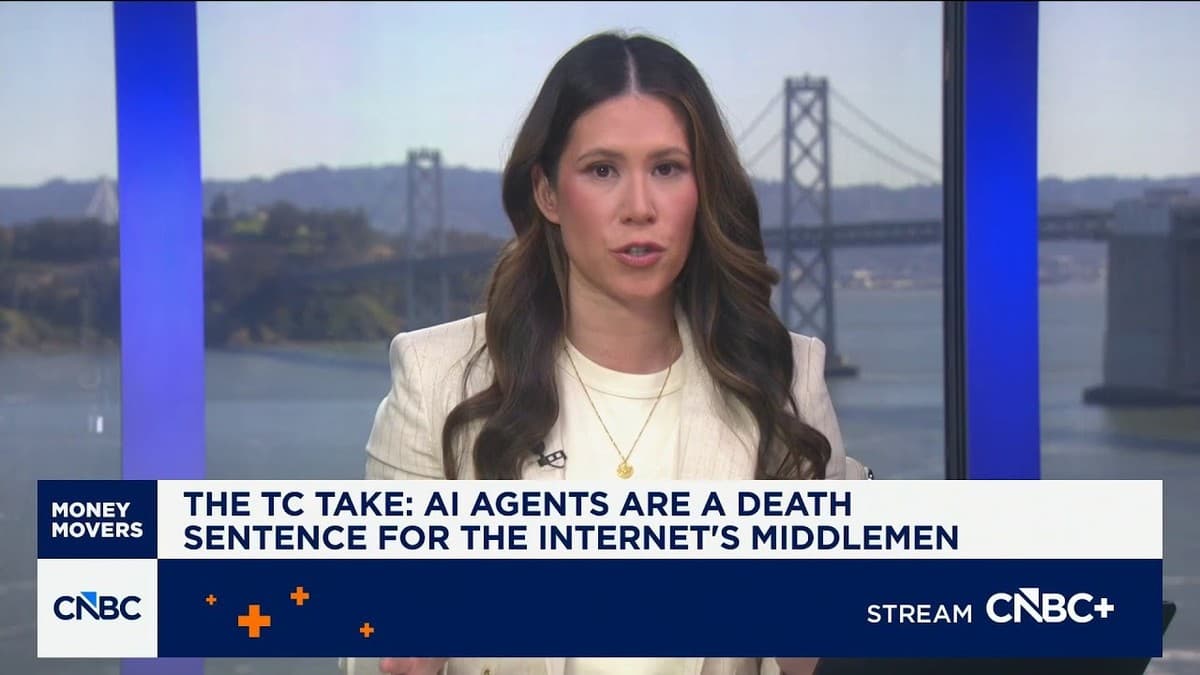
CNBC anchor Deirdre Bosa reports on a structural shift in how the internet works. The argument: AI agents don't browse, compare, or click on ads. They go straight from a user's request to a completed transaction through APIs (application programming interfaces, the direct data connections between software systems). That means the entire layer of search engines, comparison sites, and ad-supported aggregators could lose relevance. The segment also highlights Jensen Huang's praise of OpenClaw, the open-source AI agent platform whose creator, Peter Steinberger, was recently hired by OpenAI.
What happened
NVIDIA CEO Jensen Huang called OpenClaw "the single most important release of software, probably ever" at the Morgan Stanley TMT Conference on March 4 (0:18). Bosa notes that Huang is promoting his own business since agents use far more computing power than chatbots, which directly benefits NVIDIA's chip sales (0:27).
But the bigger story, according to Bosa, is the structural change underneath. The internet was built for humans who search, browse, compare options, and click on ads. AI agents skip all of that (0:43). An agent already knows what you want, or figures it out in the background. It doesn't need to browse ten hotel sites or read reviews. It goes right from prompt to transaction (0:57).
The agent may still access the same data, but it does so through APIs and data feeds, skipping what Bosa calls "the front door" of the internet (1:02).
Winners and losers
Bosa frames the investment question simply: who wins when the user is not a human, but an agent? (1:06)
The winners are the endpoints and infrastructure: airlines (not Kayak), hotels (not Booking.com), your bank (not NerdWallet). Infrastructure companies like Stripe, Plaid, and Shopify also benefit because agents need payment systems, data connections, and commerce platforms to complete transactions (1:13).
The losers are the middlemen, the comparison sites and aggregators that built their business by sitting between consumers and service providers. If agents go directly to the source through APIs, the value of a search-and-compare layer drops.
Aaron Levie, CEO of Box, told Bosa that agents need everything an employee needs: email, storage, a whole identity (1:26). That could mean 100 times their existing customer base (1:31). Bosa describes this as a potential new category: not Software as a Service (SaaS), but "Software for Agents as a Service" (1:37).
The OpenClaw factor
OpenClaw is a personal AI agent that runs autonomously on your machine all day, without waiting for a prompt (1:46). Its creator, Peter Steinberger, was recently hired by OpenAI (1:52). According to Huang, OpenClaw grew faster in three weeks than Linux did in 30 years.
Bosa notes that the market is starting to reflect this shift. Stocks like Twilio and Shopify, the "plumbing" that agents run on, have rebounded strongly over the past month (2:02).
Glossary
| Term | Definition |
|---|---|
| AI agent | Software that acts on your behalf autonomously, completing multi-step tasks without needing instructions at each step. |
| Token | The smallest unit an AI model processes. Roughly 3-4 characters of text. Agents use far more tokens than simple chatbot conversations. |
| API (Application Programming Interface) | A way for software systems to exchange data directly, without needing a visual interface like a website. |
| SaaS (Software as a Service) | Software delivered over the internet on a subscription basis, like Google Workspace or Slack. |
| Open source | Software whose source code is publicly available for anyone to use, modify, and distribute. |
| Middleware / Middleman | Companies that sit between the end provider and the consumer, like travel search engines or financial comparison sites. |
| Inference | When an AI model generates a response or makes a decision based on input. Each agent action requires inference, which consumes compute. |
For a deeper technical explanation of what agents still need behind the scenes, see why AI agents need more than just LLMs.
Sources and resources
- CNBC Television — The internet's coming structural shift (YouTube) (4 min)
- CNBC — Jensen Huang calls OpenClaw 'the most important software release probably ever'
- CNBC — Box CEO: AI agents will be the biggest users of software in the future
- TechCrunch — OpenClaw creator Peter Steinberger joins OpenAI
Want to go deeper? Watch the full video on YouTube →