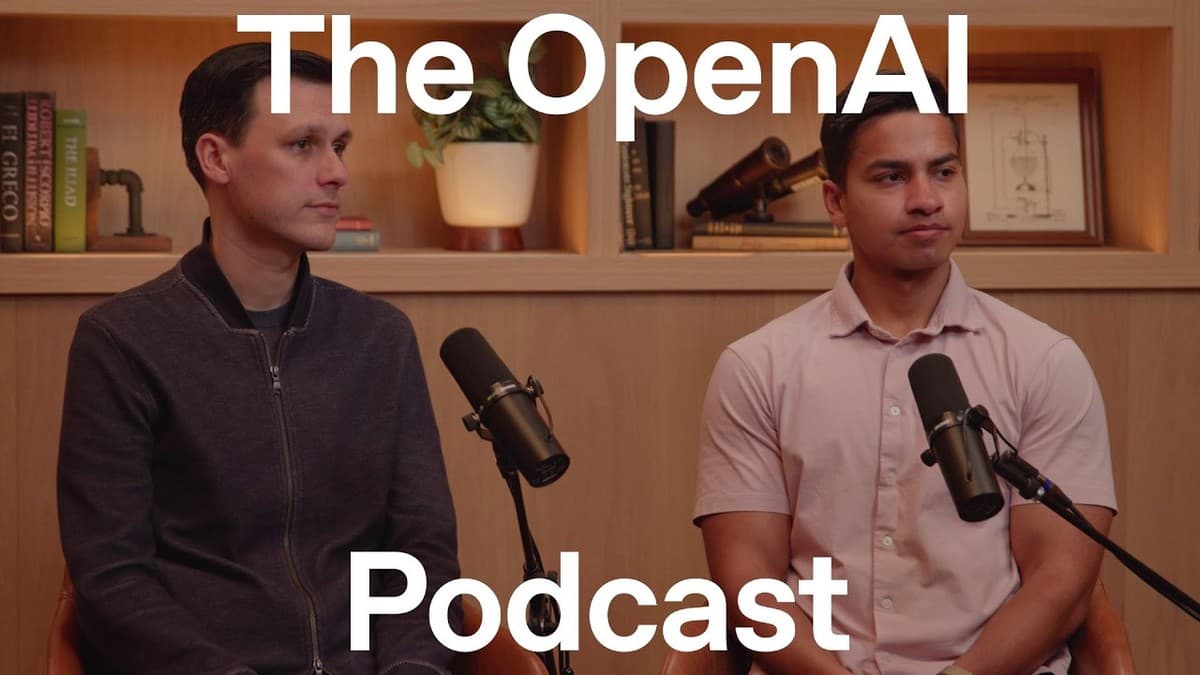
OpenAI Makes the Case for Health AI on Its Own Podcast
Key insights
- OpenAI evaluates its own health models with its own benchmark, HealthBench. Self-evaluation is standard in AI research but insufficient when patient lives are at stake.
- The Penda Health study is the strongest evidence presented: real patients, real clinics, published results. But one study in one market with OpenAI involvement does not validate a global vision.
- The promise to never train on health data builds trust, but it also means the most valuable data for improving health AI stays locked away. That tension is never addressed.
- Framing AI as a 'protective effect' (like biking next to a self-driving car) subtly shifts the burden of proof. If AI is the safety net, who catches the AI's errors?
This is an AI-generated summary. The source video may include demos, visuals and additional context.
In Brief
OpenAI says 40 million people ask ChatGPT health questions every day. In response, the company launched ChatGPT Health in January 2026, trained its models with 262 physicians, and created its own evaluation benchmark called HealthBench. It also tested an AI clinical copilot in Kenyan clinics run by Penda Health. The results they present are encouraging, including a 16% reduction in diagnostic errors. But every piece of this story comes from OpenAI telling it on their own podcast, with no independent voices, no regulatory discussion, and no mention of what happens when the AI gets it wrong.
Related reading:
The pitch: AI as healthcare's missing layer
Dr. Nate Gross, OpenAI's Vice President of Health who co-founded Doximity (a professional network for physicians) and Rock Health (a digital health investment firm), frames the company's health ambitions around three ideas. "Raise the floor" means making AI accessible to everyone, from patients in wealthy countries to clinicians in resource-limited settings. "Sweep the floor" means reducing the paperwork and administrative burden that eats into doctors' time with patients. "Raise the ceiling" means enabling entirely new capabilities, like AI spotting patterns across a patient's decade-long medical history that no human doctor could hold in their head at once.
The product itself, ChatGPT Health, is positioned as a context-aware health companion. It connects to electronic health records (the digital systems where hospitals store patient information), wearables, and lab results. Gross emphasizes that health conversations are encrypted and that OpenAI will never train on users' health data. The product is rolling out to free users, not just paying subscribers.
Karan Singhal, who leads Health AI Research at OpenAI and was previously at Google DeepMind, describes the model's ability to ask for context before answering as a key safety feature. When someone types "it burns," the model asks follow-up questions rather than guessing. This sounds simple but represents a meaningful shift from earlier chatbot behavior, where models would confidently generate an answer regardless of how little information they had.
The evidence: HealthBench and the Penda Health study
Building a benchmark with 262 physicians
OpenAI's approach to measuring health AI performance centers on HealthBench, an open-source benchmark the company released in May 2025. Singhal describes working with a cohort of around 250 physicians (the published paper says 262) who created over 5,000 training conversations and 48,562 evaluation criteria. These criteria go beyond simple multiple-choice medical exams. They test things like whether the model adapts its language for a patient versus an oncologist, whether it escalates appropriately, and whether it expresses uncertainty when it should.
HealthBench measured around 49,000 different dimensions of performance, according to Singhal. OpenAI's models consistently score highest on their own benchmark. Singhal attributes this to how health is integrated into every stage of model training. That means from pre-training (where the model learns from broad data) through post-training (where it is refined with expert feedback), rather than being added as an afterthought.
A clinical copilot in Nairobi
The most concrete evidence in the episode comes from a study conducted with Penda Health, a primary care provider in Nairobi, Kenya. The study involved 15 clinics and 39,849 patient visits (Singhal says "20 or so clinics" in the podcast, but the published numbers are more precise). An AI copilot monitored what clinicians typed into their electronic health records. The tool runs in the background during consultations and only interrupts when something potentially concerning appears.
The results: a 16% reduction in diagnostic errors and a 13% reduction in treatment errors among clinicians using the AI compared to those without it. Perhaps most telling, when Penda Health considered running a follow-up study, the team reportedly hesitated. Singhal recounts that they felt it was "dangerous" to have a group of clinicians not using the AI, a striking claim about how quickly the tool became embedded in clinical practice.
What is missing from the conversation
No independent voices
This is an OpenAI podcast featuring three OpenAI employees. No independent physician, no patient advocate, no health regulator, no ethicist. Every claim is presented without challenge. Dr. Gross and Singhal are credentialed and experienced. Gross built Doximity into what is often called "LinkedIn for doctors." Singhal made the TIME100 Health list in 2026. But credentials do not substitute for independent scrutiny, especially when a company is making claims about patient safety.
Regulatory silence
The episode discusses deploying AI tools in clinical settings across different countries without addressing the regulatory landscape. How does ChatGPT Health relate to Food and Drug Administration (FDA) oversight of clinical decision support software? What about liability when the AI copilot misses an error, or worse, introduces one? These questions are not raised, let alone answered. For a 30-minute conversation about AI in healthcare, the absence of any regulatory discussion is notable.
The data training paradox
Gross emphasizes that OpenAI will never train on users' health data. This is clearly intended as a trust signal, and for many users it will be reassuring. But it also creates a tension that the episode does not explore. If the most valuable data for improving health AI is real patient interactions, and OpenAI promises never to use that data, how do the models keep getting better? The answer presumably involves the physician cohort and synthetic data, but the episode does not address this directly.
How to interpret these claims
The benchmark problem
HealthBench is open-source, which means other researchers can use it. That is good practice. But it was designed by OpenAI, built with OpenAI's physician cohort, and used to evaluate OpenAI's models. When a company creates the test and then scores highest on it, the result tells you less than when an independent group creates the test. This does not mean HealthBench is flawed. It means that independent replication on independently designed benchmarks would carry more weight.
One study, one market
The Penda Health results are published and peer-reviewable. A 16% reduction in diagnostic errors across nearly 40,000 patient visits is a meaningful finding. But Nairobi's primary care context, where clinics may have fewer specialists and different resource constraints, does not automatically translate to a hospital system in London or a rural clinic in Texas. Replication across different healthcare systems, by independent research groups, is what separates a promising pilot from validated evidence.
The Waymo analogy and burden of proof
Singhal compares the "protective effect" of health AI to biking next to a Waymo self-driving car, saying he feels safer beside the autonomous vehicle than a human driver. The analogy is revealing. It frames AI as already safer than the human alternative, subtly shifting the question from "is AI safe enough?" to "is it safer than the status quo?" That may eventually prove true. But Waymo has logged millions of miles and published independent safety data. ChatGPT Health launched two months ago. The analogy asks for a level of trust the product has not yet earned.
Self-reported "miracle cases"
Gross mentions "miracle cases" of patients with unsolved diagnoses finally getting answers through AI. These stories are powerful but unverifiable in this format. Individual success stories, without denominator data showing how often the AI fails or misleads, can create a misleading impression of reliability. This is not unique to OpenAI. It is a pattern common to any company selling a high-stakes product.
Practical implications
For patients
ChatGPT Health may be useful for understanding lab results, preparing questions before a doctor's visit, or getting context on a diagnosis. It is not a replacement for professional medical advice. Users should treat it as a starting point for conversations with their doctors, not as a final answer.
For clinicians
The Penda Health copilot model, where AI monitors in the background and only interrupts when it spots something concerning, is worth watching. It avoids the "alert fatigue" problem that plagues many clinical tools. But clinicians should look for independent validation before relying on any AI safety net in their own practice.
For the industry
The biggest gap in OpenAI's presentation is independent validation. Healthcare organizations evaluating AI tools should prioritize products that have been tested by researchers with no financial stake in the results, across multiple healthcare settings, with transparent methodology.
Glossary
| Term | Definition |
|---|---|
| Clinical copilot | An AI tool that runs in the background during a medical consultation and alerts the doctor to potential errors or missed diagnoses. |
| HealthBench | OpenAI's open-source benchmark for evaluating how well AI models handle health questions, built with input from 262 physicians. |
| Electronic health records (EHR) | The digital system where hospitals and clinics store patient information, test results, and treatment history. |
| Adaptive literacy | Adjusting the complexity of language based on who is reading. A model might explain a condition differently to an oncologist than to a patient. |
| Post-deployment monitoring | Tracking how an AI system performs after it has been released to real users, as opposed to only testing it in controlled settings before launch. |
| Hallucination | When an AI model generates a confident answer that is factually wrong. The model does not "know" it is wrong. |
| Drug repurposing | Finding new medical uses for existing medications that were originally approved for a different condition. |
| Value-based care | A healthcare payment model where providers are paid based on patient outcomes rather than the number of procedures they perform. |
| Rubric criteria | Specific checklist items used to grade the quality of an AI's response, such as accuracy, safety, and appropriate language level. |
Sources and resources
Want to go deeper? Watch the full video on YouTube →