Nvidia's $1 Trillion Forecast Fooled the Market for Minutes
Key insights
- Doubling the forecast while doubling the timeframe means the growth trajectory is unchanged. The market spotted this within minutes.
- Hyperscaler concentration is rising, not falling. 60% of revenue from four customers makes Nvidia more vulnerable to in-house chip programs.
- Nvidia's push into CPUs signals a hedge against GPU commoditization, not a new growth engine.
This is an AI-generated summary. The source video may include demos, visuals and additional context.
In Brief
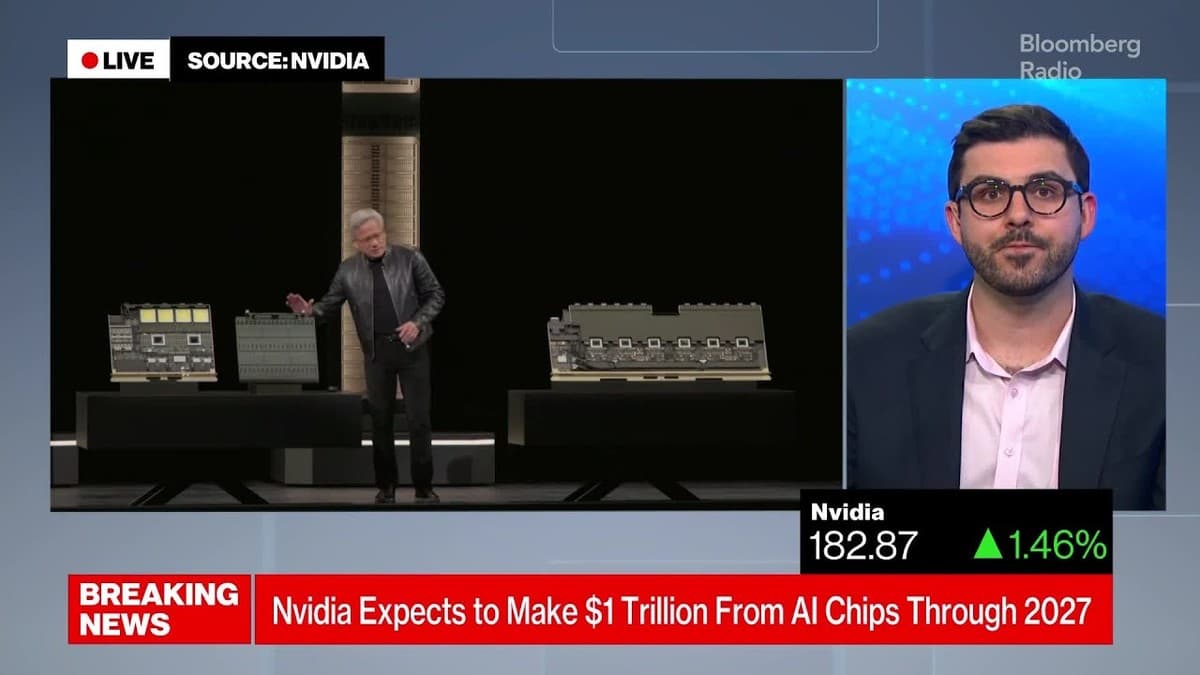
Jensen Huang took the stage at Nvidia's GTC 2026 and announced a $1 trillion cumulative chip revenue forecast through the end of 2027. The stock spiked 4.8% on the headline. Then Wall Street did the math: the previous forecast was $500 billion through the end of 2026. Doubling the number while extending the timeline by a full year doesn't signal an acceleration. The shares settled at 1.6% by close. Bloomberg's Ed Ludlow, reporting live from GTC, broke down what the market actually heard versus what Jensen presented.
Related reading:
The headline vs the math
Nvidia's previous forecast, stated by Huang on October 28, 2025, projected $500 billion in cumulative revenue from Blackwell and Rubin chip systems through the end of calendar year 2026. That covered five fiscal quarters.
The new $1 trillion figure extends the outlook by a full year, through the end of 2027. As Ludlow explains, it doesn't represent an acceleration nor an expansion of the outlook. It's the natural progression of the existing trajectory, just projected further out.
The market reaction tells the story clearly. Nvidia shares saw a massive spike when Huang said the number on stage, jumping more than 4.8%. Then analysts and traders ran the numbers and realized the per-quarter revenue path hadn't changed. The stock settled to a 1.6% gain by close, which was actually lower than where Nvidia was trading before the GTC presentation began. The company entered the event with a $4.4 trillion market cap, already pricing in enormous growth.
Ludlow raises a pointed question: why didn't Nvidia file an 8-K, a mandatory filing companies use to disclose major events to investors in writing, so the market could digest the numbers properly? His answer: Huang wanted something flashy for the stage. The $1 trillion figure is designed for a keynote applause line, not a spreadsheet.
The hyperscaler problem
A pie chart shown during the presentation revealed a detail that Bloomberg's reporting team found more significant than the headline number. 60% of Nvidia's forecasted revenue is expected to come from just four hyperscalers, the massive cloud computing providers: Amazon Web Services, Microsoft Azure, Google Cloud, and Meta.
As Ludlow notes, this concentration has been closely tracked, and the trend is moving in the wrong direction. Customer diversification appears to be going backwards, with the hyperscalers making up a larger share than before.
This matters because all four of those customers are actively developing their own AI chips. Google has its TPU chips, Amazon has Trainium and Inferentia, Microsoft is building Maia, and Meta has been investing in custom silicon. The more dependent Nvidia becomes on these four buyers, the more exposed it is if even one of them successfully reduces its reliance on Nvidia hardware.
New products, muted reactions
Beyond the headline number, Nvidia announced several product developments at GTC. The Vera CPU represents Nvidia's first standalone central processing unit, a general-purpose processor that handles orchestration tasks in data centers rather than the parallel computation that GPUs (Graphics Processing Units) are built for.
Huang called the CPU "for sure" a multibillion-dollar business. But as Ludlow points out, CPUs are not as valuable to Nvidia as GPUs are. The cost per CPU is lower, and CPUs don't have the AI-specific workload advantage that has made Nvidia's GPUs so dominant. The CPU push is best understood as a play to expand Nvidia's total addressable market (TAM), the total revenue it could theoretically capture, rather than a growth accelerator.
The market seemed to agree. Neither AMD nor Intel, the established CPU makers, saw their stocks drop on the announcement. Investors had already expected Nvidia to make this move.
Nvidia also confirmed it would bring Groq's inference technology to market. Groq (spelled with a Q, distinct from Elon Musk's xAI chatbot Grok with a K) makes specialized chips designed for running AI models rather than training them. Nvidia bought Groq's technology and key talent for $20 billion in a deal announced in December 2025. The Groq-based chips will be manufactured by Samsung, with systems expected in the second half of 2026.
The next-generation Vera Rubin platform, named after the astronomer whose observations provided evidence for dark matter, will begin shipping in systems during the second half of 2026. While it promises significant efficiency improvements over the current Blackwell architecture, Ludlow notes these specifications have been discussed before. Nothing at GTC represented a genuine surprise for the market.
How to interpret these claims
The framing matters more than the number
The $1 trillion figure is not wrong. It is simply not new information dressed up as new information. When the sell-side analysts, the investment bank researchers whose models drive stock pricing, go back and update their models, the quarterly figures likely won't change much. Ludlow expects the estimates to be "updated a little bit," not revised upward.
Concentration risk is the real story
A company worth $4.4 trillion that gets 60% of its revenue from four customers faces a structural vulnerability that no product announcement can solve. The hyperscalers buy from Nvidia because no alternative is good enough yet. That calculus could change on a different timeline than Nvidia's annual product cycle.
The CPU strategy reveals the anxiety
Nvidia entering the CPU market is a defensive move. If AI data centers increasingly use custom chips from the hyperscalers themselves, Nvidia needs revenue streams that don't depend entirely on being the only game in town for GPU-based AI training. CPUs are lower-margin but harder to replace with custom alternatives, since they handle general infrastructure rather than specialized AI workloads.
Practical implications
For investors
The gap between the 4.8% spike and 1.6% close is a useful case study in headline trading versus fundamental analysis. Nvidia's growth story remains intact, but this presentation did not change the trajectory. Watching hyperscaler in-house chip programs is likely more important than watching GTC keynotes.
For the AI industry
Nvidia's dominance continues, but 60% customer concentration means the company's pricing power depends on a small group of buyers who have both the resources and the motivation to build alternatives. The Groq technology deal and CPU expansion suggest Nvidia sees this risk clearly.
Glossary
| Term | Definition |
|---|---|
| GPU (Graphics Processing Unit) | A chip designed for parallel computation, originally for graphics but now the core hardware for AI training and inference. |
| CPU (Central Processing Unit) | The general-purpose processor in a computer or server, handling orchestration, scheduling, and management tasks. |
| Hyperscaler | One of the largest cloud computing companies (Amazon AWS, Microsoft Azure, Google Cloud, Meta) that operates data centers at massive scale. |
| Inference | When a trained AI model generates responses or predictions, as opposed to training where it learns from data. |
| TAM (Total Addressable Market) | The total revenue opportunity available if a company captured 100% of its target market. |
| 8-K filing | A mandatory SEC filing that publicly traded companies submit for significant unscheduled events, ensuring investors receive material information in writing. |
| Sell side | Investment bank analysts who publish research and price targets that influence how stocks are valued. |
| Blackwell | Nvidia's current-generation AI chip architecture, named after mathematician David Blackwell. |
| Vera Rubin | Nvidia's next-generation AI chip platform, expected to ship in the second half of 2026, named after astronomer Vera Rubin. |
| Groq (with Q) | An AI hardware company whose technology Nvidia bought for $20 billion in 2025. Builds chips specialized for inference. Distinct from Grok (with K), the xAI chatbot. |
Sources and resources
Want to go deeper? Watch the full video on YouTube →