You Already Speak the Language of AI
Key insights
- Natural language is the most important programming language of the AI era because LLMs understand human speech directly
- Programming languages have evolved through 8 generations, each getting closer to how humans think and communicate
- The fundamental shift is from translating intent into machine instructions to going straight from intent to results
This is an AI-generated summary. The source video may include demos, visuals and additional context.
In Brief
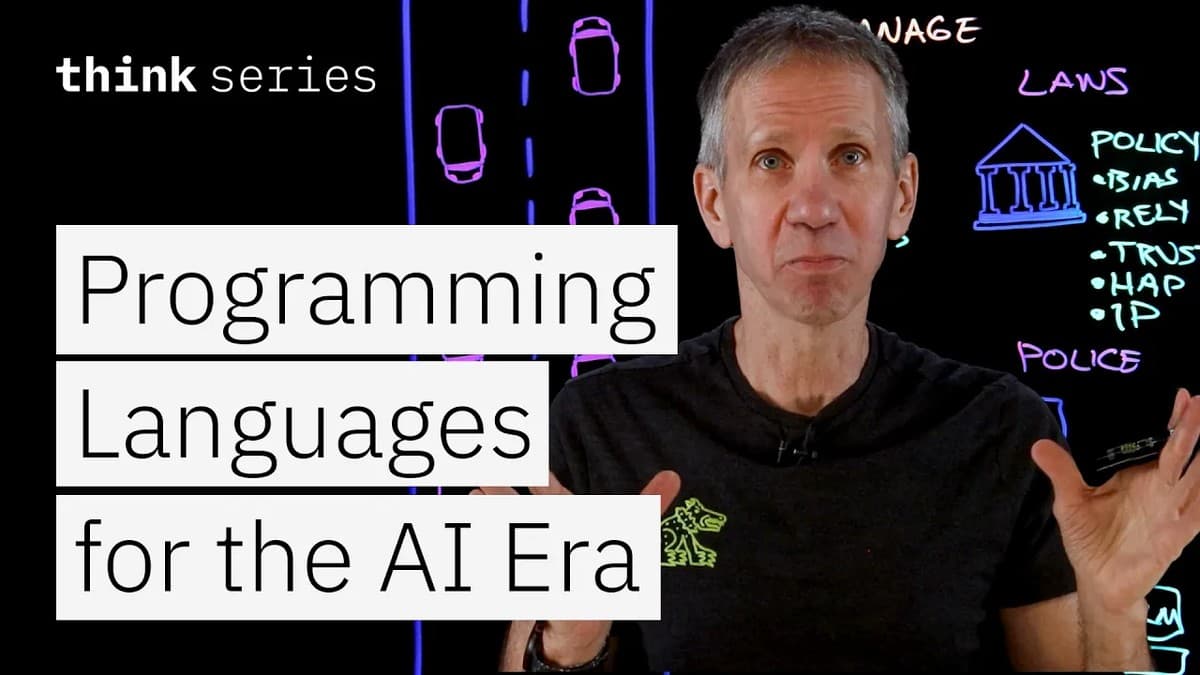
Jeff Crume from IBM argues that the most important programming language isn't Python, Java, or any traditional language. It's the language you already speak. In under 10 minutes, he traces how programming languages have evolved over 60 years, from raw machine code to natural language, and explains why Large Language Models (LLMs) have finally made computers understand humans instead of the other way around.
Why programming languages exist
Crume starts with a simple question: why do we have programming languages at all? He uses a baking analogy (0:51):
- You start with intent — you want a cake
- You translate that intent into instructions — a recipe
- You follow those instructions to get the result — the cake
Computers have worked the same way. You have something you want the computer to do (intent), you write code (instructions), and the computer runs it (result). The problem? Until recently, you had to write those instructions in the computer's language, not yours (1:21).
Eight generations of programming languages
Crume walks through the entire history of how programming languages got closer to human language (1:59).
Machine and assembly languages (1950s–60s)
The earliest computers only understood binary (ones and zeros) and hexadecimal codes. Assembly language, like IBM's Basic Assembly Language for the System/360, was a thin layer on top (2:04). You were writing in the machine's language, and it looked nothing like human speech.
High-level languages (1950s–70s)
Fortran (Formula Translation) handled mathematics. COBOL (Common Business-Oriented Language) was built for business. BASIC made programming more accessible. These looked more like English, but as Crume notes, people don't actually talk like that (2:59).
Structured programming (1960s–80s)
PL/1 (Programming Language One), Pascal, and C introduced proper program flow. No more "spaghetti code" (code that jumps unpredictably from one place to another using go-to statements) (3:44). Pascal was strongly typed (strict rules about what kind of data goes where), while C was loosely typed, giving more freedom but also more room for mistakes.
Object-oriented programming (1980s–90s)
C++ and Smalltalk let programmers think in terms of objects: you put inputs in, the object performs functions, and you get outputs (4:37). A more natural way to organize code, but still far from how people communicate.
Web languages (1990s–2000s)
Java's promise was "write once, run everywhere." Before this, code written for one platform wouldn't work on another without changes. JavaScript and PHP followed for web-specific needs (5:17).
Scripting languages (1990s–present)
Python and Ruby offered higher-level abstractions (ways to express complex operations in fewer lines of code), making code faster to write and easier to read (6:04). Python became the dominant choice for data science and AI development.
Safety-focused languages (2010s–present)
Go (designed for microservices and cloud environments) and Rust (preventing memory errors that cause crashes) added guardrails that older languages lacked (6:40).
Natural language (2020s–present)
English, Spanish, Mandarin, Norwegian — whatever you speak. Large Language Models understand human language directly through prompts (the text or speech you send to an AI). You don't translate your intent into code. You just say what you want (7:25).
The big shift: from instructions to intent
The most important point in Crume's video is what changed at the end of this 60-year evolution (8:16).
For decades, the process was: Intent → Instructions → Results. You had an idea, you translated it into code, and the computer executed it. You needed a computer science degree to do the translation step well. Crume himself spent four years in college learning to program (8:34).
Now with LLMs and natural language processing (NLP, the field of AI that deals with understanding human language), the process is: Intent → Results. You skip the translation step entirely. The AI handles everything between what you want and what you get (8:21).
As Crume puts it: early computers required you to understand their language. With LLMs, computers now understand ours.
How to start "programming" with natural language
If natural language is the new programming language, what does getting started actually look like?
Writing clear prompts
The quality of AI output depends on how clearly you describe what you want. This is sometimes called prompt engineering, but it's really just clear communication:
- Be specific: "Write a Python function that checks if a number is prime" works better than "write some code"
- Give context: "I'm building a web app for beginners, using React" helps the AI choose the right complexity level
- Break big tasks into steps: "First, outline the structure. Then, write each section" gives better results than "write the whole thing at once"
Using AI coding tools
Tools like GitHub Copilot, Claude Code, and ChatGPT let you describe what you want in plain language and get working code back. You don't need to know the syntax. You need to know what you want to build and how to evaluate what the AI gives you.
Talking to AI assistants
Voice interfaces on phones and smart speakers are the purest form of natural language programming. You speak, the AI understands, and something happens. No screen, no keyboard, no code.
Checklist: Common misconceptions
Natural language as a programming tool is powerful, but misunderstandings can set unrealistic expectations:
- "I never need to learn traditional coding." Not true. Traditional programming languages build the AI systems themselves, handle performance-critical tasks, and provide the precision that natural language can't always deliver. Natural language is a new layer on top, not a replacement for everything underneath
- "AI understands all languages equally." Not yet. Most LLMs are trained primarily on English text. Other languages work, but may produce less accurate results for technical tasks. Crume acknowledges this: the common language of computer science today is English (8:53), though other languages are catching up
- "Natural language is precise enough for everything." It's not. "Make it better" means different things to different people. Traditional code is unambiguous — the computer does exactly what you write. Natural language requires iteration and clarification
- "Programmers are obsolete." The role is changing, not disappearing. Knowing what to ask for, how to verify the output, and when to use traditional code are skills that matter more than ever
- "If AI speaks my language, it understands my intent perfectly." AI can misinterpret ambiguous requests, miss implied context, or generate plausible-looking but incorrect output. Always review what AI produces
Remember: Natural language lowers the barrier to entry, but it doesn't eliminate the need to think clearly about what you want to build.
Practical implications
For beginners
Start using AI tools today. You don't need to learn Python first. Describe what you want in plain language and let the AI generate code. Focus on learning what to build and how to evaluate the output, rather than memorizing syntax. If the code interests you, ask the AI to explain it line by line.
For experienced developers
Natural language doesn't replace your skills — it amplifies them. Use AI to handle boilerplate code, explore unfamiliar frameworks, and prototype faster. Your edge is knowing what good code looks like, which means you can catch AI mistakes that beginners would miss.
For organizations
The pool of people who can build software just expanded. Business analysts, designers, and domain experts can describe what they need and get working prototypes. This doesn't mean you replace your developers. It means developers spend more time on architecture and less time on routine tasks.
Test yourself
-
Transfer: Crume traces programming evolution from machine code to natural language. How would you apply this same "evolution toward the user" pattern to another field, like music production or medical diagnosis?
-
Trade-off: When would you choose to write traditional code (Python, JavaScript) over prompting an AI in natural language? Think of cases where natural language would be the wrong tool for the job.
-
Behavior change: If everyone can "program" with natural language, how might that change what kind of software gets built — and who decides what gets built?
Glossary
| Term | Definition |
|---|---|
| Assembly language | A low-level programming language that uses short abbreviations (like MOV, ADD) instead of raw binary. One step above machine code, but still the computer's language. Like writing cooking instructions using chemical formulas instead of ingredient names. |
| BASIC | Beginner's All-purpose Symbolic Instruction Code. One of the first languages designed to be easy to learn. Popular in the 1970s–80s for home computers. |
| C | A programming language from the 1970s that gives lots of control over hardware, but also lots of ways to make mistakes. Still used today in operating systems and embedded devices. |
| COBOL | Common Business-Oriented Language. Designed in the 1950s for business applications. Still runs many banking and government systems today. |
| Fortran | Formula Translation. One of the first high-level programming languages (1957), designed for mathematical and scientific computing. |
| Go | A programming language created by Google for cloud applications. Focuses on simplicity and built-in tools for running many tasks at once. |
| Java | A programming language whose key promise was "write once, run everywhere." Your code runs on any device with a Java Virtual Machine. Widely used for web apps and Android. |
| LLM (Large Language Model) | An AI model trained on massive amounts of text that can understand and generate human language. ChatGPT, Claude, and Gemini are examples. Like a pattern-matcher that learned language by reading billions of documents. |
| Machine language | The most basic language a computer understands: ones and zeros (binary). Every other programming language eventually gets translated down to this level. |
| Natural language | Any language that humans speak naturally — English, Spanish, Norwegian, Mandarin. In the AI context, it means talking to a computer the way you'd talk to a person. |
| NLP (Natural Language Processing) | The field of AI focused on making computers understand and generate human language. Powers everything from translation apps to AI chatbots. |
| Object-oriented programming | A way of organizing code around "objects" that combine data and behavior. Like thinking of a car as one unit with properties (color, speed) and actions (accelerate, brake), rather than separate instructions for each part. |
| Prompt | What you type or say to an AI model — your question, instruction, or request. In the context of natural language programming, the prompt is your code. |
| Python | A scripting language that became the most popular language for AI and data science. Known for readable syntax that looks close to English compared to other languages. |
| Rust | A programming language focused on safety, especially preventing memory-related bugs. Used for performance-critical software where crashes are unacceptable. |
| Spaghetti code | Code that jumps around unpredictably using go-to statements, making it hard to follow. Named because the tangled flow looks like a plate of spaghetti. Structured programming was invented to fix this. |
| Strongly typed / loosely typed | How strict a language is about data types. A strongly typed language (like Pascal) won't let you accidentally treat a number as text. A loosely typed one (like C) gives more freedom but less protection from mistakes. |
Sources and resources
Want to go deeper? Watch the full video on YouTube →