AI That Predicts Cancer Before Doctors Can See It
Key insights
- MIRAI detects subtle changes in color and texture in mammograms that are physically invisible to the human eye, predicting cancer risk years before any doctor would consider ordering a biopsy.
- Global screening policies are wildly inconsistent. AI could resolve this by identifying the 3% of women who genuinely need early intervention, while sparing the other 97% unnecessary procedures.
- Most money in drug development is lost to late-stage clinical trial failures. AI helps filter out weak candidates early, before that investment is made. The timeline from discovery to treatment is starting to compress.
- The gap between what technology can do and what hospitals actually use was the real shock for Barzilay when she became a patient in 2014, just 20 minutes from her own MIT lab.
This is an AI-generated summary. The source video may include demos, visuals and additional context.
In Brief
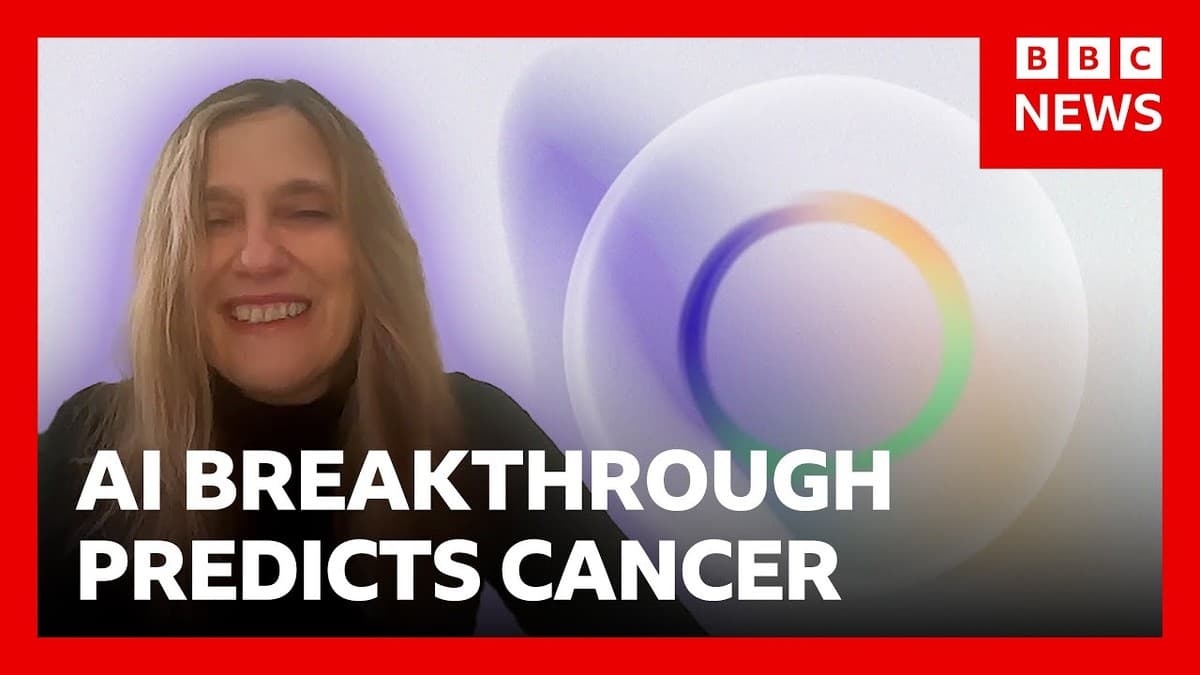
Dr. Regina Barzilay, professor at MIT and a breast cancer survivor, has built an AI model called MIRAI that can predict a patient's risk of developing breast cancer up to five years before symptoms appear. Named after the Japanese word for "future," MIRAI has now analyzed over two million mammograms and is deployed in 48 hospitals across 22 countries. On this episode of BBC AI Decoded, she joins host Christian Fraser and co-hosts Dr. Stephanie Hare and Marc Cieslak to explain how the model works, where it is already changing care, and where she thinks cancer treatment is heading in the next decade.
Related reading:
From Patient to Researcher
In 2014, Barzilay was diagnosed with breast cancer. She was a computer scientist at MIT, one of the world's top technology institutions. Massachusetts General Hospital, where she received her diagnosis, is a 20-minute walk across a bridge from her lab. And yet, as she describes it, the gap between the two worlds was staggering.
She was struck that at a hospital considered one of the top in the United States, none of the information technologies routinely used everywhere else had found its way into patient care. Every question she asked her care team was answered by pointing to a clinical trial from a decade ago. Medicine was treating patients as statistics, not individuals.
That gap, not the diagnosis itself, became her mission. If AI was transforming logistics, finance, and consumer apps, why was it absent from the clinic?
What MIRAI Actually Does
The key insight behind MIRAI is not that the AI is smarter than radiologists. It is that the signs of cancer are often already present in earlier scans, long before any clinician would act on them.
When a patient is diagnosed, oncologists who look back at previous mammograms frequently find that something was there all along. It was simply too ambiguous to trigger a biopsy. And that ambiguity is rational: a biopsy is a surgical procedure with real costs, side effects, and disruption to a patient's life. Clinicians only send patients for biopsies when they are very confident there is a problem.
The machine, Barzilay explains, "can identify very very subtle changes in color, in texture" that the human eye cannot reliably discriminate. Once trained correctly, MIRAI can recognize these patterns early enough to say that changes are already underway, years before the cancer becomes visible to any radiologist.
This is not prediction in the speculative sense. As Barzilay puts it, the cancer is often already there — "just human eye cannot see it." MIRAI extends human perception into a range our biology does not reach.
The Screening Dilemma
One of the most striking parts of the conversation is how inconsistent global screening policies actually are. In the UK, routine mammography is offered every three years. In the United States, one medical body recommends annually, another every two years, and insurance policies vary accordingly. In Israel, the standard is every two years, with screening starting at age 50.
That last figure has a troubling consequence: 25% of breast cancers in Israel occur in women under 50, precisely those who are not yet being screened. Because they are diagnosed later, their cancer is typically at a more advanced stage than in women who were screened. More aggressive cancer, worse outcomes.
The obvious fix, screening everyone from an earlier age, carries enormous cost and creates a burden of unnecessary procedures for the vast majority of women who will never develop cancer. This is exactly the tradeoff AI is positioned to resolve. Barzilay's proposal is to screen everyone at, say, age 40, but use MIRAI at that point to stratify results: around 97% of women can return at 50 as normal, while the remaining 3% identified as high-risk are monitored much more closely from that point on.
AI does not just help screen more people. It changes who actually needs screening in the first place.
Predicting the Flu, Too
MIRAI is not the only medical AI coming out of Barzilay's lab. Her team has also built models that help the World Health Organization decide which flu strain to prioritize in the annual vaccine.
Every year, WHO looks at circulating flu strains and must place a bet on which one will dominate by the time the season arrives months later. The problem is that the current leader in the race might not be the leader in six months. Barzilay's model can "tell them how the frequency of this strain is going to change in 6 months," based on the biological sequence characteristics of each strain and how they tend to compete.
The model cannot predict a strain that did not exist when the decision was made, and Barzilay is honest about this limit. What happened this year, she notes, is that the dominant strain was simply not in the running when WHO made its selection. No prediction model could have caught that. But for the many years when all the relevant strains are present and the wrong one is chosen anyway, AI provides a valuable additional source of information.
Personalized Treatment and Drug Discovery
The conversation shifts from early detection to treatment, and this is where the picture becomes more ambitious. Metastatic cancer (cancer that has spread to other parts of the body) is where the hardest problems live. At that stage, there is no standard treatment that applies to everyone. Every patient's disease has evolved in a slightly different direction.
Clinical trials are already running in the United States for breast, colon, and lung cancer where machine learning is used alongside pathology slides and genomic sequencing to identify which treatment is most likely to succeed for a specific patient. The goal is to remove the guesswork that oncologists currently have no choice but to accept.
This work is coming together with advances in drug discovery from tools like AlphaFold. By modeling how proteins fold and interact, AI lets researchers understand disease at the molecular level and design drugs with more precision. Drug development has historically been plagued by late-stage clinical trial failures, where enormous investment collapses just before the finish line. AI is starting to filter out weaker candidates earlier, before that money is spent.
The 10-Year Vision
Asked to paint a picture of cancer care in a decade, Barzilay's answer is striking in how concrete it is. She envisions "simple blood tests" replacing complex imaging for routine screening, with AI identifying who is at risk early enough to suggest lifestyle modifications. For those who do develop cancer, she hopes for treatments that are both personalized and far less toxic than what exists today.
Current cancer treatment is, in her words, "terribly toxic." The treatments that save lives are also, frequently, the treatments that damage them. The goal is not just catching cancer earlier, but treating it with far less collateral damage, guided by a detailed understanding of each individual's disease.
Three things, she says, will define the next decade: much earlier detection, a better understanding of how lifestyle conditions contribute to disease development, and personalized non-toxic treatments with high efficacy.
Glossary
| Term | Definition |
|---|---|
| Mammogram | An X-ray image of the breast used to screen for cancer. The images are read by radiologists looking for suspicious areas. |
| MIRAI | An AI model developed at MIT that analyzes mammograms to predict breast cancer risk up to 5 years ahead. Named after the Japanese word for "future." |
| Metastatic cancer | Cancer that has spread from where it first formed to other parts of the body. Harder to treat and associated with worse outcomes than localized cancer. |
| AlphaFold | Google DeepMind's AI system that predicts the 3D structure of proteins. A major breakthrough for understanding disease and designing new drugs. |
| Protein language model | An AI model that learns patterns in protein sequences, similar to how large language models learn patterns in text. Used to predict protein behavior and interactions. |
Sources and resources
- BBC AI Decoded: One Survivor's AI Breakthrough Predicts Cancer Years Ahead (YouTube) — Original source video, February 9, 2026
- Dr. Regina Barzilay — MIT CSAIL — Barzilay's research page at MIT
- MIRAI — MIT Jameel Clinic — Official page for the MIRAI breast cancer risk prediction model
- AlphaFold — Google DeepMind — DeepMind's protein structure prediction tool, referenced by Barzilay
- Dr. Stephanie Hare — Co-host, BBC AI Decoded
- Christian Fraser — christian-fraser.com — BBC presenter and host of AI Decoded
Want to go deeper? Watch the full video on YouTube →