AI Data Centers Are Creating a Rural Housing Crisis
Key insights
- Data centers are moving to rural areas where cities push back, but local infrastructure can't handle the worker influx
- Temporary worker camps with food, gyms, and wifi are becoming a booming business around data center construction
- Construction jobs are growing twice as fast as the national average, with electricians in especially high demand
This is an AI-generated summary. The source video may include demos, visuals and additional context.
In Brief
The AI boom needs more than chips and code. It needs concrete, steel, and thousands of construction workers willing to live in remote locations for weeks at a time. Bloomberg Television reports on how the rush to build data centers in rural Texas and Louisiana is creating an unexpected side effect: a housing crisis in small towns that lack hotels, roads, and grocery stores for the sudden wave of workers.
What happened
AI companies need massive amounts of land and power for their data centers, but cities are pushing back. Residents worry about property values and quality of life (0:40). So projects are moving to rural areas in Texas and Louisiana, where land is cheaper and local governments are more willing to negotiate on power and zoning (0:48).
The problem: these towns don't have the infrastructure for it. Hotels fill up immediately. RV parks are packed. Grocery store lines grow. Single-lane county roads start crumbling under heavy truck traffic (1:22). Workers are paying thousands of dollars a month just to rent an RV space near a construction site (1:39).
The mancamp solution
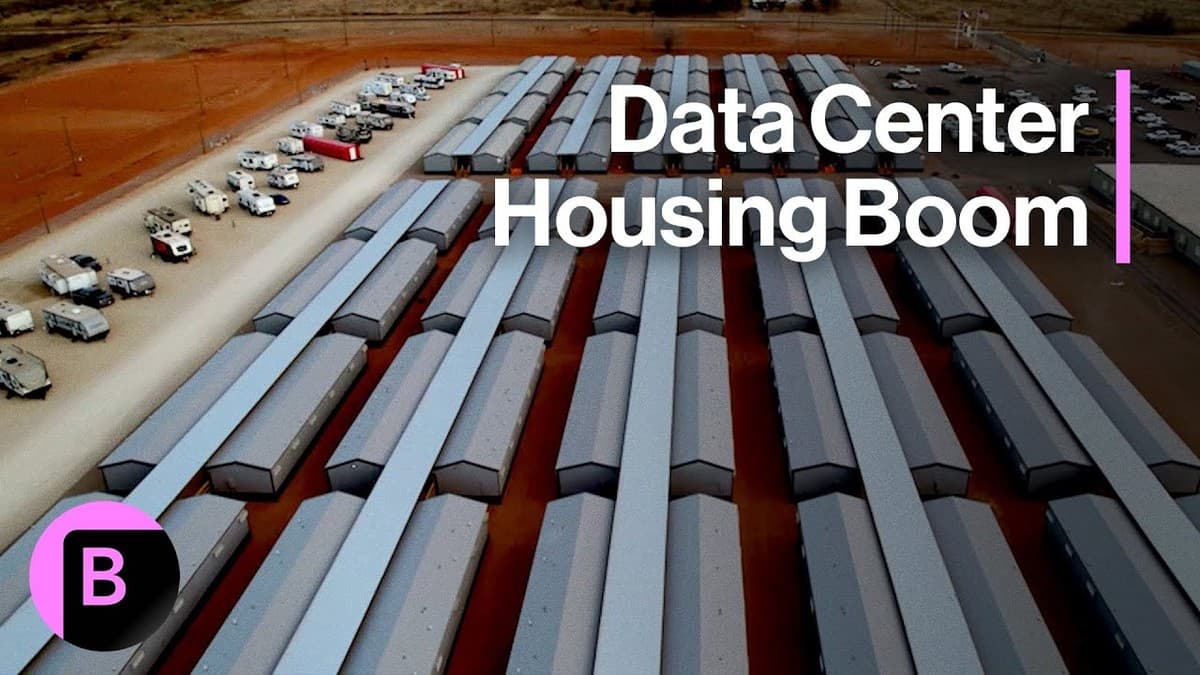
A growing number of companies are stepping in with temporary worker villages, sometimes called "mancamps." From above, they look like an Excel spreadsheet cut out of farmland: rows and rows of gray roofs on a paved surface (1:58).
These aren't bare-bones trailers. Each unit typically has its own toilet, sink, and wifi for video calls home. Shared amenities include communal dining halls, gyms, and even golf simulators (2:08). The food gets special attention. Workers do 15 to 16 hours of manual labor per day and need the calories, but quality meals are also a recruiting tool when competition for workers is fierce (2:17).
A growing workforce gap
The Bureau of Labor Statistics projects that construction employment will grow 6% between 2024 and 2034, double the projected growth for all jobs (2:39). Electricians, a particular bottleneck for AI construction, are expected to see 9% growth in the same period (2:51).
Finding workers willing to take these jobs is its own challenge. The work requires spending weeks or months away from family in remote locations. Bloomberg reports that companies are increasingly hiring veterans, who are more accustomed to similar conditions (2:57).
Community tensions
The relationship between data center projects and local communities is complicated. On one side, projects contribute to the property tax base and companies donate to local school districts (3:07). On the other, residents who chose rural living now face traffic, longer waits at gas stations and cafes, and deteriorating roads (3:16).
Some locals worry that worker camps could attract drug use or crime, echoing problems from the shale oil boom of the 2010s, when rapid growth in US oil and gas extraction led to similar temporary villages near drilling sites (3:32).
Local leaders appear clear-eyed about the situation: these are temporary projects. When the data centers are finished, the camps will be taken apart and most of the jobs will go away (3:47). Some positions will remain for ongoing operations, but the construction boom itself has a built-in end date.
Glossary
| Term | Definition |
|---|---|
| Data center | A building filled with servers that store data and run applications, including AI models. The physical backbone of cloud computing. |
| Mancamp | A temporary housing village built near remote construction sites to house workers. Common in oil, gas, and now AI infrastructure projects. |
| Zoning | Local government rules about what types of buildings or businesses are allowed in specific areas. |
| Shale boom | The rapid expansion of oil and gas extraction from shale rock formations in the 2010s, which created similar rural housing and infrastructure challenges. |
| Property tax base | The total assessed value of properties in a municipality. A larger tax base means more revenue for local services like schools and roads. |
Sources and resources
Want to go deeper? Watch the full video on YouTube →