a16z Top 100 AI Apps: ChatGPT Dominates, But Rivals Close In
Key insights
- ChatGPT is roughly 30x bigger than Claude on web and 80x on mobile, yet only 10% of the global population uses any AI product weekly. The growth runway is enormous.
- Singapore ranks #1 in per capita AI adoption while the US sits at #20, with just 32% of Americans trusting AI versus 80% in China.
- Agents, persistent memory, and AI-native browsers are emerging as the next competitive battleground, and teenagers are the leading indicator of where consumer AI heads next.
This is an AI-generated summary. The source video may include demos, visuals and additional context.
In Brief
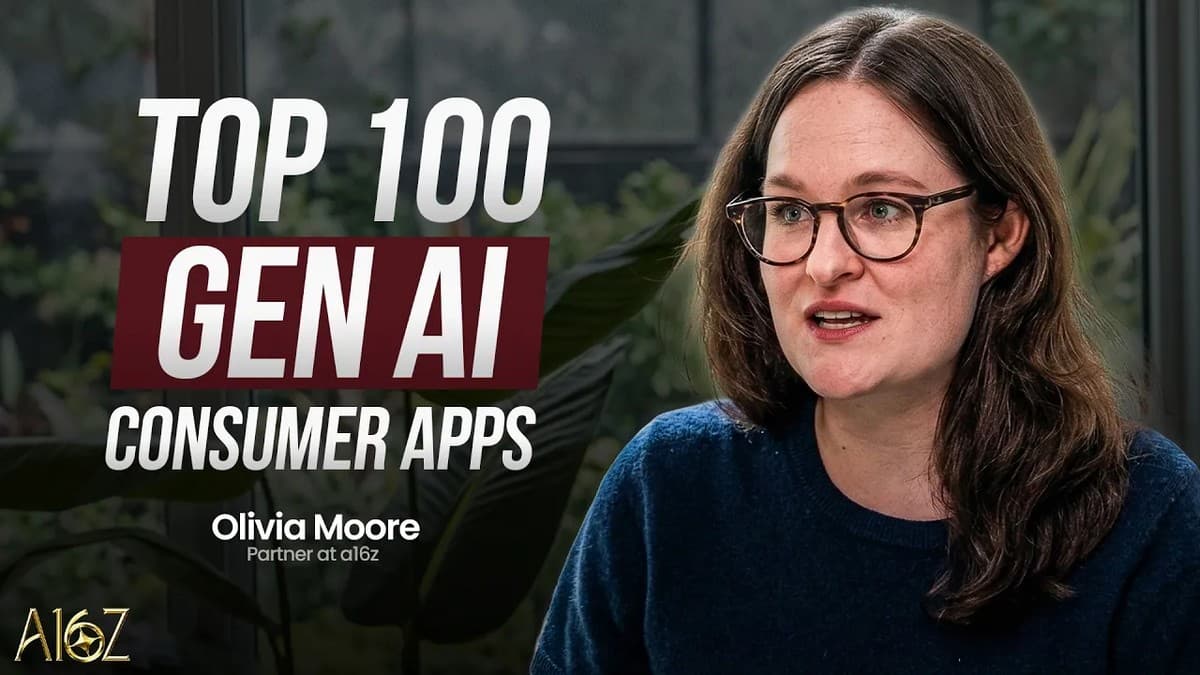
Andreessen Horowitz (a16z) has published the 6th edition of the Top 100 Gen AI Consumer Apps report, and partners Anish Acharya and Olivia Moore walk through the key findings in a 38-minute episode. ChatGPT is roughly 30x bigger than Claude on web and 80x on mobile. Yet only 10% of the global population uses any AI product on a weekly basis, signaling that the market is still in its early innings. The report also maps global adoption patterns, tracks the rise of AI-native agents and browsers, and points to teenagers as a leading indicator of where consumer AI is headed next.
Related reading:
The platform wars: ChatGPT, Claude, and Gemini
ChatGPT remains the dominant force in consumer AI. According to the report, it is about 2.7x bigger than Gemini on web and 2.5x on mobile. The gap with Claude is far wider: roughly 30x on web and 80x on mobile. ChatGPT has accumulated 900 million signups.
The subscriber picture tells a more nuanced story, however. Claude is growing paid subscribers 200% year-over-year, and Gemini 258%, according to the report. On an absolute basis ChatGPT is still 8x larger than Claude and 4x larger than Gemini in paid subscribers, but the gap is narrowing faster than the raw traffic numbers suggest.
Top 50 Gen AI web products. Source: a16z Top 100 Gen AI Consumer Apps — 6th Edition.
But Moore argues the more interesting story is how each platform is differentiating. All three major foundation model providers now operate app stores, essentially marketplaces where third parties build specialized tools on top of their AI. ChatGPT and Claude each have more than 200 apps in their stores, yet only 11% overlap between the two catalogs. ChatGPT's directory spans 220 apps across 13 categories, with 85+ in consumer transaction categories like travel, shopping, and food. Claude's store takes a different approach with roughly 160 curated connectors and 50 community MCP (Model Context Protocol) servers, focused on professional tools like PitchBook, FactSet, and PubMed. That divergence suggests the platforms are attracting different developer communities and targeting different user needs, rather than competing head-to-head on every use case.
This edition of the report also broke new ground by including non-AI-native products that have become majority AI-enabled. Tools like Canva and Notion now belong on the list. Notion, for example, announced that half of its new Annual Recurring Revenue (ARR, the predictable yearly income a subscription company expects) is now driven by AI-first features.
Global adoption: a patchwork of trust and access
Per capita AI adoption by country. Source: a16z Top 100 Gen AI Consumer Apps — 6th Edition.
The report's geographic data reveals sharp differences in how AI is spreading around the world. Singapore ranks #1 in per capita AI adoption, while the US sits at #20. Per capita adoption measures AI usage normalized by population size, so smaller countries with highly engaged user bases can rank ahead of much larger ones.
Trust levels explain part of the gap. An Edelman survey cited in the report found that only 32% of Americans trust AI, compared to 80% in China. Still, roughly one-third of the US population are monthly active AI users.
Parallel ecosystems are forming in markets cut off from the major Western platforms. Russia has become the second-largest market for DeepSeek after China. The report's traffic data shows DeepSeek's web visitors split roughly as China 33.5%, Russia 7.1%, and the US 6.6%. Russia has also built its own AI infrastructure. Yandex Browser's Alice AI assistant has 71 million monthly active users, making it a top-10 mobile AI product globally. Sber's GigaChat debuted on the web list this edition. China itself shows just 15% combined usage of ChatGPT and Gemini, a figure driven by access restrictions rather than preference.
Creative tools: video rises, image generation matures
Top 50 Gen AI mobile apps. Source: a16z Top 100 Gen AI Consumer Apps — 6th Edition.
The creative tools category is shifting. Standalone AI image generation apps are declining as image features get absorbed into broader platforms. In the first edition of the report, 7 of the top 9 web products were image generators. Now only 3 remain on the web list. Midjourney, once a top-10 fixture, has dropped to #46. Meanwhile, AI music, voice, and video tools are growing.
Sora, OpenAI's video generation app, put up striking numbers. It held the #1 spot on the US App Store for 20 consecutive days and reached 1 million users faster than ChatGPT did at launch. The app currently has 3 million Daily Active Users (DAUs), having peaked at 6 million downloads per month before settling at around 1.5 million. One unusual feature driving engagement is "Cameo," which lets real people grant their likeness for use in AI-generated videos.
AI music tools like Suno and voice platforms like ElevenLabs also rank prominently. Moore notes that audio-based AI tools show particularly strong retention, which may be because voice feels more personal and harder to replicate with generic alternatives.
The agents era arrives
Perhaps the biggest structural shift in this edition is the emergence of AI agents. An agent, in this context, is an AI that can take autonomous actions across multiple systems, not just answer questions in a chat window.
OpenClaw (OpenAI's Operator product) would have ranked #30 on the web list if it had been included, and it has become the most-starred project on GitHub of all time, surpassing both React and Linux. The project went from a solo effort to 68,000 GitHub stars in a matter of weeks before being acquired by OpenAI in February 2026. That level of developer interest signals that agent infrastructure is becoming a priority across the industry. For more on how OpenClaw fits into the broader agent landscape, see OpenClaw and the Age of Personal AI Agents.
Manus, an AI agent platform built in China, is another data point that stands out. The company grew from zero to $100-200 million ARR in just 6 to 9 months, then was acquired by Meta for more than $2 billion. That acquisition speed, from launch to nine-figure buyout in under a year, reflects how intensely the major platforms are competing to secure agentic capabilities.
AI-native browsers represent another expansion of the agent concept. Perplexity's Comet browser is 5x ahead of ChatGPT's Atlas browser in download page visits, suggesting that the race for an AI-first browsing experience is already well underway.
Memory and teenagers: the next signals
Two themes in the report are framed as leading indicators rather than present-day trends.
Memory, the ability for an AI to remember user preferences and past interactions across multiple sessions, is described as a core competitive moat forming right now. Moore argues that platforms which accumulate rich, personalized context will be harder to leave over time, since switching means losing everything the AI has learned about you.
Teenage usage patterns offer a window into where consumer AI heads next. A Pew Research Center survey found that more than half of US teens use AI for homework, 38% for creative projects, 16% for casual conversation, and 12% for emotional support. The breadth of those use cases suggests that for younger users, AI is already a general-purpose tool rather than a specialized one. For a closer look at how students are drawing their own limits around AI, see How Stanford Students Draw the Line with AI.
Context and limitations
The report relies on publicly available traffic and download data, which captures breadth of reach but not depth of engagement. An app with millions of casual sign-ups may behave differently from one with a smaller but highly committed user base. The ranking also reflects a particular moment: the 6th edition covers a period of unusually rapid change, and Moore acknowledges that the platform rankings could look different again by the next edition.
The global trust gap is also worth holding onto. A 32% trust figure in the US does not mean 68% of Americans are skeptical of AI — many may simply be indifferent. The Edelman survey methodology, and what "trusting AI" means to different respondents, is worth keeping in mind when interpreting that number.
Glossary
| Term | Definition |
|---|---|
| Monthly Active Users (MAU) | The number of unique users who interact with a product at least once per month. A standard measure of app health. |
| Daily Active Users (DAU) | The number of unique users who engage with a product on a given day. Higher DAU relative to MAU suggests stronger habit formation. |
| Annual Recurring Revenue (ARR) | The predictable revenue a subscription company expects to earn over a year. Often used as a proxy for business health. |
| Per capita adoption | AI usage measured relative to population size. Lets smaller countries rank higher than raw user numbers would suggest. |
| App store (AI context) | A marketplace of third-party tools built on top of a platform like ChatGPT or Claude, similar to how the Apple App Store works for iPhone apps. |
| Agent / agentic AI | An AI that can take autonomous actions across multiple systems, rather than just responding to questions in a chat window. |
| Memory (AI context) | An AI's ability to remember user preferences and past conversations across separate sessions, making interactions more personalized over time. |
| Lock-in | When switching to a competing product becomes costly because your data or accumulated context lives on one platform. |
| GitHub stars | A way developers bookmark projects they find useful on GitHub, the world's largest code hosting platform. High star counts signal broad developer interest. |
| Cameo (Sora feature) | A feature in OpenAI's Sora app that lets real people grant permission for their likeness to appear in AI-generated videos. |
| MCP (Model Context Protocol) | An open standard that lets AI models connect to external data sources and tools. Think of it as a universal adapter that lets an AI plug into databases, APIs, and services. |
| Foundation model | A large AI model trained on broad data that serves as a base for many different applications. ChatGPT, Claude, and Gemini are all built on foundation models. |
Sources and resources
Want to go deeper? Watch the full video on YouTube →